Showing posts with label cowboys. Show all posts

Monday, February 1, 2016

Old West Cowboy Valentines Poem


Valentine's Day is just around the corner. Here is a traditional old west Cowboy poem for your sweetie! 
Remember Cowboys' needs were simple!!!!


A love Poem

My horse is brown,
my dog’s name is Blue.
I feel so lucky to
have someone like you.
Your hair is like cornsilk
blowing in the breeze.
It’s softer than Blue’s
without all the fleas.
Cut from good cloth
like my best longjohns,
You pluck chickens all day
and still sing sweet songs.
I think I’m in love,
and I’m tickled pink.
We go together like, a skunk goes with stink


Our family has been dedicated for 30 years in serving the 
Western Horseman the safest most durable 
Quality American made leather horse tack....... Buckaroo John Brand Buckaroo Leather, The Brand to Demand 
Visit Our Unique Store Today  

Tuesday, January 19, 2016

The Horse Queen of Idaho....Kittie Wilkins


In 1870, Kittie Wilkins built and empire that encompassed a large area of Southern Idaho, northern Nevada and eastern Oregon. She became an outstanding rancher and expert dealer in horses and often was called "The Horse Queen of Idaho," or "The Queen of Diamonds," due to her diamond brand.

Kittie was born in 1857 in Jacksonville, Oregon. Her parents, John R. and Laura Wilkins, were an ambitious couple who visited many boomtowns of the west before settling in Challis, Idaho, where they began raising cattle and horses. During her early years Kittie lived in several western states. John and Laura, however, never neglected their daughter's schooling. While her father taught her the horse trading business, Kittie's mother made sure she attended the finest schools. She grew into a well educated woman who could ride the range, carry out a shrewd business deal, or sit at the piano to entertain guests.


Kittie always claimed she got her start as a small child when two of her father's friends each gave her a $20 gold piece to invest. When her father became involved in the stock company, he used the money to buy Kittie a filly, which started her in business. She soon acquired her own herd that numbered between 700 and 800 horses. Kittie was an expert horsewoman, it was said she could ride anything with four feet on the ground, or anything with one foot on the ground and three feet in the air.
 

By the time she was 28, the Wilkins Company had moved to the Bruneau Valley of Owyhee County, Idaho. Although the outfit consisted of Kittie's father and her three brothers, she was the undisputed head of the company. She claimed every unbranded mustang on their range, which ran from the Humbolt River in Nevada, to the Snake River in Idaho, and from Goose Creek County in Idaho to the Owyhee River in Oregon. Kittie had the hardest working outfit west of the Mississippi River. Her boys were riding almost constantly as the ranch broke and shipped 154 horses every two weeks. The Wilkins riders became known as the finest in the world.
 

Kittie rode the open range with her cowhands, roping and saddle-breaking. The newspapers described her as a striking, blue-eyed blonde who rode a palomino the color of her hair. Seated upon a saddle that was mounted in silver and gold, Kittie was one with her horse as he flew over the rough terrain, rounding strays into the holding-corrals.

When traveling to the Eastern stockyards, Kittie took two trunks, one for here work-clothes and the other for her fancy outfits, which were worn with flair. Although she raised more than one eyebrow, the talented lady personally watched over her own horses, disdaining the idea that women were limited to playing the piano and attending tea parties. The herd was more important to her than the whispered gossip of others.


Because she was totally feminine, Miss Wilkins never failed to create excitement as she entered the marketplace. While selling her horses, the lady pulled her golden hair up under a hat and dressed in skillfully tailored mannish attire, something that was unheard of in that era. Whatever her attire, however, Kittie knew her business. She found a way to move the abundant wild mustangs of the West to the horse-hungry markets of the East.


One time she brought 3,000 head with her to St. Louis, Missouri and auctioned them off herself turning a tidy profit. It was rumored that the beautiful woman could make a better deal than her male counterparts and in 1891, Kittie Wilkins was the only female in the United States whose sole occupation was horse dealing.


Once the horse trading was over, Kittie changed her male attire and met the press wearing the most stylish fashions. In 1895, during an interview, a reporter told his friends he was hardly prepared to meet the tall young woman "dressed in a svelte, tailor-made costume, her blonde curls surmounted by a dainty Parisian creation, who greeted him with perfect self-possession and invited him to be seated."
He said she was a strikingly handsome woman. In 1904, at the age of 46, Kittie visited San Francisco. During her stay, she was a guest of the city and awarded, "The Palm for Beauty," which meant she was the toast of the town.


Often a cowboy who rode over the large Wilkins spread looking for a job, was surprised to find that "Kit" Wilkins was a she not a he. At first many of the men weren't sure they wanted to work for a female. However, once they realized the beautiful lady could not only handle her horse, but would also ride beside them, they always hired on. All of her "boys" were paid $40 a month and board, and they were strong, rough riders. Kittie ruled with an iron hand. If a cowboy got out of line, he was immediately fired. In a magazine article, one her "hands" wrote: "If a man weren't a good rider when he went to work for Kit Wilkins, he was a good rider when he left of he wasn't riding at all-unless in a hearse."


Many of Kittie's riders hired on as apprentices, and, under her guidance, became excellent cowboys. A few of them went on to fame in the Wild West Shows and others performed in rodeos. High Strickland became a Champion of the World several times; Jess Coates rode before the King and Queen of England in a Command Performance, and Walter Scott became part of Buffalo Bill Cody's show, and then became known as Death Valley Scotty.


Kittie was king to her crew and earned their admiration as a skilled rider. She was not afraid of the unbroken horses and would enter the pens and manage the most unruly. She knew more about pedigrees than most women did about stylish clothes.


With all her wealth and beauty, however, Kittie never married. It had been rumored she loved only one man. He was her top foreman and superintendent and they were reportedly engaged to be married. Unfortunately, he was killed while trying to remove and intruder from the Wilkins spread and Kittie was true to his memory the rest of her life.

Kit raised her horses on "Wilkins Island", a high plateau between what was then called "Kittie's Hot Hole" and the mining area of Jarbridge, Nevada. The Hot Hole was a natural hot springs at the bottom of a gorge, and today is known as "Murphy's Hot Springs." The Island was the company's headquarters where Kittie's "hands" built a corral that held the horses until they were shipped on to the eastern markets.


 Kittie's Letter Head


As Kittie rode the range and worked beside her cowboys, they shared a special camaraderie. Often, after a hard weeks work, she and her hands would ride into town and visit the local tavern for a bit of rest and frivolity. On one of these occasions, the Wilkin's boys were so carried away with their fun-making that someone "accidentally" opened the corral gate and the entire herd of captured "dollars" escaped.

Mrs. Alice Hicks, of Mountain Home, Idaho, remembers both Kittie and the tavern, as her father, Elijah Fletcher, once worked for the Wilkins. In a letter, she described a day in which she and her brother rode into town with their father to buy beef. Kit was standing in the door of the tavern and she greeted Elijah in a friendly manner saying, "Hello Lige, come on in and join the boys." When her father left the children sitting in the wagon, Mrs. Hicks recalls being a bit upset because at that young age she considered a tavern a den of "sin."


Although respectable women of that period didn't enter a tavern, it must be remembered that Kittie Wilkins was not an ordinary woman. She was always a lady, but she lived by her own rules.
Kittie had a lively personality and was a polished publicist. Her news releases were consistent and timely. She never deviated from her original tale of how she got her start with the two $20 gold pieces. Kittie's beauty and her success stories made headlines from San Francisco to St. Louis. Reporters admired her and the public enjoyed reading about the charming woman who many called "The Golden Queen".


Her generosity extended beyond the welfare of the cowboys who rode beside her on the ranch. Kittie supported an orphanage in Salt Lake City, Utah, and she donated to a Catholic academy near San Francisco. When the boys were old enough to work, they were hired as hands for the Wilkins Company. Several of the girls were taken into Kittie's home to assist with the housework, and a few she sent on to further their education. Numerous letters of appreciation from those who Kittie helped are on file, along with her property deeds and old records.


As time passed and Kittie grew older, she may have tinted her hair a bit, but she never lost that inner spark that made her so special. When she died of a heart attack in 1935, at the age of 79, no one thought of Kittie as an old woman.

She is buried in the Mountain View Cemetery in Mountain Home. There is a modest stone bearing a simple inscription in which her name, birth and death dates are followed by the words, "Horse Queen of Idaho."


Although Miss Wilkins was one of the best known women of her generation, there has been very little written about her. Bits and pieces of Kittie's colorful life have come from old newspaper articles, a few paragraphs here and there, and through the courtesy of the Elmore Historical Society in Mountain Home, Idaho.
 

this is an excerpt from the book "Daughters of the West", by Anne Seagraves.


Our family has been dedicated for 30 years in serving the 
Western Horseman the safest most durable 
Quality American made leather horse tack....... Buckaroo John Brand Buckaroo Leather, The Brand to Demand 
Visit Our Unique Store Today  
Buckaroo Leather Shopping Site

Monday, January 11, 2016

Rope Talk of the Old West Cowhands


Old West Cowhands "Rope Talk"


Here is a brief list of some general rope terms used by the Old West Cowhands:
 

Lariat is an Americanization of la reata, Spanish for the rope
 

Lasso is the lazo, meaning in Spanish a noose or snare.
 

Lazo reata is a Spanish term meaning snare rope.
 

Catch rope, throw rope, saddle rope, grass rope, twine, whale line, hard twist, lass rope, and rope are all used to designate a catch rope.
 

Reata is from the Spanish reata, meaning rope, but the American cowhands use it to designate a rawhide rope.
 

Reata men are hands who use a rawhide rope and they sometimes refer to this rope as a lass rope.
 

Roping terms used by the cowhand are, rope, meaning to throw a rope, roped, meaning to have caught something with the rope, roping the act of catching and looped meaning caught.


Our family has been dedicated for 30 years in serving the 
Western Horseman the safest most durable 
Quality American made leather horse tack....... Buckaroo John Brand Buckaroo Leather, The Brand to Demand 
Visit Our Unique Store Today  
Buckaroo Leather Shopping Site

Monday, January 4, 2016

First American Cowgirl


 The First American Cowgirl....Lucille Mulhall


Equally skilled with rifle, lariat and horse, a teenager from Oklahoma named Lucille Mulhall became America’s first cowgirl. Will Rogers wrote that Lucille's achievement in competition with cowboys was the 'direct start of what has since come to be known as the Cowgirl'. He continued to write, “there was no such a word up to then as Cowgirl”. It was coined to describe her after she beat dozens of cowboys in a 1904 cattle-roping competition that set world records.

Lucille Mulhall was born on October 21, 1885, in St. Louis, Missouri to Colonel Zack and Agnes Mulhall. Native American tribes still roamed the open grassland of the Mulhall Ranch when Lucille was growing up. Wolves prowled the prairie, preying on the Mulhall livestock. Cowhands were a vital part of ranching; roping, branding, round-ups and shooting were practical skills instead of pastimes. The little blonde girl with blue-gray eyes was an eager student for the ranch hands and cowboys who lived in the bunkhouses of the Mulhall spread. Lucille, instead of learning piano or sewing like her sisters, learned to toss a lariat and tie a steer. Lucille learned her horsemanship and skills from the Cowboys who rode the cattle drives of the Old West.


Lucille Mulhall was a cowgirl long before she entertained crowds with feats of horsemanship on Governor, her trained horse. By the age of 7, she was riding around her father’s 80,000-acre ranch. Cowboys who rode the plains of the Indian Territories tutored her in the art of lassoing. Zack Mulhall claimed that when his daughter was 13, he told her she could keep as many of his steers as she could rope in one day. Lucille, he bragged, didn’t quit until she lassoed more than 300 cattle! "By the age of fourteen,” the New York Times reported, "She could break a bronco and shoot a coyote at 500 yards.” Teddy Roosevelt was among Lucille’s fans. While campaigning in Oklahoma as a vice presidential candidate in 1900, Roosevelt first saw the blonde teenager perform. It was the Fourth of July, and Lucille roped in front of a crowd of 25,000 people at a "Cowboy Tournament.” The Daily Oklahoman reported, "Roosevelt was most enchanted with the daring feats of Lucille Mulhall.” "She rode beautifully throughout the contest and lassoed the wildest steer in the field.”

Teddy Roosevelt was so dazzled by the 14-year-old’s skills that he invited the Mulhalls to join him and a select group of Rough Rider veterans at a private dinner. That night Lucille gave the hero of the charge up San Juan Hill the silk scarf she had worn during the Cowboy Tournament.


When Zack Mulhall reciprocated the dinner invitation by asking Roosevelt to stay at his ranch, Teddy readily accepted. After watching Lucille’s daredevil antics on the ranch, Roosevelt encouraged her father to get her more exposure. "Zack, before the girl dies or gets married or cuts up some other caper,” Roosevelt reportedly said, "you ought to put her on the stage and let the world see what she can do.” During that same visit, Roosevelt spent time in the saddle riding alongside Lucille. He saw a gray wolf at a distance, which whetted his appetite for the hunt. The wolf eluded Roosevelt that day, but it didn’t escape Lucille. After Roosevelt left, she hunted down the predator. By one account, she dispatched it with a shot from her Winchester, but in another version she lassoed the creature and clubbed it to death. The pelt was sent to Roosevelt, who displayed it in the White House after he and McKinley won the presidential election that fall. Roosevelt later gave Lucille a saddle and an 1873 Winchester .44-40 that had been presented to him.

Lucille Mulhall, was the first well known cowgirl. She competed with 'real' cowboys - the range hardened cowboys accustomed to riding for days in the saddle; the cowboys who spent many hours branding cattle. Her expert roping skills were a natural talent honed by the skills of another natural roper - Will Rogers. She not only was an expert at using the lariat but she had a natural gift of working with horses. She trained horses to respond to the roping of a steer as well as how to perform a number of what she called 'tricks.' Her trained horses she called 'high schooled horses' and one was particularly famous: "Governor." She claimed her horse, Governor, knew at least forty tricks. He could pull off a man's coat and put it on again, could walk upstairs and down again, a difficult feat. He could sit with his forelegs crossed, could lie down and do just about everything but talk.


In 1904 Lucille competed against the best cowhands from across the Southwest in a roping contest at Dennison, Texas. In this competition she won a belt buckle, declaring her to be the World's Champion Lady Roper. She won three solid gold medals in Texas for steer roping, a trophy for winning a Cutting Horse contest as well as many other medals, trophies and honors. At the turn of the twentieth century Lucille Mulhall was American's greatest cowgirl.

While still in her early teens, Lucille was the top cowboy performer in the West. Extremely feminine, soft-spoken, and well educated, she seemed a paradox, for she was so steel-muscled she could beat strong and talented men at their own games. She could have been a society belle, but she loved the rough, dangerous life of a cowboy. Had she been a man, she would have been content to work on a ranch, but as a woman she was a novelty and the only way she could make use of her singular talents was in show business. The term cowgirl was invented to describe her when she took the East by storm in her first appearance at Madison Square Garden (in 1905). "Against these bronzed and war-scarred veterans of the plains, a delicately featured blonde girl appeared,” a 1905 New York Times profile intoned. "Slight of figure, refined and neat in appearance, attired in a becoming riding habit for hard riding, wearing a picturesque Mexican sombrero and holding in one hand a lariat of the finest cowhide, Lucille Mulhall comes forward to show what an eighteen-year-old girl can do in roping steers.”


In 3 minutes and 36 seconds, she lassoed and tied three steers. "The veteran cowboys did their best to beat it,” the New York Times reported, "but their best was several seconds slower than the girl’s record-breaking time. The cowboys and plainsmen who were gathered in large numbers to witness the contest broke into tremendous applause when the championship gold medal was awarded to the slight, pale-faced girl, and from that day to this Miss Mulhall has been known far and wide throughout the West as the Queen of the Range.”

Lucille had set a new world record. She won a gold medal and a $10,000 prize. Just as she had dazzled Teddy Roosevelt, Lucille now entranced journalists. Newspapers showered her with titles like "Daring Beauty of the Plains” and "Deadshot Girl,” but the one that stuck was "Original Cowgirl.”

Lucille’s career took her to Europe, where she performed for heads of state and royalty. She officially retired in 1917 at age 32. Live Wild West performances were being eclipsed by the rise of Hollywood westerns. Ironically, many of the stars of silent movies, including "King of the Cowboys” Tom Mix, got their start in Zack Mulhall’s Congress of Rough Riders. But as late as the 1930s, Lucille still did exhibition riding on the Mulhall Ranch.


Throughout her life, Lucille remained captivated by show business and more loyal to her father than to any other man. Her two marriages ended in divorce, and she rarely saw her son, born in 1909, because she was always on tour. Though Lucille was a top draw at Wild West shows and had run her own company, "Lucille Mulhall's Round-up," many people considered her an ineffective wife and mother because she had never learned to do "woman's work."

Although Wild West shows became less popular and less financially viable starting in the mid 1910s, Lucille and her brother Charley continued to perform in them through the 1930s. Show attendance dwindled, as did the number of performers. Despite the lack of publicity being given to wild west shows in the shadow of the polio epidemic, the United States' entry into World War I, and then the Great Depression, Lucille seemed unable to pull herself away from the limelight. She made her last known public appearance in September of 1940.


Lucille went back to work at her families ranch, which was located fourteen miles north of Guthrie, Oklahoma, on highway 77. The Mulhall ranch at one time encompassed 80,000 acres of land, much of which was unclaimed land. In addition some land was leased. The original ranch began with 160 acres claimed at the 1889 Oklahoma Land Opening. The Mulhall family operated their show and cattle business from this ranch and had many visitors. Some of their famous visitors were President Theodore Roosevelt, Will Rogers, Tom Mix and even the outlaw Henry Starr. Geronimo also was an admirer of Lucille's talent and gave her a beaded vest and a decorated Indian bow.

Lucille Mulhall died less than a mile from the Mulhall Ranch in an automobile accident on December 21, 1940. She was only 55 years old. In December 1975, she was posthumously inducted into the National Rodeo Hall of Fame.


Our family has been dedicated for 30 years in serving the 
Western Horseman the safest most durable 
Quality American made leather horse tack....... Buckaroo John Brand Buckaroo Leather, The Brand to Demand 
Visit Our Unique Store Today
Buckaroo Leather Shopping Site

Thursday, November 19, 2015

Old West Thanksgiving


Next week is Thanksgiving!!! An Old West Story of Thankfulness.......


This is a brief story of Mrs. Hulda Esther Thorpe-and her reason to be thankful!


A Close Call

In 1938, Mrs. Hulda Esther Thorpe remembers the dangers that settlers faced on the prairie in the 1800s, and the many reasons settlers had for giving thanks:

One of the best Thanksgiving dinners we ever knew of was when a family of settlers had their nice wild turkey dinner taken by the Indians, who came in silently and just shoved the folks back and eat it up. They did not harm the white people though and after they were gone the women made a big corn bread and with what few things the Indians left, they had a feast, the best as the daughter tells, that she ever eat. This was because they were so happy and thankful that the Indians spared them. This is one of many stories Mrs. Thorpe remembers from her pioneer childhood. To read more, in American Life Histories, 1936-1940, search on Hulda Esther Thorpe to find the document entitled, "Mrs. Hulda Esther Thorpe."


The Cowpuncher's Thanksgiving Rhymes of the Range

By L. Maynard Dixon
Sunset Magazine, November, 1903


Yearlin's


Now swing your rope—and swing 'er wide! It's brandin' time,—and it's time, you bet


To swing a big loop and to take yer ride,— Thank God, there's cows in the country yet!


Cut out that yearlin' and take a chance;— Show how you can ride. Bets up! I say


He'll burn the earth and he'll burn your pants. (We must have some sport Thanksgiving Day!)He's risin' high and he's landin' hard,— Stay with him, Bill! or it's gals good night!


If you can't stick him, a sure thing, pard, You'll land on the only rock in sight!


Now ride straight up—you must ride him fair. He's risin' high and he's landin' far!


Bet I can ride 'im and not pull hair,— Fer that's the kind of boy I are!


Our family has been dedicated for 30 years in serving the 
Western Horseman the safest most durable 
Quality American made leather horse tack....... Buckaroo John Brand Buckaroo Leather, The Brand to Demand 
Visit Our Unique Store Today  
Buckaroo Leather Shopping Site

Monday, October 19, 2015

Harvey Girls of the Old West


Harvey Girls Movie

When you think of the Wild West what comes to mind??? Cowboys, gunfights, saloon fights, lawlessness, gunslingers, and Harvey Girls???  And I am not referring to Judy Garland in the 1946 musical, "The Harvey Girls". 
A Harvey Girl was a waitress at the Harvey House restaurants in the American old west. These Harvey girls raised the bar on dinning and civilities in a time not necessarily know for either.
If you were traveling west by the railroad your only option for food along the way was at the roadhouses located by the railroads water stops. There you could find a meal of rancid meat, cold beans, and week-old coffee. Not necessarily appetizing. The need for the Harvey Houses was clear. 


The Harvey House chain of restaurants, hotels, and other hospitality industry businesses were owned by the Fred Harvey Company. The Harvey House's were situated alongside the Atchison, Topeka and Santa Fe Railways. Harvey opened his first depot restaurant in Topeka, Kansas. This first restaurant was so well received by the rail passengers, that the officials of the railroad allowed Harvey to build his eating establishments along the entire route. By the late 1880's, there was a Fred Harvey restaurant located every 100 miles along the Santa Fe line. Fred Harvey is credited with creating the first restaurant chain in the United States.
The success of the Harvey Houses was due to the strict standards for high quality food and first class service, by his Harvey Girls. Harvey was able to serve fresh quality food due to the Santa Fe Railroad agreeing to transport fresh meat and produce free of charge to any Harvey House on the railway line. The meals were not only fresh but were served in large portions on fine china with Irish linens. The prices for these delicious meals were quite reasonable, it has been suggested that the Harvey Houses originated the "blue-plate special". This was a daily low-priced meal served on a blue- patterned china plate. Along with the quality food, the Harvey Houses maintained a high level of custom service.


Through a series of signals between the Harvey Houses and the railroad the dinning room staff was able to feed an entire train in just thirty minutes. This dining staff included the waitresses called "Harvey Girls". 
 
The Harvey Girls were comprised of single, white, females that were well mannered, and educated. Harvey placed ads in the newspapers throughout the east coast and Midwest for "white, young women, 18 to 30 years of age, of good character, attractive and intelligent". The Harvey Girls were paid $17.50 a month plus room and board and tips. The recognizable black and white uniform was starched and consisted of a skirt that hung no more than eight inches off the floor. The uniform also consisted of an "Elsie" collar, opaque black stockings, and black shoes. The girls had their hair restrained in a net and tied with a regulation white ribbon. The Harvey Girls were not allowed to wear makeup or chew gum while working. The Harvey Girls strict dress code and conduct followed over to their personal lives.


Fred Harvey passed down this strict code of conduct. The Harvey Girls were expected to adhere to this code of conduct 24 hours a day. The girls were told what time to go to bed, whom to date, and even what to wear, including jewelry and makeup. Yet with all these restrictions, by the late 1950's over 100,000 girls had been hired.
The Harvey Houses and their Harvey Girls were a mainstay along the Santa Fe Railway. They brought a little civility and decorum to a harsh Old West.


Our family has been dedicated for 30 years in serving the 
Western Horseman the safest most durable 
Quality American made leather horse tack....Buckaroo John Brand Buckaroo Leather, The Brand to Demand 
Visit Our Unique Store Today  
Buckaroo Leather Shopping Site

Thursday, September 10, 2015

Equestrian Acts of the Old West Circus


Circuses were an important part of the old west culture in the 1800s.

Cowboys coming from the dusty cow trails, frontier men after a long work week and miners who were looking to forget there long hard day in the mine came to town looking for excitement and entertainment.

Circuses provided much needed entertainment for all. They had acts like wild animal menageries, clowns, acrobats, trapeze artists, tightrope walkers, brass bands, performing elephants and equestrians who could stand on horseback as they galloped around a center ring.


The circuses date back to Mexican times when shows based on European models came up from the South into California and the southwest around the middle of the 19th century. Circus troupes from the East began to reach settlements in the more accessible regions of Kansas and Nebraska. They traveled in horse drawn wagons over atrocious roads.

By 1880s when railroads had eased the difficulties of transportation, the circus came into its own as the greatest show in the West.

One of those shows was the John Rowe & Co. Pioneer Circus. Here is an excerpt from an article written about the show-


(From the book-“Men of the West-Life on the American Frontier” by Cathy Luchetti)

“ by far the most extensive and elegant organized equestriene establishment that ever appeared in CA…Traveling through the state at an expense of fifteen thousand dollars a month as an added incentive, the seats are carpeted, and attentive and gentlemanly ushers to wait on ladies and family."


The John Rowe & Co. Pioneer Circus was based in San Francisco, Ca and traveled extensively throughout California. As mentioned before, one of the circus acts was the equestrians who could do acrobatics on horseback.


Below is a glimpse into a typical equestrian performance at the Pioneer Circus.

The main acts of the Pioneer Circus were the equestrian events. At show time the audience was treated to all the spectacle and finery the troupe could provide. One of these spectacles was Miss Mary Ann Whittaker, the first female equestrian artist in America. She was ranked among the best in ballet and pantomime. She would ride out into the sawdust-covered ring standing on her milk white horse in pink tights and ruffles with stars and spangles. Then to the amazement of the crowd as she neared a ribbon held in her path 12 feet high by two colorful clowns, she would leap up off the horse and over the ribbon and then land gracefully onto the horses back all while it was speeding around the circus ring. The applause was thunderous and it continued through the evening. Other riders rode in pyramids on two horses with three riders stacked neatly on top of one another while still others did forward and backward flips through rings of fire.

For these amazing acts to work the horses and riders went through hours of rigorous training some of which is not what you would expect. While the horses went through their paces the grooms would carelessly kick cans about the ring, fire guns, and even tie five-gallon cans to the horse's tail! This was all done in training to teach the horse not to sway from its paces for anyone but its trainer. Timing was everything in the ring. An acrobatic rider doing a back somersault would not like it much if he came down from his leap only to find the horse spooked by a child with a firecracker and not be in his appointed spot.


The Circuses not only used their horses for entertainment, but for hauling all the equipment, animals, and performers in wagons. The travel was hard and taxing on all. Between the roads, or lack of, and the weather it made getting from one town to the next very eventful.

Usually the circus would only be able to cover two or three miles in an hour. Many of the stops were 10 to 15 miles apart and a rider would go ahead and mark the forks in the road with a rail so the caravan would go the right way.

Perhaps the worst occurrence would be after getting little or no sleep, fighting their way through a drenching rainstorm, pulling out and repairing wagons, and then hearing the word "lost." This of course meant retracing steps and going through all the problems again.

Rowe's Pioneer Circus played the mountain camps and towns until August when due to expenses they were forced to return to San Francisco. Before leaving they had played Yankee Jim, Iowa Hill, Illinois Town, Dutch Flats, Red Dog, Grass Valley, Rough and Ready, Nevada, Orleans Flat, Oroville, Horsetown, Marysville, Monk Hill, Railroad Flat, West Point, Chinese cap and Columbia.

I can just imagine the excitement of the circus coming to these prairie towns and watching the thrilling acts of the equestrian acrobatics.


Our family has been dedicated for 30 years in serving the Western Horseman the safest most durable Quality American made leather horse tack....... Buckaroo John Brand 
Buckaroo Leather, The Brand to Demand
Visit Our Unique Store Today Buckaroo Leather Shopping Site

Wednesday, July 15, 2015

Rodeo Women of the 1800's


Most women of the 1800's learned to ride out of necessity from helping on the ranch and practicing the skills of the range. From an early age, women could stay in the saddle, break a bronc and rope a steer.

In the late 1800's, the younger horsewomen began competing against males in a yearly gathering of herds -which progressed into participating in rodeo's.
 

The first rodeos began in the mid-1800 when thousands of cattle and horses were driven to town for the yearly round-up. The cowboys were eager for relaxation and would compete in tests of skills like roping, breaking horses, branding cattle and racing.
 

Women of the 1800, however, were not recognized in the arena until 1885. The most famous cowgirl was Phoebe Ann Moses or Annie Oakley (pictured here).


Here are two stories of women who also helped start the movement of women in Rodeo's (Stories are from the book "Daughters of the West" by Anne Seagraves.)


In 1897, Bertha Kaelpernick Blancett (pictured above) rode over 100 miles to enter a horse race in Cheyenne's Frontier Days and she was allowed to enter only because the arena was so muddy the cowboys refused to participate. Bertha was coerced into riding a bucking horse to keep the crowd from leaving. Once upon the animal, the petite girl had the ride of her life. Part of the time the horse was up in the air on his hind feet and once he fell backwards, but gutsy Bertha skillfully slid to his side and hung on. Although it was said at that time, that Bertha was a terrible bucker, she had managed to remain in the saddle, putting the cowboys to shame.

Later in 1904 Bertha became a star performer in Claude William's show and was a four time winner in Roman Racing at Pendleton. Bertha rode under men's rules, was seldom defeated and often beat such cowboys as Ben Corbett and Hoot Gibson.


Four years later Prairie Rose Henderson, an exuberant and talented daughter of a Wyoming rancher, rode to Cheyenne to enter a bronc busting contest. When the lady arrived, she was told, much to her chagrin that women were not permitted to ride. When Rose demanded to see the rules, she found there was no clause forbidding women to compete, and the officials were forced to let her participate. Her entrance into the arena created a sensation. Women had always been spectators, not competitors, and Miss Henderson was a colorful person. She came dashing out of the chute hanging on with all her strength and promptly lost the race. Prairie Rose, however, was really a winner, for she had opened the door to rodeo for other women to follow.
 

Later, Rose went on to victory in other rodeos and became one of the most flamboyant cowgirls of her era. In 1918, she entered the Gordon Nebraska rodeo wearing ostrich plumes over her bloomers and a blouse covered with bright sequins she had carefully sewn herself.
 

Rose eventually married a rancher and one cloudy day in 1932, Rose rode off to her last competition. This time, she faced her greatest fear, a storm, and lost her life during a blizzard. Prairie Rose's body was discovered nine years later and identified only by her champion belt buckle.


Our family has been dedicated for 30 years in serving the Western Horseman the safest most durable Quality American made leather horse tack....... Buckaroo John Brand 
Buckaroo Leather, The Brand to Demand 
Visit Our Unique Store Today 
Buckaroo Leather Shopping Site

Friday, July 3, 2015

Who are Those Guys???....Who is that Girl????


"They're beginning to get on my nerves. Who are those guys?"...A quote from Butch Cassidy played by Paul Newman in the movie "Butch Cassidy and the Sundance Kid.

This is a classic quote from a movie about two "infamous" outlaws Robert LeRoy Parker (Butch Cassidy) and Harry Alonzo Longabaugh (Sundance Kid). Both were well known members of the gang "The Wild Bunch". But what of the young women we see with Butch Cassidy and Sundance? Who was she?


Etta Place

Her name was Etta Place or maybe it was really Ethel, Eva, Rita or Ethel Bishop. There have been many theories on the true identity of Etta Place. Some say she was Ethel Bishop a young music teacher who lived in San Antonio, Texas. Another theory suggests that she was really a cattle rustler named Ann Bassett. Whatever her true identity, Etta was always described as having classic good looks.
 

Those who met Etta claimed the first thing they noticed about her was her striking beauty. She had a nice smile, brown hair, and was always cordial and refined. They also claimed she was an excellent shot with a rifle. That may be why she was reportedly only one of 5 women to have ever been allowed into the Wild Bunch hideout at Robbers Roost in southern Utah.

Etta was the companion of the Wild Bunch gang for many years. It is not know exactly how she became apart of the gang. Some believe she met the gang in a brothel and started dating Parker. But, then became involved with Longabaugh later. Rumors said she married Longabaugh, before traveling with he and Parker on their "adventures" to New York City, Argentina, and Chile but nothing was ever proven. She was spotted many times with both men throughout this time, but it was her disappearance that created the biggest sensation.


  Butch Cassidy and Sundance Kid

Little is really known about what really happened to Etta Place.  Some say she was tired of running from the law and left Longabaugh and the gang to head back to the United States to teach.  Others suggest she died either by her own hand or someone else's in Argentina. To this day, rumors and speculations still surround the disappearance of Etta Place. Many authors and historians have tried to solve the mystery but have failed.

Maybe we should all be asking, "Who was that girl Etta Place?"


Our family has been dedicated for 30 years in serving the Western Horseman the safest most durable Quality American made leather horse tack....... Buckaroo John Brand Buckaroo Leather, The Brand to Demand Visit Our Unique Store Today Buckaroo Leather Shopping Site

Monday, June 15, 2015

The Real McCoy....Who was he?


Ever wondered where the phrase "The Real McCoy" came from? Joseph G. McCoy, cattle baron, cowboy and business man was the inspiration for that phrase-


Joseph Geiting McCoy-Cattle Baron


Born on a farm in Sangamon county, Illinois, on December 21, 1837. McCoy is often cited as the inspiration for the phrase "The Real McCoy" because of his reputation and reliability and because he referred to himself by that phrase. He was educated in local schools and spent a year in the academy of Knox College in Galesburg. After his marriage to Sarah Epler in 1861, he entered the mule and cattle raising business. At the close of the Civil War, McCoy expanded his enterprise by buying animals in large quantities and shipping them to major livestock centers. In 1867 he joined a firm that shipped as many as a thousand cattle a week.


McCoy viewed the livestock industry from a national perspective and recognized the need for better contacts between southwestern ranchers, midwestern feeders, and meat-packers. He resolved to build a stock depot west of farming sections on the Great Plains to which cowboys from Texas could drive Longhorn herds.

Joseph McCoy made good on his pledge to Texas ranchers that if they would drive their Longhorn cattle from Texas to Kansas that he would have them shipped by rail to other markets and that the ranchers would receive a good price for their stock.


In the 1860s, cattle ranchers in Texas faced difficulties getting their longhorn cattle to market. Kansas homesteaders objected to the cattle crossing their land because the cattle might carry ticks which could spread a disease called Texas Fever fatal to some types of cattle. The disease could make a Longhorn sick, but they were hardier stock than the northern cattle and Longhorns seldom died from the disease.


McCoy himself said of the disease:
"In 1868 a great number of cattle arrived in Kansas and the mid-west from Texas; appx. 40,000. With them came a tick born disease called “Spanish Fever”. The local shorthorn breeds were seriously affected and in some towns the loss of the cattle was almost 100%. The result was a great prejudice against Texas cattle in Eastern Kansas and Missouri."

McCoy expected that the railroads companies were interested in expanding their freight operations and he saw this as a good business opportunity. He succeeded in obtaining cooperation from the Kansas Pacific Railway provided he assumed all the financial risks. The cattle would be shipped from his proposed stockyards to Kansas City. He then made an agreement with the Hannibal and St. Joseph line, which provided a route to Quincy, Ill.; from there the cattle could be sent to Chicago.


McCoy purchased a 250-acre tract at the edge of a frontier village along the Union Pacific. There he built a pen to handle a thousand head of cattle, a hotel known as the Drover's Cottage, a bank, office, and livery stable This village became known as Abilene, Kansas - one of the first cow towns. McCoy's plan was for cattle to be driven to Abilene from Texas and taken from there by rail to bigger cities in The Midwest and The East.
 

Abilene sat near the end of the Chisholm Trail (named after Jesse Chisholm) established during the American Civil War for supplying the Confederate army. This trail ran to the west of the settled portion of Kansas, making it possible to use the trail without creating hostility from the Kansas homesteaders.

McCoy advertised extensively throughout Texas to encourage cattle owners to drive their cattle to market in Abilene. The first herds arrived in August 1867; an initial shipment to Chicago left Abilene in September. By the end of the year 35,000 head had been driven over the Chisholm Trail to Abilene, and in 1868 the number rose to 75,000 head; by 1870 the number doubled. By 1871 as many as 5,000 cowboys were being paid off during a single day, and Abilene became known as a rough town in the Old West. Due to their long legs and hard hoofs, Longhorns were ideal trail cattle, even gaining weight on their way to market. One story says that McCoy bragged before leaving Chicago that he would bring 200,000 head in 10 years and actually brought two million head in 4 years, leading to the phrase "It's the Real McCoy"

As Abilene's leading citizen, McCoy was elected mayor and served until 1873.


Rival railroad terminal towns, farther west and south, soon diverted trade from Abilene, and McCoy moved to the new cow towns. In 1872 he went to Wichita, Kans., where he became a promotion agent for American and Texas Refrigerator Car. By 1880 he was a commission dealer in livestock in Kansas City and had been employed by the U.S. Census Bureau to report on the livestock industry for the eleventh census. For a time he lived in Oklahoma and served as agent for the Cherokee Nation in collecting land revenues. In 1890 he was an unsuccessful Democratic candidate for the U.S. Congress.

Joseph G McCoy died in Kansas City, Missouri on Oct. 19, 1915.


Our family has been dedicated for 30 years in serving the Western Horseman the safest most durable Quality American made leather horse tack....... Buckaroo John Brand Buckaroo Leather, The Brand to Demand Visit Our Unique Store Today Buckaroo Leather Shopping Site

Thursday, May 28, 2015

Old West Cowgirl Outfits


 Whether you are a cowgirl of today or a cowgirl from the Old West "bling" has always been apart of the cowgirl style!.


A traditional cowgirl outfit in the old west consisted of:


A typical pair of Victorian gauntlets, a short skirt, tall lace up boots, and a red scarf. The sash was probably a style adopted from Charlie Russell who, inspired by the vaquero costume always wore a red sash.


  (top picture is from the book "Cowgirls Women of the wild west” by Elizabeth Clair Flood)


The cowgirl riding gauntlets came in a wide variety of commercial designs were often sold at Western trading posts. Inspired by cavalry gauntlets, cowboys and cowgirls adopted the style of the work glove embellished with various Indian designs. Many were embroidered with horse shoes and whips, others were decorated in buckskin fringe. Cowgirls wore gauntlets for work and in the show arena. 


 (top picture is from the book "Cowgirls Women of the wild west” by Elizabeth Clair Flood)


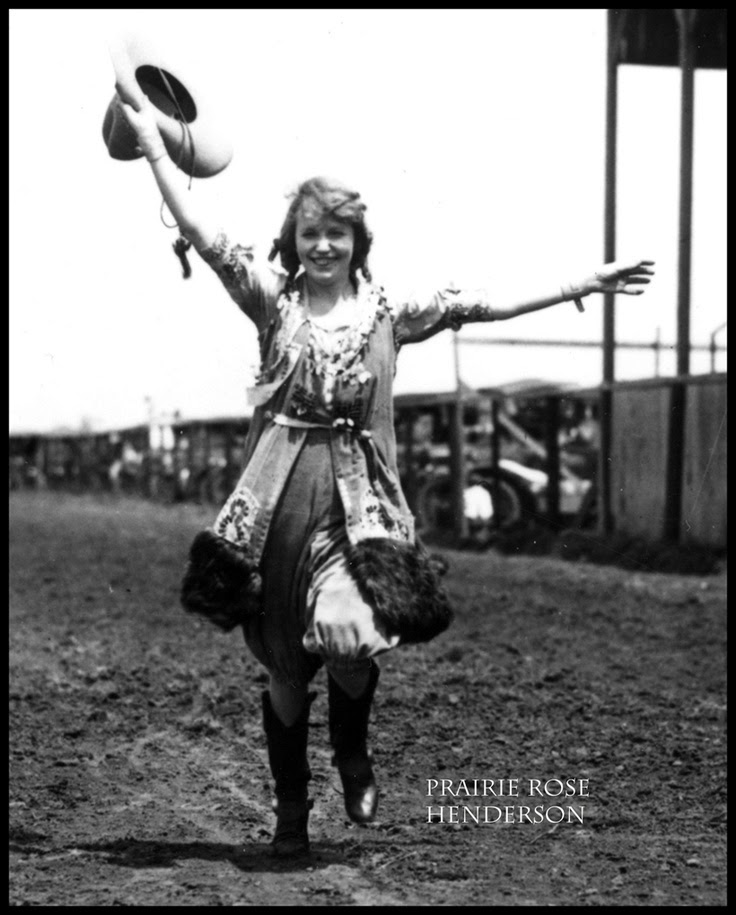
As you can see in the pictures many of the outfits had fringe, bright sequins, and the gauntlets were intricately beaded designs. One famous Cowgirl, Prairie Rose Henderson wore Ostrich plumes over her bloomers and a blouse covered with bright sequins.


Cowgirl Prairie Rose Henderson


Our family has been dedicated for 30 years in serving the 
Western Horseman the safest most durable 
Quality American made leather horse tack....... Buckaroo John Brand Buckaroo Leather, The Brand to Demand 
Visit Our Unique Store Today 
Buckaroo Leather Shopping Site

Tuesday, March 24, 2015

Prairie Rose Henderson....A True Cowgirl


How a young girl became an American Cowgirl.

Most women in the 1800's learned to ride out of necessity from helping on the ranch or they would practice their skills out on the range. From a very early age women could stay in the saddle, break a bronc and rope a steer.

In the late 1800's, the younger horsewomen began competing against cowboys in a yearly gathering of herds -which progressed into participating in rodeo's.

One of these young horsewomen was "Prairie" Rose Henderson. She was an exuberant and talented daughter of a Wyoming rancher. Rose rode to Cheyenne to enter a bronc busting contest. Much to her dismay, Rose was told she could not ride in the contest. Rose demanded to see the rules. In the bronc busting rules there was nothing stating that women could not compete. The officials had to let her participate. As you can imagine her entrance into the arena caused quit a stir. Women were spectators...not competitors!!!

Prairie Rose came crashing out of the chute, hanging on to the bronc with all her strength....and lost! But, Rose opened the door for all women to compete in rodeos, so I guess you could say she really did win!


Eventually, Prairie Rose did have wins at the rodeos. Rose was even present a champion award by the Union Pacific Railroad.  She was known as the most flamboyant cowgirl of her time. How about this cowgirl costume for you. In 1918 Prairie Rose entered the Gordon Nebraska rodeo wearing ostrich plumes over her bloomers and a blouse covered with bright sequins.


Prairie Rose competed in Rodeos until her death. In 1932, Prairie Rose rode to a competition and was caught in blizzard. She did not survive. Her body was discovered nine years later. The only way they identified her was by her champion belt buckle.


Prairie Rose Henderson a true American Cowgirl with spirit, courage, determination!


At Buckaroo Leather we celebrate the cowgirl spirit with traditional, sheekaroo and exotic styles of Quality Leather horse tack….Ride American!


Our family has been dedicated for 30 years in serving the Western Horseman the safest most durable Quality American made leather horse tack....... Buckaroo John Brand Buckaroo Leather, The Brand to Demand Visit Our Unique Store Today Buckaroo Leather Shopping Site
Monday, March 16, 2015

The History of the Mecate Reins and Hackamores


The Mecate Reins are the Rage of the Sage because they are so versatile.

The Mecate is the rein portion of the horse tack, called the Hackamore. The Hackamore is a type of headgear for horse training. The unique part of the Hackamore is that it does not have a bit. It uses a braided noseband called a Bosal. The Bosal is a special type of noseband that works on pressure points on the horse's face, nose, and chin. The Mecate is a rope made from horse hair or soft feeling rope that serves as reins and lead rope.

The history of the Hackamore and Mecate goes all the way back to 4,000 BC. The first Hackamore was probably a piece of rope placed around the nose or head of a horse not long after domestication. These early devices for controlling horses may have been adapted from equipment used to control Camels. Over time, this means of controlling a horse became more sophisticated.

The Persians in 500 BC were one of the first to use a thick plaited noseband to help the horse look and move in the same direction. This was called a Hakma. On this Hakma was a third rein added at the nose, which allowed the rider to achieve more power from the horse. Later this third rein moved from the top of the noseband to under the chin, where it is still part of the modern Bosal style Hackamore with Mecate reins.

The Hackamore used in the United States came from the Spanish Vaqueros in California. From this, the American Cowboy adopted two different uses, the "Buckaroo" tradition closely resembling that of the original Vaqueros and the "Texas" tradition which blended some Spanish techniques with methods from the eastern states.


These types of Hackamores include the Bosal and side pull. The Bosal Hackamore uses the Vaqueros tradition of the braided noseband and the Mecate rope.

The Mecate is tied to the Bosal in a specialized manner that adjusts the fit of the Bosal around the muzzle of the horse and creates both a looped rein and a long free end that can be used for a number of purposes.


For the mounted rider, the free end is coiled and attached to the saddle or tucked under your belt. When the rider dismounts, the lead rein is not used to tie the horse to a solid object but used as a lead rope and a form of lunge line when needed.

The traditional Mecate used by the California Vaqueros was made from the long hair of a horse's tail and was hand braided. Modern Mecates are made with horse hair and synthetic rope with a horse hair tassel at one end and a leather popper at the other end.

A properly tied Mecate knot allows wraps of rope to be added to the knot in front of the rein loop in order to tighten the Bosal noseband on a horse or the rope can be unwrapped to loosen the Bosal.

This Vaquero style of Hackamore is used in Western Riding and is an indispensable part of the Vaquero way of making a California reined horse. It is also used with horses that have dental issues, where a bit would be painful. Some riders also like to use this style of Hackamore in the winter instead of a frozen metal bit.

Buckaroo Leather Products uses the influence of the Vaquero when creating the many styles of Hackamores and Mecates we have available. Buckaroo also offers many traditional "Old mexico" hand braided Rawhide Bosals.


Hand Woven 100% Alpaca Mecate Rein with the colors Summer Rose with Black and tan. The Alpaca fibers used in these Mecates are grown on a family ranch in South East Colorado. 


Complete Hackamore Set includes an all natural color beautifully hand braided 12 plait 5/8" Vaquero style, All rawhide core (no cable core) natural rawhide bosal.


 These are Braided in the old Vaquero tradition with a forelock tie, some of the finest braiding we have ever seen.


Mane Hair Mecate


Mane Hair Mecate 5/8" - 22' long, 6 Strand Braid.
Beautiful Quality hand braided feel and communication.


Mecate Rein with Leather Popper


This rein has a Nylon Mecate with Leather poppers. Available in 5/8" width and 23' length. This mecate is Perfect for the beginning stages of Horse training or everyday mecate use.


Buckaroo Leather Products has all your Hackamore, Mecate, and slobber strap needs. We have many styles to choose from and all are fashioned from the highest grade American Made leather, from Hermann Oak Leather. The quality of our horse tack can not be beat!! Proud to be American made!!


Our family has been dedicated for 30 years in serving the 
Western Horseman the safest most durable 
Quality American made leather horse tack....... Buckaroo John Brand Buckaroo Leather, The Brand to Demand 
Visit Our Unique Store Today 
Buckaroo Leather Shopping Site