Showing posts with label pioneers. Show all posts

Thursday, November 19, 2015

Old West Thanksgiving


Next week is Thanksgiving!!! An Old West Story of Thankfulness.......


This is a brief story of Mrs. Hulda Esther Thorpe-and her reason to be thankful!


A Close Call

In 1938, Mrs. Hulda Esther Thorpe remembers the dangers that settlers faced on the prairie in the 1800s, and the many reasons settlers had for giving thanks:

One of the best Thanksgiving dinners we ever knew of was when a family of settlers had their nice wild turkey dinner taken by the Indians, who came in silently and just shoved the folks back and eat it up. They did not harm the white people though and after they were gone the women made a big corn bread and with what few things the Indians left, they had a feast, the best as the daughter tells, that she ever eat. This was because they were so happy and thankful that the Indians spared them. This is one of many stories Mrs. Thorpe remembers from her pioneer childhood. To read more, in American Life Histories, 1936-1940, search on Hulda Esther Thorpe to find the document entitled, "Mrs. Hulda Esther Thorpe."


The Cowpuncher's Thanksgiving Rhymes of the Range

By L. Maynard Dixon
Sunset Magazine, November, 1903


Yearlin's


Now swing your rope—and swing 'er wide! It's brandin' time,—and it's time, you bet


To swing a big loop and to take yer ride,— Thank God, there's cows in the country yet!


Cut out that yearlin' and take a chance;— Show how you can ride. Bets up! I say


He'll burn the earth and he'll burn your pants. (We must have some sport Thanksgiving Day!)He's risin' high and he's landin' hard,— Stay with him, Bill! or it's gals good night!


If you can't stick him, a sure thing, pard, You'll land on the only rock in sight!


Now ride straight up—you must ride him fair. He's risin' high and he's landin' far!


Bet I can ride 'im and not pull hair,— Fer that's the kind of boy I are!


Our family has been dedicated for 30 years in serving the 
Western Horseman the safest most durable 
Quality American made leather horse tack....... Buckaroo John Brand Buckaroo Leather, The Brand to Demand 
Visit Our Unique Store Today  
Buckaroo Leather Shopping Site

Wednesday, March 18, 2015

Stories of the Old West and the Pionners.....Snakes!


The old west and American prairie are full of stories, legends, and lore. Some about cowboys and their courage, about cowgirls and prairie women strength, and of course Indians.

But have you heard about Snakes and Snake Lore.......

I came across some great stories of snakes and superstitions......


Indians believed that by killing a snake they would make the "other" snake tribes mad-so Indians did not kill snakes.......

So when the Pioneers and early settlers came to the old west there were a lot of snakes!!!

Pioneer women found the snakes to be a very large "inconvenience"- they were always showing up in their frontier home while cleaning the kitchen or under a bed. Here is a true story of one Pioneer woman's experience with her first rattlesnake....


"Returning from the woods one day with an armful of sticks, I saw a large snake lying across the path in front of my three year old daughter who was with me. I caught and pushed her behind me, then throwing down my sticks, picking out the largest as I did, I went for the snake. The stick was rotten and broke with my first stroke. It enraged the rattler. He coiled himself up on one side of the path, and, rearing his head two or three feet from the ground, ran out a red forked tongue and made such a noise with his rattles that my other daughter in our cabin nearby ran to the door to see what it was. 
 
Without taking my eyes off the snake I called to her to get the hoe. She ran around and came up behind us with it. Then, without moving from my tracks I took the hoe and made short work with his snakeship. We dragged him up to the house and cut off the rattles, sixteen in number, and measured him. He was over five feet in length and as large around as a man's arm."

(from the book "True Tales of the Old-Time Plains" by David Dary) 


There is another story told, about a boy who found a hole with a few snakes.....later he came back with his friend to the same hole and they found and killed 46 snakes. The boys told the other frontier men and they came back to investigate. The men dug a hole around the original hole and found more snakes.....1700 to be exact. They killed them all.....

The men kept on digging, hoping to find an end to the snakes, but it never came....at first the snakes were cowardly and timid, but as time went on the snakes started to fight back and become vicious. The men kept on. When the number of snakes dead reached 4,000 the men decided to pour blasting powder down the hole.....

Needless to say the remaining snakes were disposed of. The pioneer men reasoned that the hole they found led to a larger cavern in the depths of the earth. The believed that many thousands of snakes, from all over, gathered in this cavern for winter.


The old west stories and tales of the pioneer men and women are fascinating!! And I guess they can teach us a few lessons-

If you see a snake hole-let it be, who knows how many more snakes are down there!!!!!!!!


Our family has been dedicated for 30 years in serving
the Western Horseman the safest most durable
Quality American made leather horse tack.......Buckaroo John Brand
Buckaroo Leather, The Brand to Demand
Visit Our Unique Store Today
Buckaroo Leather Shopping Site

Monday, March 2, 2015

When I am an Old Horsewoman.....


 Constance Reeves, Cowgirl


A few years ago I found this poem, 
"When I am an Old Horsewoman" by Patty Barnhart.....
 

When I am an old horsewoman

I shall wear turquoise and diamonds,

And a straw hat that doesn’t suit me

And I shall spend my social security on

white wine and carrots,

And sit in my alleyway of my barn

And listen to my horses breathe.


I will sneak out in the middle of a summer night

And ride the old bay gelding,

Across the moonstruck meadow

If my old bones will allow

And when people come to call, I will smile and nod

As I walk past the gardens to the barn

and show instead the flowers growing

inside stalls fresh-lined with straw.


I will shovel and sweat and wear hay in my hair

as if it were a jewel

And I will be an embarrassment to all

Who will not yet have found the peace in being free

to have a horse as a best friend

A friend who waits at midnight hour

With muzzle and nicker and patient eyes

For the kind of woman I will be

When I am old.

Originally published in The Arabian Horse World magazine in l992


Constance Reeves, Cowgirl

This poem was a huge hit and still is!! So I went on a search for the author Patty, and I found her. Here is what I learned.....

Patty started writing for an equine newsletter in the late 70's and 80's. This is where she started writing her poems. Patty decided to send her poems to a magazine. The editor contacted Patty to publish her work.... and the rest is history. Patty submitted "When I Am An Old Horsewoman" and it took off, appearing on all kinds of websites!!!


And while the Poem is incredible, what Patty does today is even more interesting and fun!!! Patty has a beautiful guest ranch in Lakeview, Oregon called Willow Springs Guest Ranch. The fun and interesting fact of this ranch is that it is run totally "off the Grid" !!!!


Patty and her husband Keith moved to their present location, Lakeview Oregon, in the fall of 1996. It was their intention from the beginning to make their 2500+ spread into a guest ranch. They swung open their gate for clients a few short years later.


The ranch is surrounded on three sides by public land which makes the riding pretty much unlimited and guests can bring their own horses and point them in almost any direction and ride. The ranch does get a fair number of international folks and guests without horses of their own, and they maintain a herd of quiet ranch horses for those guests. The vistas are spectacular and encompass high desert sage flats, pine forests, rim rocks, and even a lake or two depending on where the guest ride.


The ranch has a high volume of repeat clients that Patty and Keith think of as friends. They love to sit around the campfire with them, eating Keith's good Dutch oven fare, and thinking about what the day has presented.


When Patty and Keith moved to Lakeview, they realized there was no commercial electricity and that they would have to generate their own. There was a small existing array of solar panels, which they relied on for several years. They eventually put in an up-dated system, a wind generator. They have a propane generator when there is neither wind nor sunshine, which is not often!


Their cabins are outfitted with propane fireplaces and hot water heaters for creature comfort and LED lanterns for use after sundown. The guests love it!

Patty says..."I think we all have a sense of getting in touch with our "inner pioneer"! "
 

Almost all the guests ask about Patty and Keith living "off the grid" and Keith is happy to give the green energy tour.

Their guest season begins in April as a Bed and Breakfast, then midway through May they offer horse-back riding and outdoor dinners. This continues through September when they put the outdoor activities on hold until spring, but they offer the ranch experience as a Bed and Breakfast for the month of October.


If you want a true "Old West Cowboy Experience" with a "green" twist, visit this ranch!!!! And while you are there tell Patty how much you love her Poem!!!!!!


Willow Springs Guest Ranch
34064 Clover Flat Rd.
Lakeview, 
Oregon 97630
541-947-5499

info@willowspringsguestranch.com 

willowspringsguestranch.com


Our family has been dedicated for 30 years in serving the 
Western Horseman the safest most durable 
Quality American made leather horse tack....... Buckaroo John Brand Buckaroo Leather, The Brand to Demand 
Visit Our Unique Store Today  

Buckaroo Leather Shopping Site

Wednesday, March 27, 2013

Rawhide...The Mexican Iron Used by the Vaquero's


Clint Eastwood In Rawhide

  You may have heard the term rawhide ( and I am not talking of the 1960's series starring Clint Eastwood) when speaking about different types of leather horse tack. Rawhide is the hide of an animal that has been kept in its natural state and has not been treated. This is different from the leather process. Leather is the hide of an animal that has been altered by a special "pickling" process called "tanning". After this process is completed the hide is termed "tanned". These different processes make the look and feel of leather quit different than the look and feel of rawhide. Leather's strength and utility properties are also different than those of rawhide.


Most rawhide originated from the skin of buffalo, deer, elk or cattle. It was prepared by removing all the fur, meat and fat. The hide was then usually stretched over a frame before being dried. The resulting material was hard and translucent. It could be then shaped by rewetting and forming before being allowed to thoroughly re-dry. The rawhide was then rendered more pliable by bending repeatedly in multiple directions. This happened by rubbing it over a post and even sometimes using a traditional method of chewing. The rawhide was also oiled or greased for a degree of waterproofing.


"California Vaqueros," painted by James Walker, 1875.


Rawhide was one of the most useful products of the pioneer cattleman. From it he made ropes, hobbles, clotheslines, bedsprings, seats for chairs, overcoats, trousers, and shirts. The rawhide was used to patch saddles and shoes. Strips of rawhide was used to bound loose wagon tires or used to lash together pieces of broken wagon tongue. It was also used as a substitution for nails. Indians used the rawhide to make drum heads and shield covers. Rawhide was so tough and durable it was known as the "Mexican iron". That is why the Vaqueros used this "Mexican Iron" for their beautiful horse tack.


The Vaqueros used many types of fancy braided rawhide horse equipment during their daily activities in the old west. It was common to see the vaqueros using these beautifully crafted braided rawhide headstalls, bridle reins with romals, riatas, hobbles, quirts, hackamores, and bosals. The vaqueros took special pride in having good quality braided rawhide equipment and a well-trained horse.


Our family has been dedicated for 30 years in serving the Western Horseman the safest most durable Quality American made leather horse tack....... Buckaroo John Brand Buckaroo Leather, The Brand to Demand Visit Our Unique Store Today Buckaroo Leather Shopping Site

Tuesday, November 22, 2011

Happy Thanksgiving from Buckaroo Leather.....

Buckaroo Leather wishes all you Cowboys and Cowgirls a Happy Thanksgiving!!!


What will be on your Thanksgiving table??? Turkey, stuffing, mash potatoes, cranberries......

The first Thanksgiving had quite a different a menu. The table was filled with native fruits, like plums, melons, grapes, and cranberries. There
were also local vegetables such as leeks, wild onions, beans, Jerusalem artichokes and squash.

The main dishes included native birds and game as well as five deer. There were also fish and shellfish on the table.


Although our food for Thanksgiving dinner varies from the first dinner, the feelings of thankfulness, family, and freedom are still with us today.


Here is a story of one Thanksgiving from the 1800's of a settlers reasons for being thankful:


A Close Call

In 1938, Mrs. Hulda Esther Thorpe remembers the dangers that settlers faced on the prairie in the 1800s, and the many reasons settlers had for giving thanks:

One of the best Thanksgiving dinners we ever knew of was when a family of settlers had their nice wild turkey dinner taken by the Indians, who came in silently and just shoved the folks back and eat it up. They did not harm the white people though and after they were gone the women made a big corn bread and with what few things the Indians left, they had a feast, the best as the daughter tells, that she ever eat. This was because they were so happy and thankful that the Indians spared them. This is one of many stories Mrs. Thorpe remembers from her pioneer childhood.


Our family has been dedicated for 30 years in serving the
Western Horseman the safest most durable
Quality American made leather horse tack.......Buckaroo John Brand
Buckaroo Leather, The Brand to Demand
Visit Our Unique Store Today
Buckaroo Leather Shopping Site

Thursday, February 10, 2011

History of Cattle Rustling in the Old West


Cattle Rustlers of the American West


Cattle raiding is the act of stealing livestock. In Australia, such stealing is often referred to as duffing, and the person as a duffer. In North America, especially in cowboy culture, cattle theft is dubbed rustling and an individual who engages in it is a rustler.

Historically the act of cattle rustling is quite ancient with the first suspected raids conducted over seven thousand years ago.


Cattle raids play an important part in Indo-European mythology. These myths are often paired with myths of the abduction of women. Abduction of women and theft of livestock were practiced in many of the world's pre-urbanized cultures, the former likely reaching back to the Paleolithic, and the latter to the earliest domestication of animals in the Neolit

hic.


In the American Old West, rustling was considered a serious offense, and it did frequently result in lynching by vigilantes. Mexican rustlers were a major issue during the American Civil War, with the Mexican government being accused of supporting the habit. Failure to brand new calves facilitated theft.


Conflict over alleged rustling was a major issue in the Johnson County War in the U.S. state of Wyoming.

The transition from open range to fenced grazing gradually reduced the practice of rustling in North America. In the 20th century, so called 'suburban rustling' became more common, with rustlers anesthetizing cattle and taking them directly to auction. It often takes place at night, posing problems for law enforcement because on very large ranches it can take several days for loss of cattle to be noticed and reported. Convictions are rare to nonexistent.


Famous or Infamous Rustlers (depending on how you look at.........)


Jack Sully


Jack Sully (c. 1850 – May 16, 1904), also Arthur McDonald, was an American cattle rustler and outlaw. He was also elected Sheriff of Charles Mix County, South Dakota.


Jack Sully was born Arthur McDonald in Virginia circa 1850. Sully graduated from an American or Canadian college and was living in Hamilton, Ontario, by the early 1870s. During that d

ecade, he moved to the southern area of the Dakota Territory (to what is now South Dakota) and gained employment as a cowboy. There, the young man became a skillful horse rider as well as a good shooter. In 1872, Sully was elected Charles Mix County, South Dakota, sheriff in a landslide, winning the vote 61-1. However, election observers noted that this tally placed the number of ballots cast greater than the number of people who actually voted.


The cowboy soon became acquainted with criminals, and by 1880 had become an outlaw and married a Sioux woman named Mary. Sully and his wife moved to the Rosebud Indian Reservation, and the former became the leader of an outlaw gang which caused the loss of hundreds of cattle and horses from Dakota Territory properties each year. In his early days, Sully also caused the Government of the United States trouble when he cut timber from government-owned property to sell at the market.


By the early 1890s, the cattle rustlers had reached into Canada, with stolen Saskatchewan and Alberta cattle being found in American markets, and vice-verse. Law enforcement remained unaware of the perpetrators of the crimes. By 1900, the rustling gang had accumulated over 12 members, stolen 50,000 cattle and 3,000 horses, as well as killed seven settlers on the Missouri River. In 1901, law enforcement forced Sully to retreat to Canada, but he returned two years later, in 1903. On an unknown date, Sully was arrested and held at Mitchell on a cattle rustling charge, but escaped from prison and eluded officers until May 1904. During that month, the new United States Deputy Marshal, Johnny Petrie, who had been a close friend of Sully's until he discovered his illegal activities, shot the outlaw when he refused to surrender in a stand at Rosebud Indian Reservation. By 1906, law enforcement officers had forced Sully's old gang to disband.


Ellen Liddy Watson ( Cattle Kate)


Ellen Liddy Watson (July 2, 1860[1] – July 20, 1889) was a female pioneer of Wyoming who became better known as Cattle Kate, a post-claimed outlaw of the Old West. The "outlaw" characterization is a dubious one, as she was not violent and was never charged with any crime during her life.


She was ultimately lynched by agents of powerful cattle ranchers as an example to what happens to those that opposed them and whose interests she had threatened. Her life has become the subject of an Old West legend.


Cattle Kate was born Ellen Liddy Watson on July 2, 1861, in Arran Lake, Bruce County, On

tario, Canada. Her father was Thomas Lewis Watson, and her mother was Francis Close Watson. She was called Ella in her youth, and she was the eldest of ten children born to the Watson family, the later four of which were born in Kansas after the family moved there in 1877.


The family settled near Lebanon, Kansas, and began to homestead. At the age of sixteen, Ella was courted by a local farmer named William A.

Pickell, who was three years older than she. The two were married on November 4, 1879. However, Pickell was abusive, both verbally and physically, and drank heavily. He often would beat Ella with a horse

whip. In January 1883, Ella fled to her parents' home. Pickell came after her, but was intimidated by her father and fled, having no contact with her afterward. Ella filed for divorce and moved to Red Cloud, Nebraska, fourteen miles (21 km) north of her family's homestead.


That same year she moved, against her family's wishes, to Denver, Colorado. One of her brothers lived there, and she stayed with him for a time, then moved on to Cheyenne, Wyoming. It was unusual during that period in American history for a woman to move independently and alone. However, she did so, finding work as both a seamstress and a cook.


Ella later moved on to Rawlins, Wyoming. While in Rawlins she began working as cook and waitress in the premier boarding-house/hostelry in town, the Rawlins House. It has been alleged that the Rawlins House was a brothel and Ella worked as a prostitute there, but it was not a brothel, and there is no evidence Ella ever worked as a prostitute anywhere. The story that Ella was a prostitute was circulated in newspaper articles later on by the influential cattle barons, in order to discredit her.

On February 24, 1886, Ella met a homesteader named James "Jim" Averell, who was in town on business. The two began a romance, and she moved with him to his homestead near the Sweetwater River country.

He had previously married Sophia Jaeger after his second service in the army was up. The two had a child together, but both Sophia and the infant died from fever in August 1882. Devastated, Averell began homesteading fifteen miles (24 km) north of the homestead he had worked while married to Sophia. He began to frequent the Rawlins House, where he became acquainted with Ella.


Jim had built and opened a "road ranch" (a combination eating place and general store) on his homestead property, serving both cowboys and settlers who traveled through headed to Oregon and

other locations west. Ella served as the cook, and she was allowed to keep the money she made, fifty cents a meal. In March 1886, Ella's divorce became final. Ella and Averell applied for a marriage license in Lander, Wyoming, that same year, but it is unclear whether the two ever legally married, as the license was never filed. On June 26, 1886, Averell was appointed postmaster of the community. Ella, however, expressed her desire to have her own ranch, working independently from his.


Ella filed on a homestead adjacent to Averell's in August 1886 and built a small two-room cabin. At the time, the Maverick Law stated that unbranded calves found on a property were to be branded with an "M" and became the property of the Wyoming Stock Growers Association, a powerful group of cattlemen at the time. The cattlemen's association limited small ranchers from bidding on cattle at auctions, and insisted that all ranchers, small and large, have a registered brand. The cost for registering a brand was set quite high, to ensure that few smaller ranchers could afford it. Also, a brand had to be "accepted", and the cattlemen's association had substantial power inside the committee that either rejected or accepted brands. Essentially, this locked out many smaller ranchers from operating within the scope of the law of the time.


The wealthy cattlemen began to build portable cabins on land, claiming it as homesteads, thus making the land theirs, and after registering it with the county, they would simply move the portable cabins to another location and repeat the same process over again. Averell, being the local justice of the peace, began writing about these acts to a newspaper in Casper, Wyoming. This infuriated the cattlemen.


On March 23, 1888, Ella filed her claim for her homestead, where she had built her cabin two years before. By law, this made the property hers. Between her claim and Averell's, the two owned 320 acres (1.3 km2). She fenced much of the property and built a livery stable and several corrals. In 1888, under extreme pressure from small ranchers and homesteaders, the governor repealed the Maverick Law, bringing on heavy opposition from the wealthy cattlemen. By now, Ella had been dubbed by local newspapers as "Cattle Kate".


In the fall of 1888, Ella purchased 28 cattle from a man who was driving them from Nebraska to Salt Lake City, Utah. On December 3, 1888, Ella applied for the "WT" brand, but was rejected. On March 16, 1889, likely feeling her own brand would never be accepted, she bought a brand already registered, thus now having a legal operating brand.


That same year she adopted an eleven-year-old boy named Gene Crowder, whose father, a heavy drinker who was unable to properly care for his son, had worked for her previously. Gene and another boy, fourteen-year-old John DeCorey, worked her steadily increasing ranch. By the middle of July 1889, she had forty-one head of cattle, and she hired a man named Frank Buchanan to mend fences. Albert John Bothwell, a wealthy cattleman and member of the cattlemen's association, lived only about a mile from the ranch. Although he had never owned the area of land on which Ella's ranch was now located, he had used it from time to time in years past. He now greatly resented the presence of her ranch.


Jim Averell had granted Bothwell right-of-way so that Bothwell could irrigate his property. Bothwell began to fence in parts of Ella's ranch and sent cowboys working for him to harass the couple. On July 20, 1889, a range detective, George Henderson, who was working for Bothwell, accused Ella of rustling cattle from Bothwell and branding them with her own brand. The cattlemen sent riders to arrest Ella. While young Gene Crowder watched, they forced her into a wagon, telling her they were going to Rawlins.

Crowder rode to tell Averell and Buchanan what had happened, finding Buchanan first, and Buchanan rode after the wagon. By the time Buchanan arrived, the group of riders were lynching both Ella and Jim. Buchanan rode in and opened fire on the riders, and a shoot-out followed. At least one of the vigilante riders was wounded, but Buchanan was forced to withdraw, as there were around ten men facing him. He then rode to the ranch, where he was met by employee Ralph Coe and the two teenage boys. By that time, both Jim and Ella were dead.


County sheriff Frank Hadsell and deputy sheriff Phil Watson (no relation to Ella) arrested six men for the hangings. A trial date was set, but prior to the date several witnesses were intimidated and threatened, and several people were killed mysteriously. One of those who disappeared was young Gene Crowder, who was never seen again. Buchanan fled after another shoot-out with unknown suspects, and was seen periodically over the next two to three years, eventually changing his name and disappearing altogether. Ralph Coe, who was a nephew to Averell, died the very day of the trial, from poisoning.


Another witness, Dan Fitger, had observed the lynchings, and had seen the riders arrive at the location with Buchanan riding far behind. He also witnessed the shoot-out between Buchanan and the riders, stating that at least one of the vigilante riders was wounded, possibly two. However, he did not come forward until years after the incident, for fear of the cattlemen. At the time of the trial, it was unknown that Fitger had witnessed this. He stated he had been plowing in a field when the incident happened.

In the end, Jim and Ella's possessions were sold off in auction, and their property eventually became the property of members of the cattlemen's association. This was one of many events that eventually sparked the Johnson County War.


Our family has been dedicated for 30 years in serving the
Western Horseman the safest most durable
Quality American made leather horse tack.......Buckaroo John Brand
Buckaroo Leather, The Brand to Demand
Visit Our Unique Store Today
Buckaroo Leather Shopping Site

Saturday, April 17, 2010

The Cowboy Code- Words to Live by!!


A few months ago I wrote a blog entry for The Pony Expression on The Cowboy Code. I wanted to revisit this topic, because I believe today's world needs to be reminded of the simple "golden rule" and how the Cowboy's of the old west applied it to their everyday life!

(pictured above Grandpa Del)


Cowboy Code of the West (expanded addition)

First chronicled by the famous western writer, Zane Grey, in his 1934 novel The Code of the West, no "written" code ever actually existed. However, the hardy pioneers who lived in the west were bound by these unwritten rules that centered on hospitality, fair play, loyalty, and respect for the land.

If it's not yours, don't take it.
If it's not true, don't say it.
If it's not right, don't do it.
Cowboy's word is his sacred bond
Bargains sealed with handshake are more binding than legal documents
be loyal
Demand square dealings
Be proud of your occupation
Lay down your life, if necessary, for the privilege of defending your outfit
Grant quick assistance to friends and strangers in need
Never tolerate cowards
Be cheerful
Endure hardships without complaining
Don't make excuses
Try to be better than the other fella
Never quit
Share anything you own with a fellow worker
Be generous with your life and money
Treat women like ladies
Never shoot an un-armed or un-warned man
Stealing and rustling are evil wrong doing


Found a few interesting writings from the 1800's depicting these exact qualities of the Cowboy listed above .

William G "Billy" Johnson, who worked the range during the 1880's, recalled that "cowpunchers (cowboys) were square shooters upright, and honest men. I never heard of a cowboy insulting a woman. If they were not up to par they were soon run out of the country."

From the Texas Livestock Journal 10/21/1882- wrote of the cowboy's courage, chivalry and loyalty.

"We deem it hardly necessary to say in the next place that the cowboy is a fearless animal. A man waiting in courage would be as much out of place in a cow camp as a fish would be on dry land. Indeed the life he is daily compelled to lead calls for the existence of the highest degree of cool calculating courage. As a natural consequence of this courage, he is not quarrelsome or a bully.

As another necessary consequence to possessing true manly courage, the cowboy is as chivalrous as the famed knights of old. Rough he may be, and it may be that he is not a master in ball room etiquette, but no set of men have loftier reverence for women and no set of men would risk more in the defense of their person or their honor.


Another and most notable of his characteristics is his entire devotion to the interests of his employer. We are certain no more faithful employee ever breathed than he, and when we assert that he is par excellence, a model in this respect, we know that we will be sustained by every man who has had experience in this matter."

(both excerpts from the book "Cowboys of the America's" by Richard W Slarta)


The Cowboys of the Old West Lived by these simple rules. Think about how our world would be if all live by these simple Cowboy ethics.

A challenge for all Buckaroos and Cowboys today- take just one rule and live by it. Let us know your experiences, or comment on how you already live by the Cowboy Code of the West!!!!


At Buckaroo Leather American Made is not just a sales slogan, standing tall behind our Buckaroo logo is honesty, hard work, dedication, sacrifice and integrity. In our journey of the last 30 years we have met many amazing artists, business horseman and women , craftsmen and customers who still live, as us by American Made. Our family has been dedicated for 30 years in serving the Western Horseman the safest most durable Quality American made leather horse tack.

(pictured to the right is my Grandpa Del)


Buckaroo John Brand

Buckaroo Leather, The Brand to Demand
Visit Our Unique Store Today
Buckaroo Leather Shopping Site

Wednesday, March 24, 2010

The Circus- Equestrian Entertainment in the Old West

The Circus- we all have been to one, kids love them, they are an iconic part of our culture. As in modern times, Circuses were an important part of the old west culture in the 1800s.

Cowboys coming from the dusty cow trails, frontier men after a long work week and miners who were looking to forget there long hard day in the mine came to town looking for excitement and entertainment.

Circuses provided much needed entertainment for all. The had any manner of acts, including wild animal menageries, clowns, acrobats, trapeze artists, tightrope walkers, brass bands, performing elephants and equestrians who could stand on horseback as they galloped around a center ring.
The circuses date back to Mexican times when shows based on European models came up from the South into California and the southwest around the middle of the 19th century. Circus troupes from the East began to reach settlements in the more accessible regions of Kansas and Nebraska. They traveled in horse drawn wagons over atrocious roads.

By 1880s when railroads had eased the difficulties of transportation, the circus came into its own as the greatest show in the West.

One of those shows was the John Rowe & Co. Pioneer Circus. Here is an excerpt from an article written about the show-


(From the book-“Men of the West-Life on the American Frontier” by Cathy Luchetti)

“ by far the most extensive and elegant organized equestrienne establishment that ever appeared in CA…Traveling through the state at an expense of fifteen thousand dollars a month as an added incentive, the seats are carpeted, and attentive and gentlemanly ushers to wait on ladies and family."


The John Rowe & Co. Pioneer Circus was based in San Francisco, Ca and traveled extensively throughout California. As mentioned before, one of the circus acts was the equestrians who could do acrobatics on horseback.

Below is a glimpse into a typical equestrian performance at the Pioneer Circus.


The main acts of the Pioneer Circus were the equestrian events. At show time the audience was treated to all the spectacle and finery the troupe could provide. One of these spectacles was Miss Mary Ann Whittaker, the first female equestrian artist in America. She was ranked among the best in ballet and pantomime. She would ride out into the sawdust-covered ring standing on her milk white horse in pink tights and ruffles with stars and spangles. Then to the amazement of the crowd as she neared a ribbon held in her path 12 feet high by two colorful clowns, she would leap up off the horse and over the ribbon and then land gracefully onto the horses back all while it was speeding around the circus ring. The applause was thunderous and it continued through the evening. Other riders rode in pyramids on two horses with three riders stacked neatly on top of one another while still others did forward and backward flips through rings of fire.


For these amazing acts to work the horses and riders went through hours of rigorous training some of which is not what you would expect. While the horses went through their paces the grooms would carelessly kick cans about the ring, fire guns, and even tie five-gallon cans to the horse's tail! This was all done in training to teach the horse not to sway from its paces for anyone but its trainer. Timing was everything in the ring. An acrobatic rider doing a back somersault would not like it much if he came down from his leap only to find the horse spooked by a child with a firecracker and not be in his appointed spot.

The Circuses not only used their horses for entertainment, but for hauling all the equipment, animals, and performers in wagons. The travel was hard and taxing on all. Between the roads, or lack of, and the weather it made getting from one town to the next very eventful.

Usually the circus would only be able to cover two or three miles in an hour. Many of the stops were 10 to 15 miles apart and a rider would go ahead and mark the forks in the road with a rail so the caravan would go the right way.

Perhaps the worst occurrence would be after getting little or no sleep,
fighting their way through a drenching rainstorm, pulling out and repairing wagons, and then hearing the word "lost." This of course meant retracing steps and going through all the problems again.

Rowe's Pioneer Circus played the mountain camps and towns until August when due to expenses they were forced to return to San Francisco. Before leaving they had played Yankee Jim, Iowa Hill, Illinois Town, Dutch Flats, Red Dog, Grass Valley, Rough and Ready, Nevada, Orleans Flat, Oroville, Horsetown, Marysville, Monk Hill, Railroad Flat, West Point, Chinese cap and Columbia.


I can just imagine the excitement of the circus coming to these prairie towns and watching the thrilling acts of the equestrian acrobatics.

During these acts I am sure you would see such leather horse tack as the Martingale breast collars, headstalls, and lariat ropes. And of course, I am sure there saddles and horse tack were adorned with silver.

Not unlike the equestrian performers of the old west circuses, many riders today adorn there saddles and leather horse tack with "bling" and silver. Riders today, also like the look of the old west cowboy horse tack, such as the Cowboy Harness Leather Headstall, Old West Bridle, or the Western Roper Breast Collar.


Our family has been dedicated for 30 years in serving
the Western Horseman the safest most durable Quality
American made leather horse tack.......

Buckaroo John Brand

Buckaroo Leather, The Brand to Demand
Visit Our Unique Store Today
Buckaroo Leather Shopping Site

Monday, March 8, 2010

Patent Medicine & Traveling Medicine Shows of the Old West

Diphtheria instantly relieved and permanently cured by using “Kurakoff, Nature’s Life Preserver.”


If you were a cowboy living in the 1800’s on the frontier in the west, you may have seen a sign with a statement like the one above.

Traveling Medicine men selling all sorts of dollar-a bottle tonics and restoratives for any matter of mental or physical ills were part of the normal scenery in an old west town.


These tonics and patent medicines were popular in the western country for many reasons,

  • Just as in society today, the cowboys and frontier men wanted a cheap, quick, painless way to reach good health.
  • Gullibility, ignorance and pure boredom were also factors.
  • The most important reason was just the fact that there was a scarcity of qualified doctors. In their absence, “granny” remedies and magic cure-all's were substituted.
  • To make matters worse, many of the elixirs were concocted by greed-inspired men who could boast a medical degree, and some of the poorly trained physicians in country practice actually prescribed the pills and potions of the traveling medicine men.

The main reason for the tonics demand was the alcohol content.

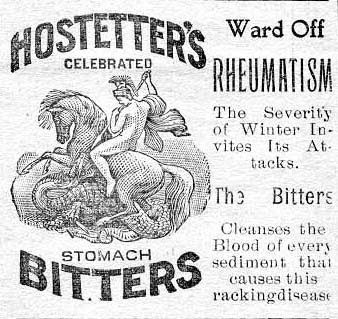
Some of the more popular tonics like Hostetter’s Celebrated Stomach Bitters had an alcohol content of 44.3% by volume. Others, like Parkers Tonic had 41.6% and Peruna had 28%.


Along with the Traveling Medicine men and their tonics, were their entertaining medicine shows. The pioneers and cowboys living in the scattered towns were very much deprived of entertainment. The shows were a natural draw. The shows typically opened with banjo or piano music, then proceeded with variety acts, minstrel skits, and sing-alongs, followed by the medicine man’s sales pitch. This cycle continued until the crowd thinned out; promising more entertainment after the sales period kept audience members in their seats. Other popular medicine show attractions included sword swallowers, fire eaters, tumblers, fortunetellers, flea circuses, magicians, strongmen, and buxom female singers.


The pioneers, mesmerized by the entertainment, forked over their hard-earned dollars for every kind of tonic, salve, or solution. And it was not just the cowboys or miners who paid for the tonics. People of all ages and walks of life, including women, and children used the patent medicines.

Which in turn, outraged the legitimate doctors. Doctors already had the daunting task of over coming the terrain and sheer distances between towns and well as the absence of public health precautions resulting in constant epidemics. Now they had to contend with the cheap easier fix for health ailments.

When the doctors were ultimately called, it was often to late for the doctor to help. The doctors were blamed for deaths that were directly or indirectly related to the Traveling Medicine men tonics.

The Traveling Medicine Men paved the way for all manner of “quackery”. The variety was limited only by the imagination of the inventors and the gullibility of the suffering. From doctors gadgets to clinics and health institutes that promised quick cures for almost everything.

In Oklahoma and Kansas before the turn of the century two fast-talking con men swindled hundreds of unsuspecting citizens (mostly women) with an imaginative patent medicine scheme. One of the “doctors” would appear in a town and spend a week or so visiting all the chronic cases, hypochondriacs and any other potential pushover’s he could find. He was glib and sympathetic, and as he chatted with them he wrote down all their symptoms, how long they had been suffering and, of course, his analysis of their ability to pay. People were pleased because he listened, and he didn’t try to force his medicines on them. Then, with his research completed, he’d leave town.


Not long after wards, his henchman would appear, and this second “doctor” would set up an office and advertise extensively in the community newspaper. Soon the same complainers came to see them. A nurse, (also part of the team) would get the patient’s name, and the “doctor” would proceed to look up the individual’s history secured the week before by his cohort.

When the victim was ushered in, the smooth talking quack would rattle off the patient’s symptoms in a wise, professional manner. The dupe, of course, would be amazed at the “doctor’s” brilliance, and when a guaranteed cure was offered-payable in advanced, of course- the response was immediate. By the time the phony physician had gone through this entire list, he would have a bundle of money, all for a few bottles of cheap tonic, which he gave to each caller as the first step in his treatment. And that would also be the last, too, because the “doctor” would suddenly disappear-off to the next frontier town where his partner had prepared a new clientele.

(The above story is from the book, “Doctors of the Old West” by Robert F. Karolevitz)


Look for future stories of the Traveling Medicine Men and life living in the old west.


Our family has been dedicated for 30 years in serving
the Western Horseman the safest most durable Quality
American made leather horse tack.......

Buckaroo John Brand

Buckaroo Leather, The Brand to Demand
Visit Our Unique Store Today
Buckaroo Leather Shopping Site