Showing posts with label californios. Show all posts

Wednesday, January 20, 2016

Mecate, Bosal, Hackamore Vaquero Tack


 Vaquero Horse Tack, Mecate, Bosal and Hackamore


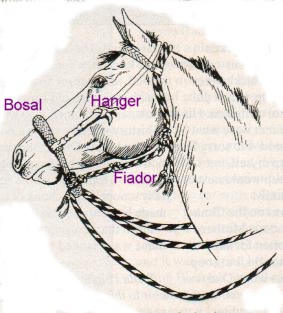
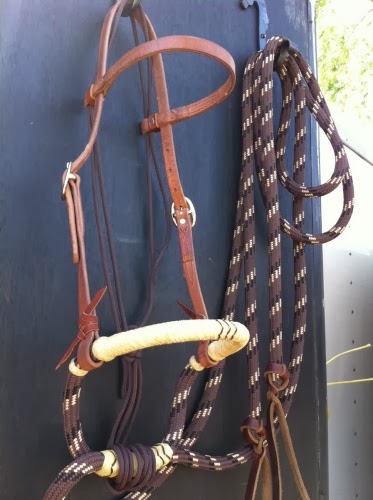
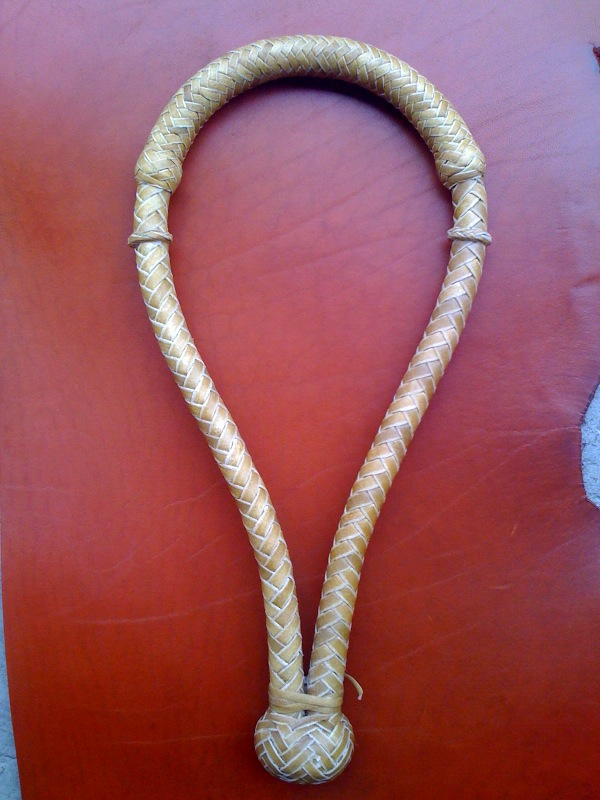
The Mecate is the rein portion of the horse tack, called the Hackamore. The Hackamore is a type of headgear for horse training. The unique part of the Hackamore is that it does not have a bit. It uses a braided noseband called a Bosal. The Bosal is a special type of noseband that works on pressure points on the horse's face, nose, and chin. The Mecate is a rope made from horse hair or soft feeling rope that serves as reins and lead rope.

The types of Hackamores include the Bosal and side pull. The Bosal Hackamore uses the Vaqueros tradition of the braided noseband and the Mecate rope.


 100% Alpaca Mecate
$100

The Mecate is tied to the Bosal in a specialized manner that adjusts the fit of the Bosal around the muzzle of the horse and creates both a looped rein and a long free end that can be used for a number of purposes.  

For the mounted rider, the free end is coiled and attached to the saddle or tucked under your belt. When the rider dismounts, the lead rein is not used to tie the horse to a solid object but used as a lead rope and a form of lunge line when needed.


 AAA Bosalitos Vaquero Style
 $249


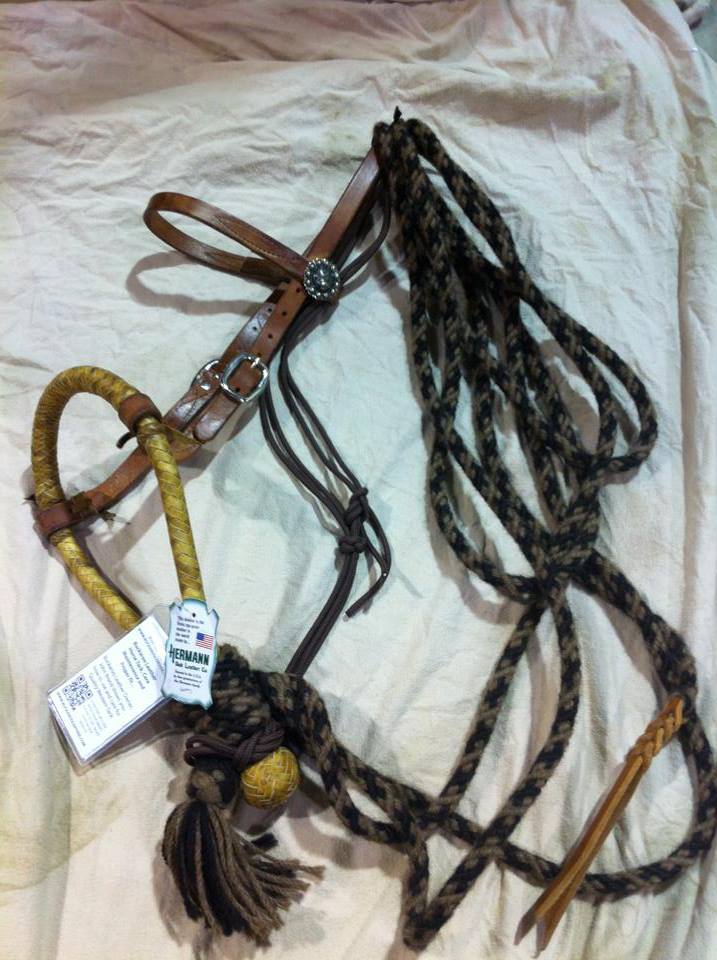
The traditional Mecate used by the California Vaqueros was made from the long hair of a horse's tail and was hand braided. Modern Mecates are made with horse hair and synthetic rope with a horse hair tassel at one end and a leather popper at the other end.

A properly tied Mecate knot (please view the how to video here) allows wraps of rope to be added to the knot in front of the rein loop in order to tighten the Bosal noseband on a horse or the rope can be unwrapped to loosen the Bosal.


 Black Beauty Concha Hackamore
$259


 Cadillac Hackamore Set with Fiador and Mecate
$395


Our family has been dedicated for 30 years in serving the 
Western Horseman the safest most durable 
Quality American made leather horse tack....... Buckaroo John Brand Buckaroo Leather, The Brand to Demand 
Visit Our Unique Store Today  
Buckaroo Leather Shopping Site

Monday, January 11, 2016

The Reata Rope used by the Californio Vaqueros


The reata (or riata) was a long braided rawhide rope used by the early Mexican Vaqueros and was no doubt first introduced into Mexico by the Spanish conquerors.
 

Reata is from the Spanish word reatar, meaning to retie or a rope which ties one animal to another.
 

Though the word reata is often used to refer to any rope, the genuine Vaquero reata was and is a special item. It was usually 40 to 80 feet long and made from twisted strands of rawhide. The finest riatas used rawhide strands, cut by experts, from the primest part of several young heifer hides. The hides were well chosen and properly cured.

The Riatas are braided in 4, 6, or 8 strands. The 8 strand, if made by a top reatero, is a beautiful article and superb for light roping. For the average hard work on large stock, the 4 strand is the best. Diameters vary according to individual preference, but the 3/8 inch riata is the one most used.

A riata can be different stiffness's (called in roping circles: lays) depending on what type of rawhide is used. For instance, bull hide makes a very stiff rope for heel roping.


The Reateros (Spanish for "rope maker") were masters at the craft of braiding reatas and all other vaquero rawhide tools. Many of these tools were truly works of art. The braiding of the riatas was not only an art form but the braids had uniformity and even tension. This was to insure durable working tool for the Vaquero.
 

The riata was the most useful tool of the Californio Vaquero and he was highly proficient in handling it. The dexterity displayed by the Vaquero ropers impressed the early Americans cowhands and the riata was quickly adopted by them as were other items of equipment used by the vaquero. The riata can be thrown farther, with the use of less energy and retaining a more perfect loop, than any other type of rope on the market.

The Mexican way to treat a riata, to keep it supple, is to tie it between two trees. Then rub it first with lemon juice (cut a fresh lemon in two and rub the fruit along the length) and then rub it with beef fat (suet). This keeps the leather from drying out or becoming stiff. Using artificial products will make the reata too limber.


Our family has been dedicated for 30 years in serving the 
Western Horseman the safest most durable 
Quality American made leather horse tack....... Buckaroo John Brand Buckaroo Leather, The Brand to Demand 
Visit Our Unique Store Today  
Buckaroo Leather Shopping Site

Monday, March 16, 2015

The History of the Mecate Reins and Hackamores


The Mecate Reins are the Rage of the Sage because they are so versatile.

The Mecate is the rein portion of the horse tack, called the Hackamore. The Hackamore is a type of headgear for horse training. The unique part of the Hackamore is that it does not have a bit. It uses a braided noseband called a Bosal. The Bosal is a special type of noseband that works on pressure points on the horse's face, nose, and chin. The Mecate is a rope made from horse hair or soft feeling rope that serves as reins and lead rope.

The history of the Hackamore and Mecate goes all the way back to 4,000 BC. The first Hackamore was probably a piece of rope placed around the nose or head of a horse not long after domestication. These early devices for controlling horses may have been adapted from equipment used to control Camels. Over time, this means of controlling a horse became more sophisticated.

The Persians in 500 BC were one of the first to use a thick plaited noseband to help the horse look and move in the same direction. This was called a Hakma. On this Hakma was a third rein added at the nose, which allowed the rider to achieve more power from the horse. Later this third rein moved from the top of the noseband to under the chin, where it is still part of the modern Bosal style Hackamore with Mecate reins.

The Hackamore used in the United States came from the Spanish Vaqueros in California. From this, the American Cowboy adopted two different uses, the "Buckaroo" tradition closely resembling that of the original Vaqueros and the "Texas" tradition which blended some Spanish techniques with methods from the eastern states.


These types of Hackamores include the Bosal and side pull. The Bosal Hackamore uses the Vaqueros tradition of the braided noseband and the Mecate rope.

The Mecate is tied to the Bosal in a specialized manner that adjusts the fit of the Bosal around the muzzle of the horse and creates both a looped rein and a long free end that can be used for a number of purposes.


For the mounted rider, the free end is coiled and attached to the saddle or tucked under your belt. When the rider dismounts, the lead rein is not used to tie the horse to a solid object but used as a lead rope and a form of lunge line when needed.

The traditional Mecate used by the California Vaqueros was made from the long hair of a horse's tail and was hand braided. Modern Mecates are made with horse hair and synthetic rope with a horse hair tassel at one end and a leather popper at the other end.

A properly tied Mecate knot allows wraps of rope to be added to the knot in front of the rein loop in order to tighten the Bosal noseband on a horse or the rope can be unwrapped to loosen the Bosal.

This Vaquero style of Hackamore is used in Western Riding and is an indispensable part of the Vaquero way of making a California reined horse. It is also used with horses that have dental issues, where a bit would be painful. Some riders also like to use this style of Hackamore in the winter instead of a frozen metal bit.

Buckaroo Leather Products uses the influence of the Vaquero when creating the many styles of Hackamores and Mecates we have available. Buckaroo also offers many traditional "Old mexico" hand braided Rawhide Bosals.


Hand Woven 100% Alpaca Mecate Rein with the colors Summer Rose with Black and tan. The Alpaca fibers used in these Mecates are grown on a family ranch in South East Colorado. 


Complete Hackamore Set includes an all natural color beautifully hand braided 12 plait 5/8" Vaquero style, All rawhide core (no cable core) natural rawhide bosal.


 These are Braided in the old Vaquero tradition with a forelock tie, some of the finest braiding we have ever seen.


Mane Hair Mecate


Mane Hair Mecate 5/8" - 22' long, 6 Strand Braid.
Beautiful Quality hand braided feel and communication.


Mecate Rein with Leather Popper


This rein has a Nylon Mecate with Leather poppers. Available in 5/8" width and 23' length. This mecate is Perfect for the beginning stages of Horse training or everyday mecate use.


Buckaroo Leather Products has all your Hackamore, Mecate, and slobber strap needs. We have many styles to choose from and all are fashioned from the highest grade American Made leather, from Hermann Oak Leather. The quality of our horse tack can not be beat!! Proud to be American made!!


Our family has been dedicated for 30 years in serving the 
Western Horseman the safest most durable 
Quality American made leather horse tack....... Buckaroo John Brand Buckaroo Leather, The Brand to Demand 
Visit Our Unique Store Today 
Buckaroo Leather Shopping Site

Wednesday, July 2, 2014

History of Santa Maria Style Barbeque


Happy 4th of July!!


First, lets remember why we celebrate this day..our Freedom!!! And give thanks to all those who have and are still defending our Freedom!!! 

Buckaroo Leather is Proud to be American Made!!


With 4th of July comes barbecues, family and food!!

What are you barbecuing??? What type of barbeque do you use????


Have you heard of Santa Maria Barbeque??? This style of barbeque is flavorful and simple. Simple ingredients but great taste.


The history of Santa Maria barbeque goes back to the early Californio-Vaqueros of the 1800's. The ranchers of the Santa Maria Valley in California would host large Spanish style feasts for their Vaqueros (cowboys) after every cattle roundup.

The ranchers would barbeque large quantities of beef over pits dug in the ground. They would fill the pits with hot coals of local coast live oak or "Red Oak" wood. The beef would be seasoned with local ingredients, but nothing to elaborate. The key to the flavor was the simple ingredients and the beef being slowly cooked to seal in the flavor.


The meal would be served with pinquitos. They are a small pink bean that according to local legend are indigenous to Santa Maria Valley. Some believe the beans were given as a gift by a Mexican vaquero to one of the early Swiss-Italian settlers. Others believe that a lady brought several plants with her when she migrated from Europe.

This style of Santa Maria Barbeque was still used in the 20th century. As seen below in this picture from R.H. Tesene's book Santa Maria Style Barbeque, it show volunteers tending the barbeque over a pit at an Independence Day Celebration in 1904.


Over the years, the style used by the Vaqueros remained the same, but how locals of Santa Maria grilled the meat changed. Instead of grilling the beef over a pit in the ground, they began to string cuts of beef on skewers or rods and would still cook the beef over the red oak wood.

This led way to a local group of business men in Santa Maria who formed a Santa Maria Barbecue club. They would meet at a one of the mens house and cook over a grill, more like what you would see today.


The key to Santa Maria barbeque is the simplicity of the ingredients, the thick cuts of beef, and the use of the red oak from the Santa Maria Valley. The rest of the meal consists of toasted sweet French bread, pinquito beans, salsa, and a simple dessert.


Love this picture of Ronald Reagan at the White House.


President Ronald Reagan was an avid fan of Santa Maria-style barbecue. While he was President the White House staged several Santa Maria style barbecues including five feasts on the South Lawn of the White House.


Our family has been dedicated for 30 years in serving the Western Horseman the safest most durable Quality American made leather horse tack....... Buckaroo John Brand
Buckaroo Leather, The Brand to Demand
Visit Our Unique Store Today
Buckaroo Leather Shopping Site

Tuesday, November 19, 2013

The History of the Hackamore and Mecate


 Vaquero's

The Hackamore was used by the Vaquero's in the beginning for horse training. The Vaquero's quickly learned that this piece of horse tack was a must for every day riding too. Today the hackamore is wildly popular among the Natural Horseman and women and horse riders still true to the Vaquero ways.

The unique part of the Hackamore is that it does not have a bit. It uses a braided noseband called a Bosal. The Bosal is a special type of noseband that works on pressure points on the horse's face, nose, and chin. 


                      Cadillac Hackamore set with Fiador and Mecate


The mecate is the rein portion of the Hackamore.The Mecate is a rope made from horse hair or soft feeling rope. The mecate can act as a lead rope too.

The traditional Mecate used by the California Vaqueros was made from the long hair of a horse's tail and was hand braided. Modern Mecates are made with horse hair and synthetic rope with a horse hair tassel at one end and a leather popper at the other end.


The history of the Hackamore and Mecate goes all the way back to 4,000 BC. The first Hackamore was probably a piece of rope placed around the nose or head of a horse not long after domestication. These early devices for controlling horses may have been adapted from equipment used to control Camels. Over time, this means of controlling a horse became more sophisticated.

The Persians in 500 bc were one of the first to use a thick plaited noseband to help the horse look and move in the same direction. This was called a Hakma. On this Hakma was a third rein added at the nose, which allowed the rider to achieve more power from the horse. Later this third rein moved from the top of the noseband to under the chin, where it is still part of the modern Bosal style Hackamore with Mecate reins.


The Hackamore used in the United States came from the Spanish Vaqueros in California. From this, the American Cowboy adopted two different uses, the "Buckaroo" tradition closely resembling that of the original Vaqueros and the "Texas" tradition which blended some Spanish techniques with methods from the eastern states.


Bosal Hackamore Style

These types of Hackamores include the Bosal and side pull. The Bosal Hackamore uses the Vaqueros tradition of the braided noseband and the Mecate rope.

The Mecate is tied to the Bosal in a specialized manner that adjusts the fit of the Bosal around the muzzle of the horse and creates both a looped rein and a long free end that can be used for a number of purposes.

For the mounted rider, the free end is coiled and attached to the saddle or tucked under your belt. When the rider dismounts, the lead rein is not used to tie the horse to a solid object but used as a lead rope and a form of lunge line when needed.


A properly tied Mecate knot allows wraps of rope to be added to the knot in front of the rein loop in order to tighten the Bosal noseband on a horse or the rope can be unwrapped to loosen the Bosal.

This Vaquero style of Hackamore is used in Western Riding and is an indispensable part of the Vaquero way of making a California reined horse. It is also used with horses that have dental issues, where a bit would be painful. Some riders also like to use this style of Hackamore in the winter instead of a frozen metal bit.


Sidepull Headstall / Hackamore

The side pull Hackamore or headstall is a modern design inspired by the Bosal style. This style has a heavy noseband with side rings that attach the reins on either side of the head. This allows very direct pressure to be applied from side to side.


                             Loping Sidepull Hackamore


The noseband is made of leather, rawhide, or rope with a leather or synthetic strap under the jaw. It is held on by a leather or synthetic headstall.

Visit the Buckaroo Leather Website for our full collection of Hackamores......


Our family has been dedicated for 30 years in serving the 
Western Horseman the safest most durable 
Quality American made leather horse tack....... Buckaroo John Brand Buckaroo Leather, The Brand to Demand 
Visit Our Unique Store Today
Buckaroo Leather Shopping Site

Monday, July 8, 2013

How to tie a Mecate on your Hackamore Rawhide Bosal


How to tie a cotton mecate on your rawhide bosal hackamore.


Watch this video and learn how to tie a mecate on your rawhide bosal just like the Vaqueros (cowboys) of the old west. This particular "rig" was the favorite of the Californio Vaqueros when starting young horses for head set and control, before they were moved in to the bridle.

In this video you can watch Buckaroo John from Buckaroo Leather Products walk you thru how to tie the mecate to suit your needs and size.

Buckaroo John starts with a basic rawhide bosal and the cowboy harness leather hanger headstall. This headstall does not have hardware, just a basic wrap around tie in a cowboy knot for adjustment.

Buckaroo John is using a 23' cotton mecate to tie around the bosal. You can use a cotton, nylon, horsehair, alpaca and yacht rope mecate. The most common type of mecate used by the natural horseman is the cotton/nylon mecate. The Traditional style of mecate is the horsehair, it was used by the Vaqueros of the old west.


Begin by:

Taking the tassel end of the mecate through the "v" part of the bosal, making sure it is facing away from your hanger headstall.

Wrap your mecate around the "v" portion of  the bosal 3 times

Push the mecate down sung

Reach from underneath and pull down the mecate to form your reins in the length you need.

Push down the mecate inside the "v" portion of your bosal.

Pull the popper end of the mecate and continue wrapping the mecate around 2 times above your reins.

You can adjust the number of wraps to accommodate the size of the opening in the bosal. The less wraps you have the larger the bosal opening to accommodate a larger nose.

The more wraps of the mecate on the bosal the smaller the bosal opening to accommodate a smaller nose.

Take the popper end and put it back down in between your last 2 wraps. If you have done it correctly the popper will come across your reins.

The popper end is used as a light lead when you are off your horse. Or you can be like the Vaqueros of old and use the popper in the western style by tucking the popper in your belt while riding.


Our family has been dedicated for 30 years in serving the 
Western Horseman the safest most durable Quality 
American made leather horse tack.......Buckaroo John Brand
Buckaroo Leather, The Brand to Demand
Visit Our Unique Store Today
Buckaroo Leather Shopping Site

Wednesday, April 17, 2013

The Rawhide Reata a Work of Art and a Tool of the Vaquero


The Vaqueros of the old west were skilled horsemen who valued their horses and their rawhide horse tack. The Vaqueros had an arsenal of "tools" to assist them with their every day task on the range. One of these "tools" was the Rawhide Reata (or riata).

The word reata is from the Spanish word reatar, meaning to retie or a rope which ties one animal to another. The rawhide reata was a long braided rawhide rope used by the early Mexican Vaqueros and was no doubt first introduced into Mexico by the Spanish conquerors. Though the word reata is often used to refer to any rope, the genuine Vaquero reata was and is a special item. The reata was usually 40 to 80 feet long and was made from twisted strands of rawhide. The finest riatas used rawhide strands, cut by experts, from the primest part of several young heifer hides. The hides were well chosen and properly cured.

The Reateros (Spanish for "rope maker") were masters at the craft of braiding reatas and all other vaquero rawhide tools. Many of these tools were truly works of art. The braiding of the riatas was not only an art form but the braids had uniformity and even tension. This was to insure a durable working tool for the Vaquero.


The rawhide riata was the most useful tool of the Californio Vaquero and he was highly proficient in handling it. The dexterity displayed by the Vaquero ropers impressed the early Americans cowhands and the riata was quickly adopted by them as were other items of equipment used by the vaqueros. The riata can be thrown farther, with the use of less energy and retaining a more perfect loop, than any other type of rope on the market.

The Mexican way to treat the riata to keep it supple was to tie it between two trees. Then rub it first with lemon juice (cut a fresh lemon in two and rub the fruit along the length) and then rub it with beef fat (suet). This kept the leather from drying out or becoming stiff. Today, if you use an artificial product it will make the reata too limber.


 The Riatas of the old west and today are braided in 4, 6, or 8 strands. The 8 strand, if made by a top reatero, is a beautiful article and superb for light roping. For the average hard work on large stock, the 4 strand is the best. Diameters vary according to individual preference, but the 3/8 inch riata is the one most used today and in the old west. A rawhide riata can also be different stiffness's (called in roping circles: lays) depending on what type of rawhide is used. For instance, bull hide make a very stiff rope perfect for heel roping.

The rawhide reatas of the old west were a useful tool of the Vaquero. But, one may also look at them as a true work of art and craftsmanship.


Be apart of true Western Horsemanship at the Horsemen's Re-Union in Paso Robles, Ca. See our modern day horseman and horsewoman use their knowledge of the Vaquero's of the Old West to start 40 colts in 5 days.


The Horesmen's Re-Union is from April 15th-20th and Buckaroo Leather is attending this magnificent display of horsemanship.

 Buckaroo Leather Wagon at the Horsemen's Re-Union


Our family has been dedicated for 30 years in serving the Western Horseman the safest most durable Quality American made leather horse tack....... Buckaroo John Brand Buckaroo Leather, The Brand to Demand Visit Our Unique Store Today Buckaroo Leather Shopping Site

Friday, August 17, 2012

Custom Designed Leather Horse Tack Made in America


The Vaqueros and the Californios of the old west took pride in not only their horsemanship and horse training skills but also their leather horse tack. Many Vaqueros were skilled in rawhide braiding and would use this skill to create unique leather horse tack.

Californios and Vaqueros also adorned their unique leather horse tack with beautiful silver conchas and hand tooling.

Buckaroo Leather carries on the Vaquero tradition with custom handcrafted leather horse tack designed by YOU!!!  Beautiful conchas, hand tooling in unique patterns, rawhide braiding, quality leather all available to you to custom design your own unique piece of leather horse tack.

Below are some examples of custom designed leather horse tack manufactured by Buckaroo Leather and designed by YOU the customer.....


Call John Brand to order your custom leather horse tack today....... cell # 530-545-0139


                                         Custom Martingale Breast Collar


top and bottom pictures


Our family has been dedicated for 30 years in serving the Western Horseman the safest most durable Quality American made leather horse tack....... Buckaroo John Brand 
Buckaroo Leather, The Brand to Demand 
Visit Our Unique Store Today
Buckaroo Leather Shopping Site

Friday, July 29, 2011

Silver the Vaquero Tradition of Adorning Your Western Horse Tack


Does your western horse tack and saddle need some "shine" or "spiffing up".....how about the traditional Vaquero ornament of silver.

The Californio Vaquero's were skilled horseman who took great pride in their horsemanship and their western horse tack. Looking good was as important as riding well.


The Californio Vaquero'
s western Saddles and horse tack were truly works of art. While the decoration styles remained very traditional, the saddle's decoration changed by geographical location and time. The Vaquero adorned their saddles with leather lacing, leather carving or stamping and of course engraved silver work.
This silver work can still be seen on Western Saddles of today. The Western Saddles of today reflect the beauty and tradition of the old Vaquero style. This silver decoration can be subtle or extreme. Whether it is an elaborate show or parade saddles or a custom everyday saddle, they all reflect the riders pride in their horsemanship and distinct style.
Below are just some of the ways to adorn your
saddle with engraved silver:

Silver trim is available in sets or as individual pieces. The most basic set includes two corner plates for the back corners of the skirts, a cantle plate, a horn cap, and 4 large and 2 small conchos. In addition to these pieces, you'll find silver trim designed for accenting stirrups and tapadaros(are covers or hoods for the front
of the stirrups), fenders, swells, rigging plates, latigo holders, buckles, breast plates and breast collars.


Silver conchos and trim are not just found on saddles- remember Roy Rogers' Trigger. Trigger's famous western breast collar was adorned with silver trim.


Conchos, buckles, silver trim, engraved silver are all beautiful pieces to add to your western horse tack........capture the Vaq
uero spirit or your own cowboy/cowgirl personality.....


Buckaroo Leather has gorgeous silver conchas to add to your leather horse tack..........and if you have a special style or look you want to capture contact me at 530-545-0139

Buckaroo Leather is proud to manufacture your custom horse tack............


Our family has been dedicated for 30 years in serving the
Western Horseman the safest most durable
Quality American made leather horse tack.......Buckaroo John Brand
Buckaroo Leather, The Brand to Demand
Visit Our Unique Store Today
Buckaroo Leather Shopping Site

Tuesday, March 15, 2011

Vaquero, Californio, Buckaroo ......They all mean Cowboy!


Cowboys of the old west were referred to as "Vaquero's", ( spanish word, "Vaca" means cow), "Californio's", "hands", or "cowhands". The term "Cowboy" was rarely used back in the old west. It is more commonly used today.
The word Vaquero pronounced by American Cowboys, was "bukera" and finally "Buckaroo". For a time anyone working cattle, whether in Texas, CA or elsewhere was known as a "Buckaroo". It wasn't until the late 1860's when the Texans began to drive their cattle north to the new railroads in Kansas, that the term "Cowboy" came into widespread use.


Vaqueros were poor, owned no land, probably not even a horse, but he began the noble tradition of the working cowboy that spread from Mexico into the US.

Vaquero's felt superior to farmer's. They were proud of their work, had courage, fortitude, physical endurance, patient, long suffering, and uncomplaining. The Vaquero's worked in bad weather and with aches and pains. They went without food and tracked down stray animals at all costs. They had courage, riding into the midst of a milling herd.


The Vaquero and cowboys expected and valued these qualities. Virtuous actions would not bring praise, but failing to measure up to the Vaquero's standard could bring criticism censure or ridicule.


Jo Mora (cartoonist, illustrator, and Cowboy in the 1800's, pictured here) described the appearance of the Vaquero or Californio, (from the book "Cowboys of the America's" by Richard W Slarta)


"A kerchief was bound about his head, atop which, at a very rakish, arrogant angle sat a trail-worn weather beaten hat wide of brim, low of crown, held in place by a barbiquejo (chin strap) that extended just below the lower lip. His unkempt black beard straggled over his jowls and his long black hair dangled down his back to a little below the line of his shoulders. His ample colonial shirt was soiled and torn and a flash of brown shoulder could usually be seen through a recent tear. The typical wide red Spanish sash encircled his lean midriff. His short pants reaching to his knees, buttoned up the sides and were open for 6 inches or so at the bottom. Long drawers (which were once white) showed wrinkles at the knees and were folded into wrapped leather botas (leggings). He wore a rough pair of buckskin shoes with leather soles and low heels to which were strapped a pair of large and rusty iron spurs. This costume was finished off by a tirador ( a heavy wide at the hips belt) that helped him to snub with the reata (rawhide rope) when lassoing on foot. The ever present long knife in its scabbard was thrust inside the garter on his right leg."


Much of the dress, language, Vaquero horse tack and values of the Mexican and Californio Vaquero's passed to the Anglo American Cowboy. The Vaquero gear, the La reata became the Cowboys Larait (a rope in the form of a lasso). Chaparejos became chaps and the term "Dar la Vuelta" (take a turn) became "dally". Meaning to twist the end of a Lariat around the saddle horn rather than tying it down.


Vaquero Tack offered from Buckaroo Leather.......


Complete Hackamore/Mecate Set

Complete Hackamore Set includes an all natural beautifully hand braided 14 plait 5/8" rawhide bosal w/ Hermann Oak harness head piece attached with Cowboy knot adjustment and a 1/2" cotton 23' Mecate w/braided rawhide button. This Hackamore features our best quality all rawhide core bosal; a beautiful piece of "Old Style" rawhide braiding.


Once you use this Full Grain Leather Chap you will use no other! Batwing Chap in Full Grain Leather in Brown Earth Tones. This Hand Crafted Chap has an amazing extra special Glovey Feel! for that Broke in Feel. This 3 snap Shotgun Style Chap is Straight Edge and has Hand Tooled plaque. You have a choice of Tooling Designs Basket, Wild Rose/Basket, and Acorn/Basket. Fully adjustable waist belt and leg straps.


Our family has been dedicated for 30 years in serving the
Western Horseman the safest most durable
Quality American made leather horse tack.......Buckaroo John Brand
Buckaroo Leather, The Brand to Demand
Visit Our Unique Store Today
Buckaroo Leather Shopping Site