Showing posts with label braided rawhide. Show all posts

Wednesday, January 20, 2016

Mecate, Bosal, Hackamore Vaquero Tack


 Vaquero Horse Tack, Mecate, Bosal and Hackamore
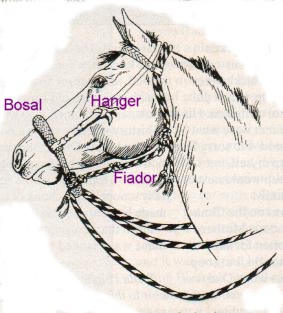


The Mecate is the rein portion of the horse tack, called the Hackamore. The Hackamore is a type of headgear for horse training. The unique part of the Hackamore is that it does not have a bit. It uses a braided noseband called a Bosal. The Bosal is a special type of noseband that works on pressure points on the horse's face, nose, and chin. The Mecate is a rope made from horse hair or soft feeling rope that serves as reins and lead rope.

The types of Hackamores include the Bosal and side pull. The Bosal Hackamore uses the Vaqueros tradition of the braided noseband and the Mecate rope.


 100% Alpaca Mecate
$100

The Mecate is tied to the Bosal in a specialized manner that adjusts the fit of the Bosal around the muzzle of the horse and creates both a looped rein and a long free end that can be used for a number of purposes.  

For the mounted rider, the free end is coiled and attached to the saddle or tucked under your belt. When the rider dismounts, the lead rein is not used to tie the horse to a solid object but used as a lead rope and a form of lunge line when needed.


 AAA Bosalitos Vaquero Style
 $249


The traditional Mecate used by the California Vaqueros was made from the long hair of a horse's tail and was hand braided. Modern Mecates are made with horse hair and synthetic rope with a horse hair tassel at one end and a leather popper at the other end.

A properly tied Mecate knot (please view the how to video here) allows wraps of rope to be added to the knot in front of the rein loop in order to tighten the Bosal noseband on a horse or the rope can be unwrapped to loosen the Bosal.


 Black Beauty Concha Hackamore
$259


 Cadillac Hackamore Set with Fiador and Mecate
$395


Our family has been dedicated for 30 years in serving the 
Western Horseman the safest most durable 
Quality American made leather horse tack....... Buckaroo John Brand Buckaroo Leather, The Brand to Demand 
Visit Our Unique Store Today  
Buckaroo Leather Shopping Site

Monday, January 11, 2016

Rope Talk of the Old West Cowhands


Old West Cowhands "Rope Talk"


Here is a brief list of some general rope terms used by the Old West Cowhands:
 

Lariat is an Americanization of la reata, Spanish for the rope
 

Lasso is the lazo, meaning in Spanish a noose or snare.
 

Lazo reata is a Spanish term meaning snare rope.
 

Catch rope, throw rope, saddle rope, grass rope, twine, whale line, hard twist, lass rope, and rope are all used to designate a catch rope.
 

Reata is from the Spanish reata, meaning rope, but the American cowhands use it to designate a rawhide rope.
 

Reata men are hands who use a rawhide rope and they sometimes refer to this rope as a lass rope.
 

Roping terms used by the cowhand are, rope, meaning to throw a rope, roped, meaning to have caught something with the rope, roping the act of catching and looped meaning caught.


Our family has been dedicated for 30 years in serving the 
Western Horseman the safest most durable 
Quality American made leather horse tack....... Buckaroo John Brand Buckaroo Leather, The Brand to Demand 
Visit Our Unique Store Today  
Buckaroo Leather Shopping Site

The Reata Rope used by the Californio Vaqueros


The reata (or riata) was a long braided rawhide rope used by the early Mexican Vaqueros and was no doubt first introduced into Mexico by the Spanish conquerors.
 

Reata is from the Spanish word reatar, meaning to retie or a rope which ties one animal to another.
 

Though the word reata is often used to refer to any rope, the genuine Vaquero reata was and is a special item. It was usually 40 to 80 feet long and made from twisted strands of rawhide. The finest riatas used rawhide strands, cut by experts, from the primest part of several young heifer hides. The hides were well chosen and properly cured.

The Riatas are braided in 4, 6, or 8 strands. The 8 strand, if made by a top reatero, is a beautiful article and superb for light roping. For the average hard work on large stock, the 4 strand is the best. Diameters vary according to individual preference, but the 3/8 inch riata is the one most used.

A riata can be different stiffness's (called in roping circles: lays) depending on what type of rawhide is used. For instance, bull hide makes a very stiff rope for heel roping.


The Reateros (Spanish for "rope maker") were masters at the craft of braiding reatas and all other vaquero rawhide tools. Many of these tools were truly works of art. The braiding of the riatas was not only an art form but the braids had uniformity and even tension. This was to insure durable working tool for the Vaquero.
 

The riata was the most useful tool of the Californio Vaquero and he was highly proficient in handling it. The dexterity displayed by the Vaquero ropers impressed the early Americans cowhands and the riata was quickly adopted by them as were other items of equipment used by the vaquero. The riata can be thrown farther, with the use of less energy and retaining a more perfect loop, than any other type of rope on the market.

The Mexican way to treat a riata, to keep it supple, is to tie it between two trees. Then rub it first with lemon juice (cut a fresh lemon in two and rub the fruit along the length) and then rub it with beef fat (suet). This keeps the leather from drying out or becoming stiff. Using artificial products will make the reata too limber.


Our family has been dedicated for 30 years in serving the 
Western Horseman the safest most durable 
Quality American made leather horse tack....... Buckaroo John Brand Buckaroo Leather, The Brand to Demand 
Visit Our Unique Store Today  
Buckaroo Leather Shopping Site

Tuesday, March 31, 2015

Horse Tack Influenced by the Vaquero Horsemanship


Vaquero’s, which in Spanish means, “Cowboys”, were Spanish horseman. Their style of horsemanship, gear and training has had an influence on the “Traditional American Cowboy”. Their unique style spread from Europe all the way to the United States.

The Vaquero learned many of their horse skills from Medieval and Renaissance Europe. The European Knights and their war horses used many skills on the battlefield that can be seen today in both the reined working cow horse and dressage.

When the Spanish began to colonize the “America’s”, they used the skills found on the European Battlefields to train their horses.

The Vaquero’s Spanish style of training horses spread throughout California. Once in California the “California” Vaquero began to refine their methods of training horses and working cattle.

Because of the unique climate and culture in California the growing Vaquero tradition of training could take as long as needed. The mild climate allowed for the Vaquero’s training of a horse to take all the time that was needed. So, the California bridle horse evolved to a point where a top hand could ride his horse with just a light string attaching his rein chains to a bit.

The influence of the Vaquero spread from California to Texas. The Texas Cowboy, or what we think of today as the “Classic American Cowboy”, had a different style of training horses and working cattle. The different styles of both the Texas Cowboy and the Vaquero can still be seen today.

One example, is the that the Texas Cowboy prefers to tie their rope directly to the saddle horn by a loop on the tail end, while the Vaquero prefers to wrap his rope around the saddle horn.

The Texas Cowboy uses his horse to work cattle, while the Vaquero uses cattle to work his horses. These two unique styles have grown into two very different competitions.

The cutting horse has grown out of the Texas style which prefers the use of a horse that is bred to work a cow on its own once that horse has been trained.

The reined working cow horse has grown out of the Vaquero style, which came from the Vaquero tradition of training a horse that is also bred to work a cow but works entirely from the commands of the rider.


Even the buckaroo gear and vaquero gear is different. The Vaquero likes the silver spade bit with silver conchos on the bridle and a fancy set of braided rawhide rommel reins.

The Texas style is a grazer bit and simpler, but functional bridle with a plain set of leather split reins.

As with the ornate design of the Spanish style spurs and straps, 

the Spanish influence, through the California Vaquero, can be seen in not only the finesse of the reined working cow horse but in the ornate design of their bits, bridles and romel reins.

Buckaroo Leather Company has continued the Vaquero tradition with many unique styles of leather horse tack and vaquero gear.


These are Braided in the old Vaquero tradition with a forelock tie, some of the finest braiding we have ever seen. These are one of a kind, Designed to be used for a "get down rig" or for a 2 rein rig. The one on left has extra fine 16 plait cheeks with 32 plait nose and button. In browns and tans feels like Kangaroo. 


Our Complete Vaquero Cowboy Mecate Snaffle Bridle Set includes our 3/4" Hermann Oak oiled Golden bridle Browband single buckle on the Poll Headstall with hand engraved silver conchas, a 5" iron ring snaffle bit and matching Slobber Strap with silver engraved conchas and a 23' yacht braid mecate with rawhide button and tassel


This Hermann Oak Heavy Bridle Quality Leather Headstall is made in the old California Vaquero traditional styling. This is a Scallop cheek browband style Headstall made from Mid weight Oiled PREMIUM single-ply stitched Bridle leather. Accented with beautiful hand engraved conchas!


Our family has been dedicated for 30 years in serving the Western Horseman the safest most durable Quality American made leather horse tack....... Buckaroo John Brand Buckaroo Leather, The Brand to Demand Visit Our Unique Store Today Buckaroo Leather Shopping Site

Tuesday, August 5, 2014

Horse Training by the Californio Vaquero's


The Californio Vaquero's prided themselves on their horsemanship and horse tack. They took great care too hand braid their horse hair mecates and romel reins. The Vaquero’s hand braiding techniques are still used today. 

The rawhide bosals, riatas and quirts, headstalls, and hackamores are all part of the Vaquero "tool box" to train their horses.

The Vaqueros trained their horses for 7-10 years, starting at 4 years old, to react with very little pressure from the rider. At the end of training, the horse and rider would be one. 


The 3 stages of the Vaquero horse training were….


The 1st stage - starts with a hackamore bitless braided rawhide headstall to teach the horse to yield to pressure. The reins were long hand braided horse hair mecates.

The 2nd stage - or "Two Rein" is where the Vaquero would use a thinner simpler version of the hackamore nose piece, the bosal. This bosal was lighter for this part of the stage. The mecate bridle had a spade bit and a braided rawhide romel rein. During this stage of the training the Vaquero would hold both sets of reins and the horse would be controlled with mostly the bosal and light on the bit. Then the Vaquero would transition to only using the bit and would then get rid of the bosal all together.

The 3rd stage- is called the "Straight upon the Bridle". The Vaquero handles the horse with just the spade bit. The Bit is connected with romel reins. The bosal and mecate are used under the bridle to lead the horse. 


This extensive training enabled the Vaquero to control the horse with little pressure. The Vaquero's horse was a skilled cattle horse and would be tested....

The Vaquero use to test their horses skills by tying a thread to the links section of the chain part of the romel reins. The Vaquero would then bring the horse to a stop with a "light" pull of the reins. If the thread broke- the Vaquero needed to pull to hard.

Another way to show off their skills.....trying to rope Grizzlies!!!

Can you imagine the horsemanship skills and the communication of the horse and rider to stop and move in an instant to rope a Grizzly!!!!!


Buckaroo Leather Uses the Influence of the Vaquero when handcrafting our Hackamores


Our family has been dedicated for 30 years in serving the Western Horseman the safest most durable Quality American made leather horse tack....... Buckaroo John Brand Buckaroo Leather, The Brand to Demand Visit Our Unique Store Today Buckaroo Leather Shopping Site

Thursday, April 24, 2014

The Anatomy of the Bosal by Pasini Equine


Hackamore principles and the hackamore itself can be applied to any horse and any discipline. Garrick Pasini of Pasini Equine believes and uses these principles with all his new colts and in his Hackamore Horsemanship clinics. Garrick has a true respect for the hackamore. If you want a horse with a soft mouth, that responds to light cues, Garrick recommends that you try the Hackamore. 


The hackamore consists of the fiador, hanger and bosal. (watch the Buckaroo Leather how to video on the hackamore...click here) 


Garrick recently dissected a part of the hackamore, a starter 5/8th bosal....See below... 

(the information and pictures below are from Garrick's facebook page)   

This started bosal that Garrick built was 11 inches long with a 8 in. nose button. Notice the grime on the inside of the nose button showing contact on the horses nose, very important.


As he un-braids the nose button you can see different colors of muzzle hair embedded in the braid. (pictured below) The rawhide used for the cheek piece is still in great condition, which is very important for communication.


With all buttons completely removed we are left with nothing but the round or body. You can see the reata core in the first picture. (below) I will now add nerve buttons to the nose button in the second picture.


With the nose button prepped its time to braid the button.


If you are interested in learning more about Garrick Pasini and his hackamore clinics be sure to visit his website and facebook page to stay connected. 

 Garrick's next clinic


Our family has been dedicated for 30 years in serving the 
Western Horseman the safest most durable 
Quality American made leather horse tack....... Buckaroo John Brand Buckaroo Leather, The Brand to Demand 
Visit Our Unique Store Today  
Buckaroo Leather Shopping Site

Thursday, October 17, 2013

History of the Rawhide Riatas....the Vaquero's Rope


The Rawhide Riatas' History

The reata (or riata) was a long braided rawhide rope used by the early Mexican Vaqueros and was no doubt first introduced into Mexico by the Spanish conquerors.

Reata is from the Spanish word reatar, meaning to retie or a rope which ties one animal to another.


Though the word reata is often used to refer to any rope, the genuine Vaquero reata was and is a special item. It was usually 40 to 80 feet long and made from twisted strands of rawhide. The finest riatas used rawhide strands, cut by experts, from the primest part of several young heifer hides. The hides were well chosen and properly cured.

The Riatas are braided in 4, 6, or 8 strands. The 8 strand, if made by a top reatero, is a beautiful article and superb for light roping. For the average hard work on large stock, the 4 strand is the best. Diameters vary according to individual preference, but the 3/8 inch riata is the one most used.

A riata can be different stiffness's (called in roping circles: lays) depending on what type of rawhide is used. For instance, bull hide makes a very stiff rope for heel roping.

The Reateros (Spanish for "rope maker") were masters at the craft of braiding reatas and all other vaquero rawhide tools. Many of these tools were truly works of art. The braiding of the riatas was not only an art form but the braids had uniformity and even tension. This was to insure durable working tool for the Vaquero.


this is Jesse Wilkinson with rawhide riatas he crafted in 1930. 
He learned the art of rawhide braiding as a boy.


The riata was the most useful tool of the Californio Vaquero and he was highly proficient in handling it. The dexterity displayed by the Vaquero ropers impressed the early Americans cowhands and the riata was quickly adopted by them as were other items of equipment used by the vaquero. The riata can be thrown farther, with the use of less energy and retaining a more perfect loop, than any other type of rope on the market.

The Mexican way to treat a riata, to keep it supple, is to tie it between two trees. Then rub it first with lemon juice (cut a fresh lemon in two and rub the fruit along the length) and then rub it with beef fat (suet). This keeps the leather from drying out or becoming stiff. Using artificial products will make the reata too limber.


Old West Cowhands "Rope Talk"

Here is a brief list of some general rope terms used 
by the Old West Cowhands:

Lariat is an Americanization of la reata, Spanish for the rope

Reata is from the Spanish reata, meaning rope, but the American cowhands use it to designate a rawhide rope.

Reata men are hands who use a rawhide rope and they sometimes refer to this rope as a lass rope.

Roping terms used by the cowhands...

rope - to throw a rope,

roped - to have caught something with the rope

roping - the act of catching

looped - caught


Our family has been dedicated for 30 years in serving the 
Western Horseman the safest most durable Quality American made leather horse tack....... Buckaroo John Brand 
Buckaroo Leather, The Brand to Demand 
Visit Our Unique Store Today  
Buckaroo Leather Shopping Site

Wednesday, April 17, 2013

The Rawhide Reata a Work of Art and a Tool of the Vaquero


The Vaqueros of the old west were skilled horsemen who valued their horses and their rawhide horse tack. The Vaqueros had an arsenal of "tools" to assist them with their every day task on the range. One of these "tools" was the Rawhide Reata (or riata).

The word reata is from the Spanish word reatar, meaning to retie or a rope which ties one animal to another. The rawhide reata was a long braided rawhide rope used by the early Mexican Vaqueros and was no doubt first introduced into Mexico by the Spanish conquerors. Though the word reata is often used to refer to any rope, the genuine Vaquero reata was and is a special item. The reata was usually 40 to 80 feet long and was made from twisted strands of rawhide. The finest riatas used rawhide strands, cut by experts, from the primest part of several young heifer hides. The hides were well chosen and properly cured.

The Reateros (Spanish for "rope maker") were masters at the craft of braiding reatas and all other vaquero rawhide tools. Many of these tools were truly works of art. The braiding of the riatas was not only an art form but the braids had uniformity and even tension. This was to insure a durable working tool for the Vaquero.


The rawhide riata was the most useful tool of the Californio Vaquero and he was highly proficient in handling it. The dexterity displayed by the Vaquero ropers impressed the early Americans cowhands and the riata was quickly adopted by them as were other items of equipment used by the vaqueros. The riata can be thrown farther, with the use of less energy and retaining a more perfect loop, than any other type of rope on the market.

The Mexican way to treat the riata to keep it supple was to tie it between two trees. Then rub it first with lemon juice (cut a fresh lemon in two and rub the fruit along the length) and then rub it with beef fat (suet). This kept the leather from drying out or becoming stiff. Today, if you use an artificial product it will make the reata too limber.


 The Riatas of the old west and today are braided in 4, 6, or 8 strands. The 8 strand, if made by a top reatero, is a beautiful article and superb for light roping. For the average hard work on large stock, the 4 strand is the best. Diameters vary according to individual preference, but the 3/8 inch riata is the one most used today and in the old west. A rawhide riata can also be different stiffness's (called in roping circles: lays) depending on what type of rawhide is used. For instance, bull hide make a very stiff rope perfect for heel roping.

The rawhide reatas of the old west were a useful tool of the Vaquero. But, one may also look at them as a true work of art and craftsmanship.


Be apart of true Western Horsemanship at the Horsemen's Re-Union in Paso Robles, Ca. See our modern day horseman and horsewoman use their knowledge of the Vaquero's of the Old West to start 40 colts in 5 days.


The Horesmen's Re-Union is from April 15th-20th and Buckaroo Leather is attending this magnificent display of horsemanship.

 Buckaroo Leather Wagon at the Horsemen's Re-Union


Our family has been dedicated for 30 years in serving the Western Horseman the safest most durable Quality American made leather horse tack....... Buckaroo John Brand Buckaroo Leather, The Brand to Demand Visit Our Unique Store Today Buckaroo Leather Shopping Site

Wednesday, March 27, 2013

Rawhide...The Mexican Iron Used by the Vaquero's


Clint Eastwood In Rawhide

  You may have heard the term rawhide ( and I am not talking of the 1960's series starring Clint Eastwood) when speaking about different types of leather horse tack. Rawhide is the hide of an animal that has been kept in its natural state and has not been treated. This is different from the leather process. Leather is the hide of an animal that has been altered by a special "pickling" process called "tanning". After this process is completed the hide is termed "tanned". These different processes make the look and feel of leather quit different than the look and feel of rawhide. Leather's strength and utility properties are also different than those of rawhide.


Most rawhide originated from the skin of buffalo, deer, elk or cattle. It was prepared by removing all the fur, meat and fat. The hide was then usually stretched over a frame before being dried. The resulting material was hard and translucent. It could be then shaped by rewetting and forming before being allowed to thoroughly re-dry. The rawhide was then rendered more pliable by bending repeatedly in multiple directions. This happened by rubbing it over a post and even sometimes using a traditional method of chewing. The rawhide was also oiled or greased for a degree of waterproofing.


"California Vaqueros," painted by James Walker, 1875.


Rawhide was one of the most useful products of the pioneer cattleman. From it he made ropes, hobbles, clotheslines, bedsprings, seats for chairs, overcoats, trousers, and shirts. The rawhide was used to patch saddles and shoes. Strips of rawhide was used to bound loose wagon tires or used to lash together pieces of broken wagon tongue. It was also used as a substitution for nails. Indians used the rawhide to make drum heads and shield covers. Rawhide was so tough and durable it was known as the "Mexican iron". That is why the Vaqueros used this "Mexican Iron" for their beautiful horse tack.


The Vaqueros used many types of fancy braided rawhide horse equipment during their daily activities in the old west. It was common to see the vaqueros using these beautifully crafted braided rawhide headstalls, bridle reins with romals, riatas, hobbles, quirts, hackamores, and bosals. The vaqueros took special pride in having good quality braided rawhide equipment and a well-trained horse.


Our family has been dedicated for 30 years in serving the Western Horseman the safest most durable Quality American made leather horse tack....... Buckaroo John Brand Buckaroo Leather, The Brand to Demand Visit Our Unique Store Today Buckaroo Leather Shopping Site

Thursday, October 7, 2010

An Indian Hackamore-a Unique Piece of Horse Tack for Bitless Riding


The Indian Hackamore is a unique piece of Horse Equipment. Its popularity is growing in the bitless riding world and with natural horsemanship.

Indian Hackamore RW318


This very unique bosal is called an “Indian Hackamore”. It is gentler than a bosal. The nose is flat instead of round. The chin portion widens and narrows to fit most any size head. The action is most like riding with a halter but with more communication and control. The ends that connect to the reins are crossed so when you pull on say the right rein the pressure goes under the jaw and around to the opposite side to bring their head around to the right. There is a breaking in period for the area under the chin to soften up and shape to your horses head. This unique diamond braid Butter nylon with rawhide nose in Brown accents is softer than all rawhide and is already broken in. Great For Bitless Riding!!


The Indian Bosal is a unique piece of equipment found in a tack room. It is a simple and often unknown solution to the many problems that bits may cause. It is a simple design, consisting only of yacht rope or rawhide much like today’s rope halters. The Indian Bosal may be attached to any type of headstall, either Western or English in style. Much like the rope halter and The Bitless Bridle, the Indian Bosal works through pressure. The ropes of the Indian Bosal criss-cross under the horse’s jaw. Your direct rein tells your horse which way to go as it would with either a snaffle bit or side-pull.

The Indian Bosal has many advantages to its use in training. The Indian Bosal can be used on young horses or old horses, despite their level of training. They work best on a horse that knows how to respond properly to pressure. If the horse has received adequate ground training in a rope halter, he should respond well to the Indian Bosal. The bosal also aids in neck reining training as the feel the pressure on the same side as they feel the rein. The horse will learn and correspond to the pressures.

The Indian Bosal will aid in curing many of the problems associated with bits and mechanical hackamores. These devices cause problems such as head shaking, bit chewing, resisting the bit and more. Many horses that will not accept the bit will often toss and throw their heads, making a dangerous situation for both horse and rider. The use of the bosal will help solve many of these problems.

The Indian Bosal is a great tool for a horse that just doesn’t like a bit and resists having a bridle put on. It will be a welcome relief to the horse when you go to put on his bridle and there is not bit going in his mouth. This makes for a happier situation for both horse and rider and will get you in the saddle sooner. The horse will not shake his head and try to get the pressure off of his nose as the rope is fairly thin and is not heavy. The horse will also be more attentive to your desires instead of playing with a bit or trying to avoid your cues.

There is little history to be found about the Indian Bosal, but as its name suggests Native Americans once used it in riding their horses. The versions found today are probably somewhat different but the concept the same. They were introduced to the cowboy’s by Native American cowpunchers that braided them out of rawhide.

If used properly, the Indian Bosal is a great alternative to bits and great for natural horsemanship.


Our family has been dedicated for 30 years in serving the
Western Horseman the safest most durable Quality
American made leather horse tack.......Buckaroo John Brand
Buckaroo Leather, The Brand to Demand
Visit Our Unique Store Today
Buckaroo Leather Shopping Site

Thursday, September 24, 2009

Rawhide Horse Tack


Rawhide, a Brief History

Rawhide is the hide of an animal that has been kept it is natural state and not treated. Leather is the hide of an animal that been altered by a special "pickling" process called "tanning." After the tanning process is completed the hide is termed "tanned." The look and feel of leather is different than the look and feel of rawhide, and its strength and utility properties are different than those of rawhide.

Most rawhide originated from the skin of buffalo, deer, elk or cattle. It is prepared by removing all fur, meat and fat. The hide is then usually stretched over a frame before being dried. The resulting material is hard and translucent. It can be shaped by rewetting and forming before being allowed to thoroughly re-dry. It can be rendered more pliable by bending repeatedly in multiple directions. This happened by rubbing it over a post and even sometimes using a traditional method of chewing. It may also be oiled or greased for a degree of waterproofing.

Rawhide was one of the most useful products of the pioneer cattleman. From it he made ropes, hobbles, clotheslines, bedsprings, seats for chairs, overcoats, trousers, and shirts. It patched saddles and shoes, strips of it bound loose wagon tires or lashed together pieces of broken wagon tongue, as well as substituting for nails and many other things. Indians made drum heads, and shield covers. It was so tough it became known as Mexican iron. The Vaqueros used this "Mexican Iron" for their horse tack because of its durability.

The Vaqueros used many types of fancy braided rawhide horse equipment during their daily activities. It was common to see vaqueros using braided rawhide headstalls, bridle reins with , Romals, riatas, hobbles, Quirts, hackamores and bosals, and other types of horse gear. The vaquero took special pride in having good quality braided rawhide equipment and a well-trained horse.


Buckaroo Leather carries the traditional Vaquero Rawhide Romals,


Rawhide Romal Rein (pictured right)

These are the finest 12 plait Braiding we have found! Hand Braided in the Old Traditional California Style Buttons. Each Natural Rawhide strand is beveled on both sides for a smooth, comfortable feel on the reins and romal. The popper is hand basket stamped and braided. The rein portion is the traditional full 52" long.


Rawhide Romel Rein w/rein chains  (pictured right)


These are the finest 12 plait Braiding we have found! Hand Braided in the Old Traditional California Style Buttons. Each Natural Rawhide strand is beveled on both sides for a smooth, comfortable feel on the reins and romal. The popper is hand basket stamped and braided. The rein portion is 42" long with rein chain making them the traditional 52" long. The Traditional rein chains are so slobber and water will not ruin the bit ends.


Our family has been dedicated for 30 years in serving
the Western Horseman the safest most durable Quality
American made leather horse tack.......

Buckaroo John Brand

Buckaroo Leather, The Brand to Demand
Visit Our Unique Store Today
Buckaroo Leather Shopping Site

Wednesday, September 16, 2009

Rawhide Riatas


The Riatas' History

The reata (or riata) was a long braided rawhide rope used by the early Mexican Vaqueros and was no doubt first introduced into Mexico by the Spanish conquerors.

Reata is from the Spanish word reatar, meaning to retie or a rope which ties one animal to another.

Though the word reata is often used to refer to any rope, the genuine Vaquero reata was and is a special item. It was usually 40 to 80 feet long and made from twisted strands of rawhide. The finest riatas used rawhide strands, cut by experts, from the primest part of several young heifer hides. The hides were well chosen and properly cured.

The Riatas are braided in 4, 6, or 8 strands. The 8 strand, if made by a top reatero, is a beautiful article and superb for light roping. For the average hard work on large stock, the 4 strand is the best. Diameters vary according to individual preference, but the 3/8 inch riata is the one most used.

A riata can be different stiffness's (called in roping circles: lays) depending on what type of rawhide is used. For instance, bull hide makes a very stiff rope for heel roping.

The Reateros (Spanish for "rope maker") were masters at the craft of braiding reatas and all other vaquero rawhide tools. Many of these tools were truly works of art. The braiding of the riatas was not only an art form but the braids had uniformity and even tension. This was to insure durable working tool for the Vaquero.

The riata was the most useful tool of the Californio Vaquero and he was highly proficient in handling it. The dexterity displayed by the Vaquero ropers impressed the early Americans cowhands and the riata was quickly adopted by them as were other items of equipment used by the vaquero. The riata can be thrown farther, with the use of less energy and retaining a more perfect loop, than any other type of rope on the market.

The Mexican way to treat a riata, to keep it supple, is to tie it between two trees. Then rub it first with lemon juice (cut a fresh lemon in two and rub the fruit along the length) and then rub it with beef fat (suet). This keeps the leather from drying out or becoming stiff. Using artificial products will make the reata too limber.


Old West Cowhands "Rope Talk"


Here is a brief list of some general rope terms used by the Old West Cowhands:

Lariat is an Americanization of la reata, Spanish for the rope

Lasso is the lazo, meaning in Spanish a noose or snare.

Lazo reata is a Spanish term meaning snare rope.

Catch rope, throw rope, saddle rope, grass rope, twine, whale line, hard twist, lass rope, and rope are all used to designate a catch rope.

Reata is from the Spanish reata, meaning rope, but the American cowhands use it to designate a rawhide rope.

Reata men are hands who use a rawhide rope and they sometimes refer to this rope as a lass rope.

Roping terms used by the cowhand are, rope, meaning to throw a rope, roped, meaning to have caught something with the rope, roping the act of catching and looped meaning caught.


Our family has been dedicated for 30 years in serving
the Western Horseman the safest most durable Quality
American made leather horse tack.......

Buckaroo John Brand

Buckaroo Leather, The Brand to Demand
Visit Our Unique Store Today
Buckaroo Leather Shopping Site