Showing posts with label rawhide. Show all posts

Monday, March 16, 2015

The History of the Mecate Reins and Hackamores


The Mecate Reins are the Rage of the Sage because they are so versatile.

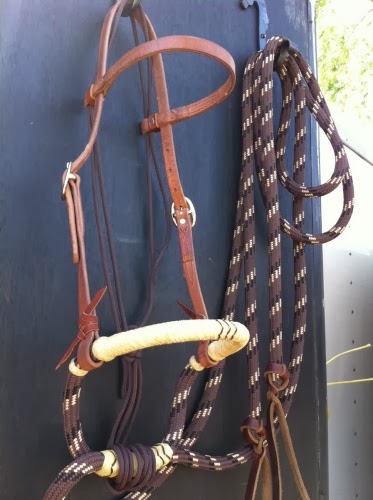
The Mecate is the rein portion of the horse tack, called the Hackamore. The Hackamore is a type of headgear for horse training. The unique part of the Hackamore is that it does not have a bit. It uses a braided noseband called a Bosal. The Bosal is a special type of noseband that works on pressure points on the horse's face, nose, and chin. The Mecate is a rope made from horse hair or soft feeling rope that serves as reins and lead rope.

The history of the Hackamore and Mecate goes all the way back to 4,000 BC. The first Hackamore was probably a piece of rope placed around the nose or head of a horse not long after domestication. These early devices for controlling horses may have been adapted from equipment used to control Camels. Over time, this means of controlling a horse became more sophisticated.

The Persians in 500 BC were one of the first to use a thick plaited noseband to help the horse look and move in the same direction. This was called a Hakma. On this Hakma was a third rein added at the nose, which allowed the rider to achieve more power from the horse. Later this third rein moved from the top of the noseband to under the chin, where it is still part of the modern Bosal style Hackamore with Mecate reins.

The Hackamore used in the United States came from the Spanish Vaqueros in California. From this, the American Cowboy adopted two different uses, the "Buckaroo" tradition closely resembling that of the original Vaqueros and the "Texas" tradition which blended some Spanish techniques with methods from the eastern states.


These types of Hackamores include the Bosal and side pull. The Bosal Hackamore uses the Vaqueros tradition of the braided noseband and the Mecate rope.

The Mecate is tied to the Bosal in a specialized manner that adjusts the fit of the Bosal around the muzzle of the horse and creates both a looped rein and a long free end that can be used for a number of purposes.


For the mounted rider, the free end is coiled and attached to the saddle or tucked under your belt. When the rider dismounts, the lead rein is not used to tie the horse to a solid object but used as a lead rope and a form of lunge line when needed.

The traditional Mecate used by the California Vaqueros was made from the long hair of a horse's tail and was hand braided. Modern Mecates are made with horse hair and synthetic rope with a horse hair tassel at one end and a leather popper at the other end.

A properly tied Mecate knot allows wraps of rope to be added to the knot in front of the rein loop in order to tighten the Bosal noseband on a horse or the rope can be unwrapped to loosen the Bosal.

This Vaquero style of Hackamore is used in Western Riding and is an indispensable part of the Vaquero way of making a California reined horse. It is also used with horses that have dental issues, where a bit would be painful. Some riders also like to use this style of Hackamore in the winter instead of a frozen metal bit.

Buckaroo Leather Products uses the influence of the Vaquero when creating the many styles of Hackamores and Mecates we have available. Buckaroo also offers many traditional "Old mexico" hand braided Rawhide Bosals.


Hand Woven 100% Alpaca Mecate Rein with the colors Summer Rose with Black and tan. The Alpaca fibers used in these Mecates are grown on a family ranch in South East Colorado. 


Complete Hackamore Set includes an all natural color beautifully hand braided 12 plait 5/8" Vaquero style, All rawhide core (no cable core) natural rawhide bosal.


 These are Braided in the old Vaquero tradition with a forelock tie, some of the finest braiding we have ever seen.


Mane Hair Mecate


Mane Hair Mecate 5/8" - 22' long, 6 Strand Braid.
Beautiful Quality hand braided feel and communication.


Mecate Rein with Leather Popper


This rein has a Nylon Mecate with Leather poppers. Available in 5/8" width and 23' length. This mecate is Perfect for the beginning stages of Horse training or everyday mecate use.


Buckaroo Leather Products has all your Hackamore, Mecate, and slobber strap needs. We have many styles to choose from and all are fashioned from the highest grade American Made leather, from Hermann Oak Leather. The quality of our horse tack can not be beat!! Proud to be American made!!


Our family has been dedicated for 30 years in serving the 
Western Horseman the safest most durable 
Quality American made leather horse tack....... Buckaroo John Brand Buckaroo Leather, The Brand to Demand 
Visit Our Unique Store Today 
Buckaroo Leather Shopping Site

Tuesday, January 27, 2015

Romel Reins A Vaquero Tool Popular Today


Romel reins are very popular in the equine world just as they were in the old days of the vaquero. The Vaquero used the romel reins for their horse training. 

The 3 stages of the Vaquero horse training were…

The 1st stage - starts with a hackamore bitless braided rawhide headstall to teach the horse to yield to pressure. The reins were long hand braided horse hair mecates.

The 2nd stage - or "Two Rein" is where the Vaquero would use a thinner simpler version of the hackamore nose piece, the bosal. This bosal was lighter for this part of the stage. The mecate bridle had a spade bit and a braided rawhide romel rein. During this stage of the training the Vaquero would hold both sets of reins and the horse would be controlled with mostly the bosal and light on the bit. Then the Vaquero would transition to only using the bit and would then get rid of the bosal all together.

The 3rd stage- is called the "Straight upon the Bridle". The Vaquero handles the horse with just the spade bit. The Bit is connected with romel reins. The bosal and mecate are used under the bridle to lead the horse.

The Vaquero use to test their horses skills by tying a thread to the links section of the chain part of the romel reins. The Vaquero would then bring the horse to a stop with a “light” pull of the reins. If the thread broke - the Vaquero needed to pull to hard.


Today, Horseman and women use the Romel Reins in horse training but they are also realizing what a great all around riding style rein they are.

They are like a one piece or roping rein with a ring or tie connector with a romel connected and a popper on the end.

Buckaroo Leather offers many types of Romel Reins in different types of leather and rawhide.


We have great everyday styles of Romel Reins with supple harness leather like the Rounded Romel Rein


We also offer a classic Vaquero style Romel Rein with hand braided rawhide buttons for decoration available in assorted colors and designs


Our family has been dedicated for 30 years in serving the 
Western Horseman the safest most durable 
Quality American made leather horse tack....... Buckaroo John Brand Buckaroo Leather, The Brand to Demand 
Visit Our Unique Store Today  
Buckaroo Leather Shopping Site

Tuesday, August 19, 2014

How to Fit the Very Popular Sidepull Bitless Headstall


Ultimate Padded Sidepull Headstall w/exotic hair on overlay


How to Fit the Very Popular Sidepull Bitless Headstall


To begin, we want to have a willing horse. By walking up and offering the Sidepull and allowing your horse to willingly put their head into the bridle should help get the process started. It also creates an understanding and ease between horse and rider. Wait for the queues from the horse to let you know they are ready to begin. What you want to do once the horse is ready is to adjust the side pull out very wide to get the Sidepull on. That way we can easily adjust it on the horse. You will want to ensure the wide nose band is not adjusted too low. This will cause irritation to your horses breathing and nasal passages. Once on and properly adjusted you want to understand the horses facial configuration. Some horses can be very narrow, other may have more prominent cheek bones, and that will affect how we want to adjust the jowel strap. Make sure you set the horse to their individual configuration. The jowl strap prevents the Sidepull from moving side to side when pulling on the reins, which can cause irritation as well.

Adjustment will really depend on the individual horse, and using your best judgement. You want to make sure of a few things: Ensure the nose band is not putting pressure on the nasal passages, and ensure you can get 2 fingers under the jowel strap, which is probably the most important piece for stability. You want the jowl strap to fall just below or at the horses cheek. The chin strap is not vital to stability, and really lends more to preference. The looser the chin strap the more freely the horse will be able to open and move their mouths.

The main concerns when adjusting your Sidepull are to ensure the noseband is not laying too low and properly adjusted above the nasal passages, that the jowel strap lands at or below the cheek bone and you can get two fingers underneath, and that you pay attention to the signs from your horse. They will tell you what needs to be adjusted and what may be irritating them. Once you have these steps down you are ready to ride!


(the above information is from an article on the Infohorse.com)


 Hermann Oak quality 5/8" Harness leather or Black latigo, flat leather nose, double stitched with soft chap lining; hand edged, rubbed and oiled for a soft supple feel. It features an adjustable throat latch, chin strap and additional jowel strap for more stability.


There are different noseband options for the sidepull available from Buckaroo Leather Products. The type you use depends on how much pressure you want to excerpt on your horses nose. The single lariat rope nose gives the most in a narrow area across the nose. The double rope spreads the pressure out. The flat leather nose gives the least amount of pressure for the more trained and experienced horse.

Buckaroo Leather Products has a great selection of these very popular headstalls. Bitless Sidepulls with rawhide noses, the Justin Dunn Bitless Sidepull, a rolled nose sidepull plus many more. We also offer the bitless sidepull headstalls in large and draft horse sizes, small horse, cob, pony, regular horse and mule sizes.  


 This is a Side Pull style with a width of 5/8". This Ultimate Headstall has a soft chap lining and is oiled for that soft supple feel. It has a flat leather nose with Braided Rawhide around the nose and is finished with Nickel or stainless hardware


 We are proud to work with Justin Dunn of Justin Dunn Mustang Horsemanship to bring you his proven designed signature Sidepull Headstall. Made from the finest quality heavy weight Hermann Oak Harness leather or Black Latigo for a smooth, rich, "broke in" feel. Oiled for that soft supple feel.


 Justin Dunn Sidepull - Draft horse size


The Buckaroo Ultimate sidepull Headstall is just that- THE BEST. Made from the finest heavy weight Latigo for a smooth, rich, "broke in" feel. This  Buckaroo Headstall is double and sewn with a soft chap lining, and oiled for that soft supple feel.


This Buckaroo Headstall is double and sewn with a soft chap lining, and oiled for that soft supple feel. Now with silver OKLAHOMA HAND ENGRAVED CONCHAS...  This Headstall is a bitless Side Pull style with a width of 5/8"


Buckaroo John, in the video below will demonstrate the SIDEPULL, aka "Bitless Bridle", its variations and the reasons to incorporate this useful piece of horse equipment.


 Play this How to Video on the Bitless Sidepull Headstall


Our family has been dedicated for 30 years in serving the 
Western Horseman the safest most durable 
Quality American made leather horse tack....... Buckaroo John Brand Buckaroo Leather, The Brand to Demand 
Visit Our Unique Store Today
Buckaroo Leather Shopping Site

Wednesday, December 11, 2013

Hot New Vintage Traditional Cowboy Style Leather Horse Tack from Buckaroo Leather


This week Buckaroo Leather Products has had a booth at the Wrangler National Finals Rodeo (NFR) in Las Vegas, Nevada.

Vintage Traditional Leather Horse Tack is back!! Cowboys and Cowgirls at the Cowboy Marketplace at Mandalay Bay Hotel love silver conchas and old west style cowboy leather horse tack. 

Take a look at our latest cowboy gear.....Vaquero style leather horse tack....rawhide.....silver.....and much more.....perfect gifts for that cowboy or cowgirl on your holiday shopping list!

Call Buckaroo John at 530-545-0139 or email buckaroojohn@sbcglobal.net if you are interested in any of the horse tack below.
 

Custom rawhide smokin' black hackamore set with 
soft black Latigo nose with tan accents to coordinate 
with the mecate and antique conchas. 
$279


This amazing American made leather Breast Collar is inspired by the old west style breast collars with large silver conchas.
$489


 All around Breast Collar tooled edge with silver conchas and stainless hardware. Beautiful medium oil honey bridle leather.  Your horse told me he or she wants it!
$159


Our newest black Hermann Oak harness with silver concha accent


Quality Leather Breast collars with Basket combo oak rose carving. Beautiful vintage silver conchas. 
$239 

Close up of the conchas


Oak acorn cowboy shaped slidear with vintage pico edge silver conchas. Start at $189 for silver plate and $299 for sterling silver


Traditional rawhide Riata 49'. Has a wonderful broke in feel. Excellent quality.
$425 


 Supple soft oiled harness with red stitch and antique conchas. 
Breast collar & bridle set.
$199


Quality leather headstalls with vintage traditional 
style silver conchas and buckles and rawhide accents (below)


Tear drop slidears (below) basic styles to traditional styles with silver conchas. Start at $59!


 Our new silver studded Breast Collar & headstall set. 2 piece set for $249.


Our family has been dedicated for 30 years in serving the 
Western Horseman the safest most durable Quality 
American made leather horse tack....... Buckaroo John Brand Buckaroo Leather, The Brand to Demand 
Visit Our Unique Store Today
Buckaroo Leather Shopping Site

Tuesday, November 19, 2013

The History of the Hackamore and Mecate


 Vaquero's

The Hackamore was used by the Vaquero's in the beginning for horse training. The Vaquero's quickly learned that this piece of horse tack was a must for every day riding too. Today the hackamore is wildly popular among the Natural Horseman and women and horse riders still true to the Vaquero ways.

The unique part of the Hackamore is that it does not have a bit. It uses a braided noseband called a Bosal. The Bosal is a special type of noseband that works on pressure points on the horse's face, nose, and chin. 


                      Cadillac Hackamore set with Fiador and Mecate


The mecate is the rein portion of the Hackamore.The Mecate is a rope made from horse hair or soft feeling rope. The mecate can act as a lead rope too.

The traditional Mecate used by the California Vaqueros was made from the long hair of a horse's tail and was hand braided. Modern Mecates are made with horse hair and synthetic rope with a horse hair tassel at one end and a leather popper at the other end.


The history of the Hackamore and Mecate goes all the way back to 4,000 BC. The first Hackamore was probably a piece of rope placed around the nose or head of a horse not long after domestication. These early devices for controlling horses may have been adapted from equipment used to control Camels. Over time, this means of controlling a horse became more sophisticated.

The Persians in 500 bc were one of the first to use a thick plaited noseband to help the horse look and move in the same direction. This was called a Hakma. On this Hakma was a third rein added at the nose, which allowed the rider to achieve more power from the horse. Later this third rein moved from the top of the noseband to under the chin, where it is still part of the modern Bosal style Hackamore with Mecate reins.


The Hackamore used in the United States came from the Spanish Vaqueros in California. From this, the American Cowboy adopted two different uses, the "Buckaroo" tradition closely resembling that of the original Vaqueros and the "Texas" tradition which blended some Spanish techniques with methods from the eastern states.


Bosal Hackamore Style

These types of Hackamores include the Bosal and side pull. The Bosal Hackamore uses the Vaqueros tradition of the braided noseband and the Mecate rope.

The Mecate is tied to the Bosal in a specialized manner that adjusts the fit of the Bosal around the muzzle of the horse and creates both a looped rein and a long free end that can be used for a number of purposes.

For the mounted rider, the free end is coiled and attached to the saddle or tucked under your belt. When the rider dismounts, the lead rein is not used to tie the horse to a solid object but used as a lead rope and a form of lunge line when needed.


A properly tied Mecate knot allows wraps of rope to be added to the knot in front of the rein loop in order to tighten the Bosal noseband on a horse or the rope can be unwrapped to loosen the Bosal.

This Vaquero style of Hackamore is used in Western Riding and is an indispensable part of the Vaquero way of making a California reined horse. It is also used with horses that have dental issues, where a bit would be painful. Some riders also like to use this style of Hackamore in the winter instead of a frozen metal bit.


Sidepull Headstall / Hackamore

The side pull Hackamore or headstall is a modern design inspired by the Bosal style. This style has a heavy noseband with side rings that attach the reins on either side of the head. This allows very direct pressure to be applied from side to side.


                             Loping Sidepull Hackamore


The noseband is made of leather, rawhide, or rope with a leather or synthetic strap under the jaw. It is held on by a leather or synthetic headstall.

Visit the Buckaroo Leather Website for our full collection of Hackamores......


Our family has been dedicated for 30 years in serving the 
Western Horseman the safest most durable 
Quality American made leather horse tack....... Buckaroo John Brand Buckaroo Leather, The Brand to Demand 
Visit Our Unique Store Today
Buckaroo Leather Shopping Site

Thursday, October 17, 2013

History of the Rawhide Riatas....the Vaquero's Rope


The Rawhide Riatas' History

The reata (or riata) was a long braided rawhide rope used by the early Mexican Vaqueros and was no doubt first introduced into Mexico by the Spanish conquerors.

Reata is from the Spanish word reatar, meaning to retie or a rope which ties one animal to another.


Though the word reata is often used to refer to any rope, the genuine Vaquero reata was and is a special item. It was usually 40 to 80 feet long and made from twisted strands of rawhide. The finest riatas used rawhide strands, cut by experts, from the primest part of several young heifer hides. The hides were well chosen and properly cured.

The Riatas are braided in 4, 6, or 8 strands. The 8 strand, if made by a top reatero, is a beautiful article and superb for light roping. For the average hard work on large stock, the 4 strand is the best. Diameters vary according to individual preference, but the 3/8 inch riata is the one most used.

A riata can be different stiffness's (called in roping circles: lays) depending on what type of rawhide is used. For instance, bull hide makes a very stiff rope for heel roping.

The Reateros (Spanish for "rope maker") were masters at the craft of braiding reatas and all other vaquero rawhide tools. Many of these tools were truly works of art. The braiding of the riatas was not only an art form but the braids had uniformity and even tension. This was to insure durable working tool for the Vaquero.


this is Jesse Wilkinson with rawhide riatas he crafted in 1930. 
He learned the art of rawhide braiding as a boy.


The riata was the most useful tool of the Californio Vaquero and he was highly proficient in handling it. The dexterity displayed by the Vaquero ropers impressed the early Americans cowhands and the riata was quickly adopted by them as were other items of equipment used by the vaquero. The riata can be thrown farther, with the use of less energy and retaining a more perfect loop, than any other type of rope on the market.

The Mexican way to treat a riata, to keep it supple, is to tie it between two trees. Then rub it first with lemon juice (cut a fresh lemon in two and rub the fruit along the length) and then rub it with beef fat (suet). This keeps the leather from drying out or becoming stiff. Using artificial products will make the reata too limber.


Old West Cowhands "Rope Talk"

Here is a brief list of some general rope terms used 
by the Old West Cowhands:

Lariat is an Americanization of la reata, Spanish for the rope

Reata is from the Spanish reata, meaning rope, but the American cowhands use it to designate a rawhide rope.

Reata men are hands who use a rawhide rope and they sometimes refer to this rope as a lass rope.

Roping terms used by the cowhands...

rope - to throw a rope,

roped - to have caught something with the rope

roping - the act of catching

looped - caught


Our family has been dedicated for 30 years in serving the 
Western Horseman the safest most durable Quality American made leather horse tack....... Buckaroo John Brand 
Buckaroo Leather, The Brand to Demand 
Visit Our Unique Store Today  
Buckaroo Leather Shopping Site

Wednesday, April 17, 2013

The Rawhide Reata a Work of Art and a Tool of the Vaquero


The Vaqueros of the old west were skilled horsemen who valued their horses and their rawhide horse tack. The Vaqueros had an arsenal of "tools" to assist them with their every day task on the range. One of these "tools" was the Rawhide Reata (or riata).

The word reata is from the Spanish word reatar, meaning to retie or a rope which ties one animal to another. The rawhide reata was a long braided rawhide rope used by the early Mexican Vaqueros and was no doubt first introduced into Mexico by the Spanish conquerors. Though the word reata is often used to refer to any rope, the genuine Vaquero reata was and is a special item. The reata was usually 40 to 80 feet long and was made from twisted strands of rawhide. The finest riatas used rawhide strands, cut by experts, from the primest part of several young heifer hides. The hides were well chosen and properly cured.

The Reateros (Spanish for "rope maker") were masters at the craft of braiding reatas and all other vaquero rawhide tools. Many of these tools were truly works of art. The braiding of the riatas was not only an art form but the braids had uniformity and even tension. This was to insure a durable working tool for the Vaquero.


The rawhide riata was the most useful tool of the Californio Vaquero and he was highly proficient in handling it. The dexterity displayed by the Vaquero ropers impressed the early Americans cowhands and the riata was quickly adopted by them as were other items of equipment used by the vaqueros. The riata can be thrown farther, with the use of less energy and retaining a more perfect loop, than any other type of rope on the market.

The Mexican way to treat the riata to keep it supple was to tie it between two trees. Then rub it first with lemon juice (cut a fresh lemon in two and rub the fruit along the length) and then rub it with beef fat (suet). This kept the leather from drying out or becoming stiff. Today, if you use an artificial product it will make the reata too limber.


 The Riatas of the old west and today are braided in 4, 6, or 8 strands. The 8 strand, if made by a top reatero, is a beautiful article and superb for light roping. For the average hard work on large stock, the 4 strand is the best. Diameters vary according to individual preference, but the 3/8 inch riata is the one most used today and in the old west. A rawhide riata can also be different stiffness's (called in roping circles: lays) depending on what type of rawhide is used. For instance, bull hide make a very stiff rope perfect for heel roping.

The rawhide reatas of the old west were a useful tool of the Vaquero. But, one may also look at them as a true work of art and craftsmanship.


Be apart of true Western Horsemanship at the Horsemen's Re-Union in Paso Robles, Ca. See our modern day horseman and horsewoman use their knowledge of the Vaquero's of the Old West to start 40 colts in 5 days.


The Horesmen's Re-Union is from April 15th-20th and Buckaroo Leather is attending this magnificent display of horsemanship.

 Buckaroo Leather Wagon at the Horsemen's Re-Union


Our family has been dedicated for 30 years in serving the Western Horseman the safest most durable Quality American made leather horse tack....... Buckaroo John Brand Buckaroo Leather, The Brand to Demand Visit Our Unique Store Today Buckaroo Leather Shopping Site