Showing posts with label old west history. Show all posts

Monday, January 4, 2016

First American Cowgirl


 The First American Cowgirl....Lucille Mulhall


Equally skilled with rifle, lariat and horse, a teenager from Oklahoma named Lucille Mulhall became America’s first cowgirl. Will Rogers wrote that Lucille's achievement in competition with cowboys was the 'direct start of what has since come to be known as the Cowgirl'. He continued to write, “there was no such a word up to then as Cowgirl”. It was coined to describe her after she beat dozens of cowboys in a 1904 cattle-roping competition that set world records.

Lucille Mulhall was born on October 21, 1885, in St. Louis, Missouri to Colonel Zack and Agnes Mulhall. Native American tribes still roamed the open grassland of the Mulhall Ranch when Lucille was growing up. Wolves prowled the prairie, preying on the Mulhall livestock. Cowhands were a vital part of ranching; roping, branding, round-ups and shooting were practical skills instead of pastimes. The little blonde girl with blue-gray eyes was an eager student for the ranch hands and cowboys who lived in the bunkhouses of the Mulhall spread. Lucille, instead of learning piano or sewing like her sisters, learned to toss a lariat and tie a steer. Lucille learned her horsemanship and skills from the Cowboys who rode the cattle drives of the Old West.


Lucille Mulhall was a cowgirl long before she entertained crowds with feats of horsemanship on Governor, her trained horse. By the age of 7, she was riding around her father’s 80,000-acre ranch. Cowboys who rode the plains of the Indian Territories tutored her in the art of lassoing. Zack Mulhall claimed that when his daughter was 13, he told her she could keep as many of his steers as she could rope in one day. Lucille, he bragged, didn’t quit until she lassoed more than 300 cattle! "By the age of fourteen,” the New York Times reported, "She could break a bronco and shoot a coyote at 500 yards.” Teddy Roosevelt was among Lucille’s fans. While campaigning in Oklahoma as a vice presidential candidate in 1900, Roosevelt first saw the blonde teenager perform. It was the Fourth of July, and Lucille roped in front of a crowd of 25,000 people at a "Cowboy Tournament.” The Daily Oklahoman reported, "Roosevelt was most enchanted with the daring feats of Lucille Mulhall.” "She rode beautifully throughout the contest and lassoed the wildest steer in the field.”

Teddy Roosevelt was so dazzled by the 14-year-old’s skills that he invited the Mulhalls to join him and a select group of Rough Rider veterans at a private dinner. That night Lucille gave the hero of the charge up San Juan Hill the silk scarf she had worn during the Cowboy Tournament.


When Zack Mulhall reciprocated the dinner invitation by asking Roosevelt to stay at his ranch, Teddy readily accepted. After watching Lucille’s daredevil antics on the ranch, Roosevelt encouraged her father to get her more exposure. "Zack, before the girl dies or gets married or cuts up some other caper,” Roosevelt reportedly said, "you ought to put her on the stage and let the world see what she can do.” During that same visit, Roosevelt spent time in the saddle riding alongside Lucille. He saw a gray wolf at a distance, which whetted his appetite for the hunt. The wolf eluded Roosevelt that day, but it didn’t escape Lucille. After Roosevelt left, she hunted down the predator. By one account, she dispatched it with a shot from her Winchester, but in another version she lassoed the creature and clubbed it to death. The pelt was sent to Roosevelt, who displayed it in the White House after he and McKinley won the presidential election that fall. Roosevelt later gave Lucille a saddle and an 1873 Winchester .44-40 that had been presented to him.

Lucille Mulhall, was the first well known cowgirl. She competed with 'real' cowboys - the range hardened cowboys accustomed to riding for days in the saddle; the cowboys who spent many hours branding cattle. Her expert roping skills were a natural talent honed by the skills of another natural roper - Will Rogers. She not only was an expert at using the lariat but she had a natural gift of working with horses. She trained horses to respond to the roping of a steer as well as how to perform a number of what she called 'tricks.' Her trained horses she called 'high schooled horses' and one was particularly famous: "Governor." She claimed her horse, Governor, knew at least forty tricks. He could pull off a man's coat and put it on again, could walk upstairs and down again, a difficult feat. He could sit with his forelegs crossed, could lie down and do just about everything but talk.


In 1904 Lucille competed against the best cowhands from across the Southwest in a roping contest at Dennison, Texas. In this competition she won a belt buckle, declaring her to be the World's Champion Lady Roper. She won three solid gold medals in Texas for steer roping, a trophy for winning a Cutting Horse contest as well as many other medals, trophies and honors. At the turn of the twentieth century Lucille Mulhall was American's greatest cowgirl.

While still in her early teens, Lucille was the top cowboy performer in the West. Extremely feminine, soft-spoken, and well educated, she seemed a paradox, for she was so steel-muscled she could beat strong and talented men at their own games. She could have been a society belle, but she loved the rough, dangerous life of a cowboy. Had she been a man, she would have been content to work on a ranch, but as a woman she was a novelty and the only way she could make use of her singular talents was in show business. The term cowgirl was invented to describe her when she took the East by storm in her first appearance at Madison Square Garden (in 1905). "Against these bronzed and war-scarred veterans of the plains, a delicately featured blonde girl appeared,” a 1905 New York Times profile intoned. "Slight of figure, refined and neat in appearance, attired in a becoming riding habit for hard riding, wearing a picturesque Mexican sombrero and holding in one hand a lariat of the finest cowhide, Lucille Mulhall comes forward to show what an eighteen-year-old girl can do in roping steers.”


In 3 minutes and 36 seconds, she lassoed and tied three steers. "The veteran cowboys did their best to beat it,” the New York Times reported, "but their best was several seconds slower than the girl’s record-breaking time. The cowboys and plainsmen who were gathered in large numbers to witness the contest broke into tremendous applause when the championship gold medal was awarded to the slight, pale-faced girl, and from that day to this Miss Mulhall has been known far and wide throughout the West as the Queen of the Range.”

Lucille had set a new world record. She won a gold medal and a $10,000 prize. Just as she had dazzled Teddy Roosevelt, Lucille now entranced journalists. Newspapers showered her with titles like "Daring Beauty of the Plains” and "Deadshot Girl,” but the one that stuck was "Original Cowgirl.”

Lucille’s career took her to Europe, where she performed for heads of state and royalty. She officially retired in 1917 at age 32. Live Wild West performances were being eclipsed by the rise of Hollywood westerns. Ironically, many of the stars of silent movies, including "King of the Cowboys” Tom Mix, got their start in Zack Mulhall’s Congress of Rough Riders. But as late as the 1930s, Lucille still did exhibition riding on the Mulhall Ranch.


Throughout her life, Lucille remained captivated by show business and more loyal to her father than to any other man. Her two marriages ended in divorce, and she rarely saw her son, born in 1909, because she was always on tour. Though Lucille was a top draw at Wild West shows and had run her own company, "Lucille Mulhall's Round-up," many people considered her an ineffective wife and mother because she had never learned to do "woman's work."

Although Wild West shows became less popular and less financially viable starting in the mid 1910s, Lucille and her brother Charley continued to perform in them through the 1930s. Show attendance dwindled, as did the number of performers. Despite the lack of publicity being given to wild west shows in the shadow of the polio epidemic, the United States' entry into World War I, and then the Great Depression, Lucille seemed unable to pull herself away from the limelight. She made her last known public appearance in September of 1940.


Lucille went back to work at her families ranch, which was located fourteen miles north of Guthrie, Oklahoma, on highway 77. The Mulhall ranch at one time encompassed 80,000 acres of land, much of which was unclaimed land. In addition some land was leased. The original ranch began with 160 acres claimed at the 1889 Oklahoma Land Opening. The Mulhall family operated their show and cattle business from this ranch and had many visitors. Some of their famous visitors were President Theodore Roosevelt, Will Rogers, Tom Mix and even the outlaw Henry Starr. Geronimo also was an admirer of Lucille's talent and gave her a beaded vest and a decorated Indian bow.

Lucille Mulhall died less than a mile from the Mulhall Ranch in an automobile accident on December 21, 1940. She was only 55 years old. In December 1975, she was posthumously inducted into the National Rodeo Hall of Fame.


Our family has been dedicated for 30 years in serving the 
Western Horseman the safest most durable 
Quality American made leather horse tack....... Buckaroo John Brand Buckaroo Leather, The Brand to Demand 
Visit Our Unique Store Today
Buckaroo Leather Shopping Site

Thursday, November 19, 2015

Old West Thanksgiving


Next week is Thanksgiving!!! An Old West Story of Thankfulness.......


This is a brief story of Mrs. Hulda Esther Thorpe-and her reason to be thankful!


A Close Call

In 1938, Mrs. Hulda Esther Thorpe remembers the dangers that settlers faced on the prairie in the 1800s, and the many reasons settlers had for giving thanks:

One of the best Thanksgiving dinners we ever knew of was when a family of settlers had their nice wild turkey dinner taken by the Indians, who came in silently and just shoved the folks back and eat it up. They did not harm the white people though and after they were gone the women made a big corn bread and with what few things the Indians left, they had a feast, the best as the daughter tells, that she ever eat. This was because they were so happy and thankful that the Indians spared them. This is one of many stories Mrs. Thorpe remembers from her pioneer childhood. To read more, in American Life Histories, 1936-1940, search on Hulda Esther Thorpe to find the document entitled, "Mrs. Hulda Esther Thorpe."


The Cowpuncher's Thanksgiving Rhymes of the Range

By L. Maynard Dixon
Sunset Magazine, November, 1903


Yearlin's


Now swing your rope—and swing 'er wide! It's brandin' time,—and it's time, you bet


To swing a big loop and to take yer ride,— Thank God, there's cows in the country yet!


Cut out that yearlin' and take a chance;— Show how you can ride. Bets up! I say


He'll burn the earth and he'll burn your pants. (We must have some sport Thanksgiving Day!)He's risin' high and he's landin' hard,— Stay with him, Bill! or it's gals good night!


If you can't stick him, a sure thing, pard, You'll land on the only rock in sight!


Now ride straight up—you must ride him fair. He's risin' high and he's landin' far!


Bet I can ride 'im and not pull hair,— Fer that's the kind of boy I are!


Our family has been dedicated for 30 years in serving the 
Western Horseman the safest most durable 
Quality American made leather horse tack....... Buckaroo John Brand Buckaroo Leather, The Brand to Demand 
Visit Our Unique Store Today  
Buckaroo Leather Shopping Site

Monday, October 19, 2015

Harvey Girls of the Old West


Harvey Girls Movie

When you think of the Wild West what comes to mind??? Cowboys, gunfights, saloon fights, lawlessness, gunslingers, and Harvey Girls???  And I am not referring to Judy Garland in the 1946 musical, "The Harvey Girls". 
A Harvey Girl was a waitress at the Harvey House restaurants in the American old west. These Harvey girls raised the bar on dinning and civilities in a time not necessarily know for either.
If you were traveling west by the railroad your only option for food along the way was at the roadhouses located by the railroads water stops. There you could find a meal of rancid meat, cold beans, and week-old coffee. Not necessarily appetizing. The need for the Harvey Houses was clear. 


The Harvey House chain of restaurants, hotels, and other hospitality industry businesses were owned by the Fred Harvey Company. The Harvey House's were situated alongside the Atchison, Topeka and Santa Fe Railways. Harvey opened his first depot restaurant in Topeka, Kansas. This first restaurant was so well received by the rail passengers, that the officials of the railroad allowed Harvey to build his eating establishments along the entire route. By the late 1880's, there was a Fred Harvey restaurant located every 100 miles along the Santa Fe line. Fred Harvey is credited with creating the first restaurant chain in the United States.
The success of the Harvey Houses was due to the strict standards for high quality food and first class service, by his Harvey Girls. Harvey was able to serve fresh quality food due to the Santa Fe Railroad agreeing to transport fresh meat and produce free of charge to any Harvey House on the railway line. The meals were not only fresh but were served in large portions on fine china with Irish linens. The prices for these delicious meals were quite reasonable, it has been suggested that the Harvey Houses originated the "blue-plate special". This was a daily low-priced meal served on a blue- patterned china plate. Along with the quality food, the Harvey Houses maintained a high level of custom service.


Through a series of signals between the Harvey Houses and the railroad the dinning room staff was able to feed an entire train in just thirty minutes. This dining staff included the waitresses called "Harvey Girls". 
 
The Harvey Girls were comprised of single, white, females that were well mannered, and educated. Harvey placed ads in the newspapers throughout the east coast and Midwest for "white, young women, 18 to 30 years of age, of good character, attractive and intelligent". The Harvey Girls were paid $17.50 a month plus room and board and tips. The recognizable black and white uniform was starched and consisted of a skirt that hung no more than eight inches off the floor. The uniform also consisted of an "Elsie" collar, opaque black stockings, and black shoes. The girls had their hair restrained in a net and tied with a regulation white ribbon. The Harvey Girls were not allowed to wear makeup or chew gum while working. The Harvey Girls strict dress code and conduct followed over to their personal lives.


Fred Harvey passed down this strict code of conduct. The Harvey Girls were expected to adhere to this code of conduct 24 hours a day. The girls were told what time to go to bed, whom to date, and even what to wear, including jewelry and makeup. Yet with all these restrictions, by the late 1950's over 100,000 girls had been hired.
The Harvey Houses and their Harvey Girls were a mainstay along the Santa Fe Railway. They brought a little civility and decorum to a harsh Old West.


Our family has been dedicated for 30 years in serving the 
Western Horseman the safest most durable 
Quality American made leather horse tack....Buckaroo John Brand Buckaroo Leather, The Brand to Demand 
Visit Our Unique Store Today  
Buckaroo Leather Shopping Site

Wednesday, March 18, 2015

Stories of the Old West and the Pionners.....Snakes!


The old west and American prairie are full of stories, legends, and lore. Some about cowboys and their courage, about cowgirls and prairie women strength, and of course Indians.

But have you heard about Snakes and Snake Lore.......

I came across some great stories of snakes and superstitions......


Indians believed that by killing a snake they would make the "other" snake tribes mad-so Indians did not kill snakes.......

So when the Pioneers and early settlers came to the old west there were a lot of snakes!!!

Pioneer women found the snakes to be a very large "inconvenience"- they were always showing up in their frontier home while cleaning the kitchen or under a bed. Here is a true story of one Pioneer woman's experience with her first rattlesnake....


"Returning from the woods one day with an armful of sticks, I saw a large snake lying across the path in front of my three year old daughter who was with me. I caught and pushed her behind me, then throwing down my sticks, picking out the largest as I did, I went for the snake. The stick was rotten and broke with my first stroke. It enraged the rattler. He coiled himself up on one side of the path, and, rearing his head two or three feet from the ground, ran out a red forked tongue and made such a noise with his rattles that my other daughter in our cabin nearby ran to the door to see what it was. 
 
Without taking my eyes off the snake I called to her to get the hoe. She ran around and came up behind us with it. Then, without moving from my tracks I took the hoe and made short work with his snakeship. We dragged him up to the house and cut off the rattles, sixteen in number, and measured him. He was over five feet in length and as large around as a man's arm."

(from the book "True Tales of the Old-Time Plains" by David Dary) 


There is another story told, about a boy who found a hole with a few snakes.....later he came back with his friend to the same hole and they found and killed 46 snakes. The boys told the other frontier men and they came back to investigate. The men dug a hole around the original hole and found more snakes.....1700 to be exact. They killed them all.....

The men kept on digging, hoping to find an end to the snakes, but it never came....at first the snakes were cowardly and timid, but as time went on the snakes started to fight back and become vicious. The men kept on. When the number of snakes dead reached 4,000 the men decided to pour blasting powder down the hole.....

Needless to say the remaining snakes were disposed of. The pioneer men reasoned that the hole they found led to a larger cavern in the depths of the earth. The believed that many thousands of snakes, from all over, gathered in this cavern for winter.


The old west stories and tales of the pioneer men and women are fascinating!! And I guess they can teach us a few lessons-

If you see a snake hole-let it be, who knows how many more snakes are down there!!!!!!!!


Our family has been dedicated for 30 years in serving
the Western Horseman the safest most durable
Quality American made leather horse tack.......Buckaroo John Brand
Buckaroo Leather, The Brand to Demand
Visit Our Unique Store Today
Buckaroo Leather Shopping Site

Wednesday, November 13, 2013

Rose Dunn Old West Outlaw????


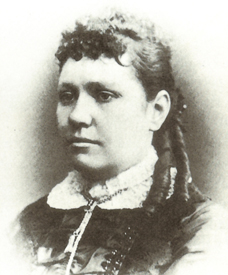
Rose Dunn, outlaw or rebellious teenager??? One may look back at Rose Dunn’s actions as just a young rebellious teenage girl in love, but history has called her an outlaw. Rose was an attractive young girl who was born in 1879 near Ingalls, Oklahoma. Even though she was from a poor family, she received a formal education at a convent in Wichita, Kansas.  Rose learned to ride, rope and shoot from her 2 older brothers who were minor outlaws when Rose was young. Through her 2 brothers, Rose met George "Bittercreek" Newcomb and it was "love at first site."
Rose or Rose of the Cimarron, as she was called by Newcomb, became romantically involved with him around 1893 when she was either 14 or 15 years old. Newcomb and his gang the Doolin-Wild Bunch Dalton gang worshiped Rose because of her good looks and her calm and kind demeanor. The gang was extremely protective of her and in turn she was especially loyal to them. Rose being completely infatuated by Newcomb began supporting him and his outlaw lifestyle by going into town for the gangs supplies since the law wanted all in the gang.

George "Bittercreek" Newcomb


While Rose was helping the Doolin-Wild Bunch Dalton gang and Newcomb, her 2 brothers left the outlaw life and became well known bounty hunters called the Dunn Brothers. Soon Rose's outlaw life would end too.
In 1893 in Ingalls, Oklahoma the Doolin-Wild Bunch Dalton gang was in George Ransom's saloon. Soon U.S. marshals surrounded the saloon demanding the outlaw’s surrender. Needless to say the gang did not go quietly. The gun battle started and quickly became an intense shootout; know today as the Battle of Ingalls. Now there is some speculation on whether this part of the story is true. It has been said that Newcomb was badly injured during the shootout. While he was lying in the streets, Rose ran from the Pierce Hotel to bring him two belts of ammunition and a Winchester Rifle. When she got to Newcomb she fired the rifle at the Marshals while Newcomb reloaded his revolvers and was able to escape. 


During the shootout 3 deputy Marshals were killed and Newcomb and Charley Pierce were wounded, but they both managed to escape. Newcomb, other members of the gang, and Rose hid out for at least two months. Rose nursed all the injured back to health. At this point there was a $5,000 bounty out for Newcomb, dead or alive.
Now, remember Rose's brothers were bounty hunters. On May 1895 Newcomb and another gang member, named Pierce came to visit Rose at her home. The Dunn Brothers shot both Newcomb and Pierce as they dismounted their horses in front of the house. Rose was later accused of setting the outlaws up by letting her brothers know when they were coming. The Dunn Brothers and Rose denied this fact. Rose was never prosecuted for her involvement with the gang. Rose's life of crime ended and she married a local politician and lived the remainder of life as a respectable citizen until her death at the age of 76.
Her rebellious teenage years or her life as an outlaw however you decide to look at it did one thing and that was to catapult her into the level of a western legend.


Our family has been dedicated for 30 years in serving the 
Western Horseman the safest most durable Quality 
American made leather horse tack....... Buckaroo John Brand 

Buckaroo Leather, The Brand to Demand 
Visit Our Unique Store Today
Buckaroo Leather Shopping Site

Tuesday, August 7, 2012

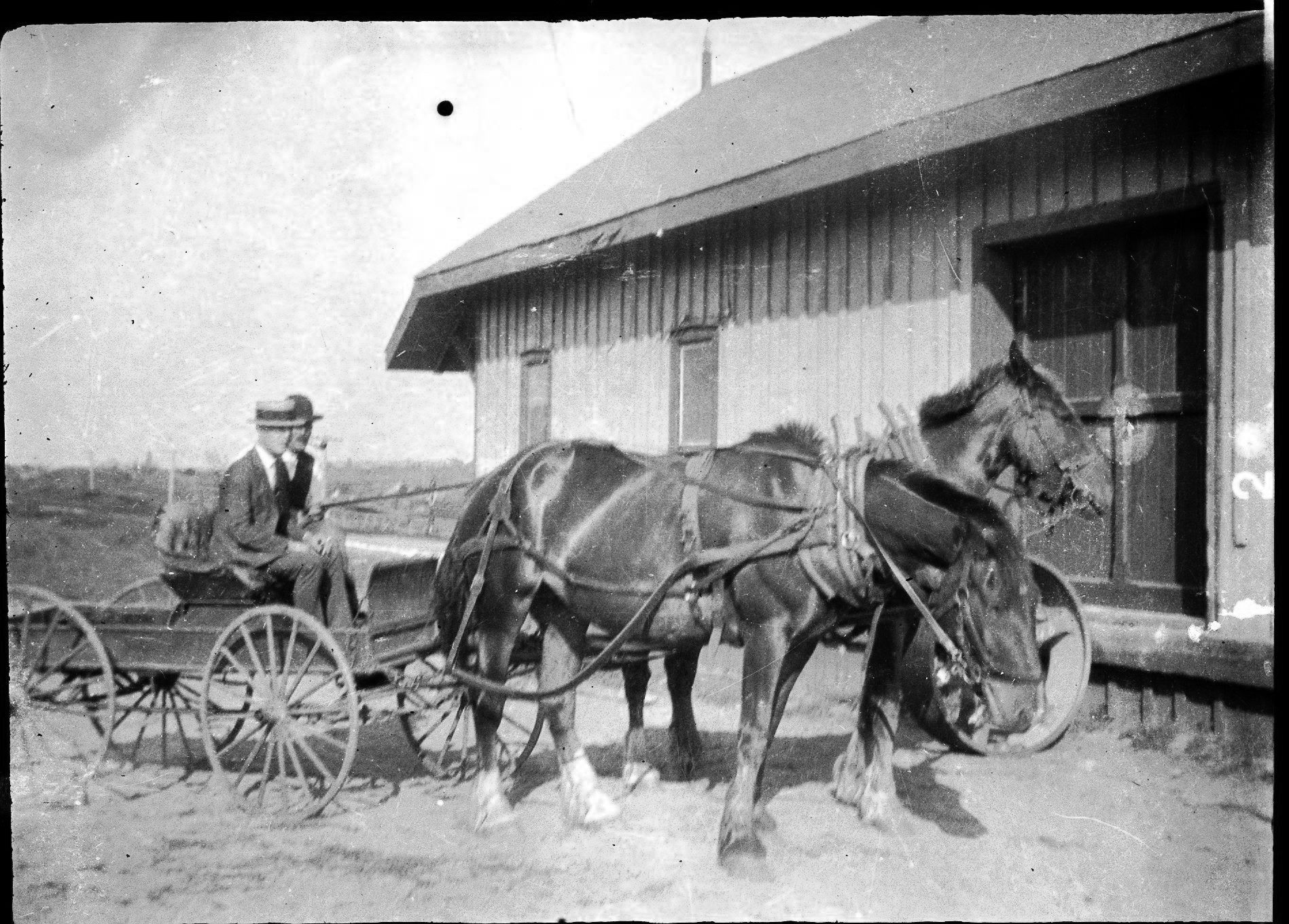
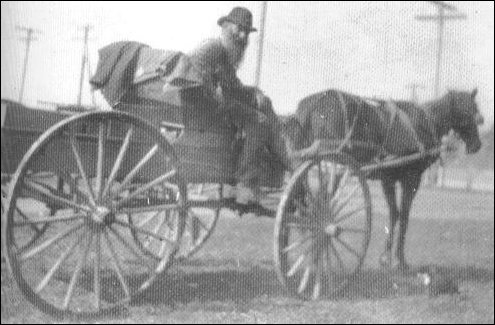
Buckboard Wagons..the farmers and ranchers work horse


The Buckboard wagons created in the 1800's were used by farmers and cowboys to transport themselves and supplies. But, what is a buckboard? The "buckboard" was the front most board on the wagon that acted as both a footrest and protection for the driver. The protection being from the horse's rear hooves in case of a "buck"- hence "Buckboard" wagon.


The buckboard wagon was simple, light, had four wheels and was uncovered. There were elastic, board slats extending from the front axle to the rear axle. The seats were placed upon these flexible boards. The boards were used instead of ordinary springs. If there were springs, they were placed between the board and the seat and not attached to the axles. There were no sides on the body of the wagon, just iron rails three or four inches high. These rails would help to hold in the supplies or other packages.

The buckboard wagon was pulled by a single horse or two horses. The wagon was steered by its front wheels which were connected to each other by a single axle. The wagon had two rows of seats, the back row could be taken off if the driver needed more hauling room.


It is believed that the Buckboard wagon was created in 1841 by Horace and James Buck. They lived in Portland, Oregon, but went to Europe to study wagon making (since that is where most of the wagons/carriages started). Horace and James came back to Portland with their new skills and start a carriage business and created the Buckboard wagon. 


Although, there is evidence to suggest that Horace and James created the buckboard wagon in South Carolina, where they eventually did most of their carriage business.

The buckboard wagon was a simple but sturdy all around work wagon. The farmers used it for supplies, fencing material, and transporting their families to and from town. The ranchers used the wagons for tools, ranch supplies, and animal supplies.

Much like today's ranchers and farmers with their favorite beat up old "pick up" truck, these buckboard wagons were the "pick up" trucks of the 1800's. Of course " horse power"  took on a whole other in meaning in the 1800's.


Our family has been dedicated for 30 years in serving the Western Horseman the safest most durable Quality American made leather horse tack....... Buckaroo John Brand Buckaroo Leather, The Brand to Demand Visit Our Unique Store Today Buckaroo Leather Shopping Site

Tuesday, July 17, 2012

Alice Ivers Tubbs....Not Your Typical Women of the West

 "Praise the Lord and place your bets. 
I'll take your money with no regrets.” 


No this quote is not from the famous poker player Johnny Chan but from Alice Ivers Tubbs. Alice Ivers Tubbs was more notably known as “Poker Alice”.

Alice Tubbs was born in Devonshire, England in 1851. When Alice was young her father, a schoolmaster, moved the family to Virginia. While living in Virginia Alice had a formal education at a boarding school. Then, when she was a teenager her family moved to Leadville, Colorado.

This is where her life would change and the name “Poker Alice” began. While she lived in Leadville Alice met Frank Duffield. Like most men in Leadville Frank worked in mining, he was an engineer. When Alice was 20, she was married to Frank.

Frank enjoyed the popular past time of most old west mining towns, gambling. So Alice, not wanting to stay at home went with her husband to the gambling halls. At first, Alice just watched and studied her husband. Soon, Alice was sitting at the poker table with her husband.


“Poker Alice” would soon have to use her new skills at the poker table to support herself. Her husband Frank was killed in a mining explosion. So she took to the poker tables to earn a living. She was skilled as both a player and a dealer. Her beauty, sophistication, and style made her a welcomed and popular player at all the gambling halls. The miners loved her charm and wit, and she loved their money!!

Simple Alice Tubbs from Virginia was transformed into “Poker Alice”. Poker Alice went from mining town to mining town puffing on a large black cigar and winning thousands. At one point she claimed to have one $250,000.

Poker Alice did not shy away from trouble either. She always carried a .38 revolver. On one occasion when a drunken miner threatened Tubbs with a knife, Alice pulled out her .38 and put a bullet into the miner's arm.

Her poker playing skills were becoming widely known throughout the west. So she took the road. She eventually went to New Mexico. While there she won $6,000 at the Gold Dust Gambling House. After staying in New York for a while Poker Alice finally ended up in Deadwood, South Dakota.


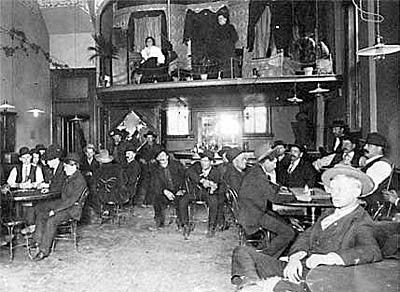
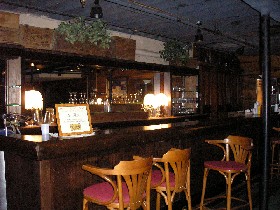
The Bodega Saloon Interior in Deadwood


Poker Alice would eventually marry again in Deadwood. She married Warren G Tubbs a painter. They met in a gambling hall, of course. After being married, Poker Alice moved to a ranch in Sturgis and raised her children.

She became a wife, mother and a rancher. This was a far cry from the gambling halls and the poker tables. She focused on her husband and her family for a while, until her husband was diagnosed with tuberculosis. Alice stayed by her husband’s side to try and nurse him back to health but to no avail. He died of pneumonia in the winter of 1910.

Poker Alice would soon emerge. To earn money for her family, Alice went back to her poker tables. Her life after this point is much of what you would expect, she was in and out of gambling halls and at one point she even owned a saloon with poker tables and lots of beautiful women. She eventually would wind up in jail (a few different times) for breaking up a fight with her .38 revolver.

At the age of 79, Alice underwent a gall bladder operation in Rapid City, but died of complications on February 27, 1930.


Our family has been dedicated for 30 years in serving the Western Horseman the safest most durable Quality American made leather horse tack....... Buckaroo John Brand
Buckaroo Leather, The Brand to Demand 
Visit Our Unique Store Today  
Buckaroo Leather Shopping Site

Tuesday, July 10, 2012

Charley Parkhurst a StageCoach Driver....With a Secret


 Writer and illustrator J. Ross Browne
holds tight as Charley Parkhurst drives the stage
.

  
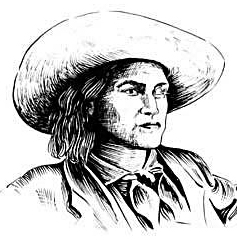
Charley Parkhurst lived an interesting life. He was a stagecoach driver, worked in a livery and was born Charlotte Darkey Parkhurst…yep Charley was a female!

Charlotte was born in Lebanon, New Hampshire about 1812. She was abandoned by her parents and was placed in an orphanage in Massachusetts. When Charlotte was a teenager she ran away from the orphanage and began working in a livery stable owned by Ebenezer Balch in Worcester.

Many people believe that Charlotte began her new identity as a male after her escape from the orphanage. It is not know exactly when the transformation occurred or what her movements were for about 20 years.

“Charley” debut as a stagecoach whip with help from Ebenezer Balch. She worked in Providence, Rhode Island for a while and then landed in Georgia. When She came back to Providence in 1849 she learned of the gold rush on the American River in northern California.

A stagecoach driver and friend of Charlotte’s, James Birch wanted to start up a stagecoach line from the goldfields to Sacramento. He promised her a job and they started on their way to California. The journey took six months. In 1851 she made her way to the goldfields and was employed by birch to drive coaches in the Mother Lode country.

In 1854 Birch organized the California Stage Company. Charlotte “Charley” was a chief driver for Birch. She was familiar with the entire Sierra Nevada foothill country. From Sacramento and Stockton to as far south as Monterrey. She ran the coach line from San Francisco to Oakland.

 One-Eyed Charley Parkhurst
 
As you can imagine many “legends” and stories came about from her journeys as a stagecoach whip in California.

One story involved a highwayman known as Sugarfoot. Sugarfoot had very large feet and used burlap sacks as shoes. Sugarfoot stopped Charlotte’s coach, stuck a shotgun in her face, and ordered her to throw down the strongbox. Charlotte did, but warned Sugarfoot, “Next time, I’ll be ready for you.”

Charlotte was, she started to wear six-shooters. A year later Sugarfoot and his gang stopped the coach again. But this time she began blazing away at them as they drew up on her coach. She flew down the trail and later when the posse returned to the site they found Sugarfoot dead and two of his gang wounded.

Charlotte was proud to say she never had a passenger suffer an injury while on her coach. She took her job very seriously and was at all times professional. She loved her horses, calling them beauties, and giving them lots of love and care. Charlotte was a good in a fight and put anyone in their place that mistreated horses or other animals in her presence.

In the 1860’s Charlotte retired from driving stagecoaches. She suffered an eye injury while shoeing a horse and had to wear an eye patch. She was then called “One-Eyed Charley”

                                           1889 Great Hot Springs in the Dakota Territory

In her retirement, she led a quiet life of raising cattle and growing vegetables. She died on her ranch from cancer. It was at this time when the physician who pronounced her at the ranch did the autopsy and found out Charlotte’s secret.

Well, the story of Charlotte’s secret life as a man spread like wildfire throughout the west. Her decades long masquerade as a man shocked and baffled many.

Even though she was only five feet seven inches tall, clean-shaven and spoke little, no one questioned her gender. She spoke with a “whiskey tenor” and often wore pleated shirts over over sized trousers and was never seen without her leather gauntlet-like gloves in public.  While on the road she slept in the stable with her horses and never bathed in public bathhouses. She also swore like a long-shore man, smoked cigars, and chewed tobacco.

She gave up a lot to live as a man. Her life was a lonely one she had no close friends or relationships for obvious reasons. So why live as a man? The reason is not know, but there is speculation that she became Charley to earn a decent wage and work at an occupation that offered excitement and challenge.


Between Christmas 1879 and New Year’s Day 1880 Charlotte was buried in the Odd Fellows Cemetery near Watsonville, California.  Rather an appropriate site for Charlotte, “Charley”…being such an “odd fellow”…


information from the book “Legends of the Wild West” by James A Crutchfield, Bill O’Neal and Dale L Walker


Our family has been dedicated for 30 years
in serving the Western Horseman the safest most durable 
Quality American made leather horse tack....... Buckaroo John Brand Buckaroo Leather, The Brand to Demand 
Visit Our Unique Store Today
 Buckaroo Leather Shopping Site

Thursday, September 1, 2011

Californio Vaquero Horse Training in the Old West


Californio Vaquero Horse Training in the Old West
The Californio Vaquero's prided themselves on their horsemanship and horse tack. They took great care too hand braid their horse hair mecates and romel reins. The Vaquero hand braiding techniques are still used today.
The rawhide bosals, riatas and quirts, headstalls, hackamores, are all part of the Vaquero "tool box" to train their horses.

The Vaqueros trained their horses for 7-10 years, starting at 4 years old, to react with very little pressure from the rider. At the end of training, the horse and rider would be one.

The 3 stages of the Vaquero horse training....

The 1st stage - starts with a hackamore bitless braided rawhide headstall to teach the horse to yield to pressure. The reins were long hand braided horse hair mecates.

The 2nd stage - called "Two Rein". The Vaquero would use a thinner simpler version of the hackamore nose piece, the bosal. This bosal was lighter for this part of the stage. The mecate bridle had a spade bit and a braided rawhide romel rein. During this stage of the training the Vaquero would hold both sets of reins and the horse would be controlled with mostly the bosal and light on the bit. Then the Vaquero would transition to only using the bit and would then get rid of the bosal all together.

The 3rd stage- is called the "Straight upon the Bridle". The Vaquero handles the horse with just the spade bit. The Bit is connected with romel reins. The bosal and mecate are used under the bridle to lead the horse.

This extensive training enabled the Vaquero to control the horse with little pressure. The Vaquero's horse was a skilled cattle horse and would be tested....

The Vaquero use to test their horses skills by tying a thread
to the links section of the chain part of the romel reins. The Vaquero would then bring the horse to a stop with a "light" pull of the reins. If the thread broke- the Vaquero needed to pull to hard.


Another way to show off their skills.....trying to rope Grizzlies!!!

Can you imagine the horsemanship skills and the communication of the horse and rider to stop and move in an instant to rope a Grizzly!!!!!

Our family has been dedicated for 30 years in serving the
Western Horseman the safest most durable
Quality American made leather horse tack.......Buckaroo John Brand
Buckaroo Leather, The Brand to Demand
Visit Our Unique Store Today

Buckaroo Leather Shopping Site

Wednesday, October 13, 2010

Old West Ghost Stories and Ghost Towns


With Halloween fast approaching- I felt some good old-fashioned ghost stories were appropriate!


I found some ghost stories about the cowboys, outlaws and towns of the old west, including Tombstone, Deadwood, and Jesse James.


Along the way I came across some Ghost Towns, Including Virginia City, Nevada-one the most “spirited” towns around! The old west tales of the town are lively and so are the Ghosts.


I have visited this town myself- and you can see and feel the history come alive!!!


Happy Halloween- Ride American!!!!


Tombstone

The Spirit of Marshal Fred White is reported to haunt the streets of Tombstone. Marshall White was accidentally shot by Cowboy faction leader, Curly Bill Brocius on October 28, 1880.


White, the first marshal of Tombstone, had gained the respect of the Clanton Gang, and in fact, had arrested "Cowboy” members on a number of occasions, rarely having any problems when doing so. In the early morning of October 28th, Curly Bill and several of his cohorts were making sport by shooting up the town.


When White went to disarm the gunman, a shot was accidentally fired, hitting White in the groin. Though, it was thought that he would make a full recovery, two days later he died. Today, he is said to haunt the street in front of the shooting site, which was an empty lot where the Bird Cage Theater was built a year later.


Deadwood

1876 saw the arrival of Seth Bullock and Sol Star to Deadwood, South Dakota. Moving their hardware store from Helena, Montana.


According to dozens of reports, Seth Bullock still continues to play host at his beloved hotel. All manner of strange occurrences have happened at the historic hotel according to both staff and guests. Reports include feelings of a strong paranormal presence inside several of the rooms and in the hallways of the second and third floors, as well as in Bully’s restaurant, and in Seth's Cellar (pictured below).


Others have reported actually seeing the tall ghostly figure of Bullock in various areas of the hotel, including the restaurant and the basement. Apparently Seth’s ghost wants to ensure that the staff is working hard, as paranormal events tend to increase when staff members stand idle, whistle or hum a tune. Plates and glasses have been known to shake and take flight in the restaurant, lights and appliances turn on and off by themselves and items are inexplicably moved by unseen hands.


Many guests have reported hearing their name called out by a male voice when no one is present, or have been tapped on the shoulder by unseen hands. Others have heard whistling and many report the sounds of footsteps in the hallways when no one is there.


In both the second and third floor rooms, guests have reported a number of strange occurrences including photographs that produce strange anomalies, alarm clocks that go off, even when they are unplugged, televisions that seemingly operate with unseen hands, cloudy figures seen in rooms and hallways, and even an antique clock, that hasn't functioned in years, that chimes of its own accord.


Bodie, California


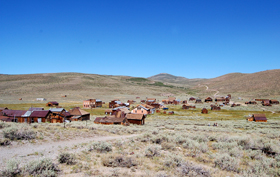
Legends about Bodie abound, including the Bodie Curse. Supposedly, if visitors take anything from this old ghost town – even a pebble, they will be cursed with bad luck. Misfortune and tragedy are heaped upon the victim until the stolen item is returned. According to Park Rangers, many who have taken things eventually return them to the park to rid themselves of this curse. Purportedly, the park maintains a logbook of pages and pages of returned items.


In the museum, you can see the letters from people who have returned items to the park. The curse is supposedly perpetuated by the ghosts of Bodie who guard against thieves and protect its treasures. Some believe that the "curse” is nothing more than a superstition perpetuated by the Park Rangers to preserve Bodie as a historic site.


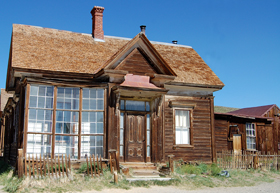
Other ghostly legends have seemingly occurred in this ghost town. The J.S. Cain house is said to be haunted by the ghost of a Chinese maid. Families of Park Rangers, who have occupied the house, describe the spirit, as not liking adults, but loves children.


Adults sleeping in the house have said that they will awake in the night to find the "heavy set” Chinese woman sitting on them. Feeling suffocated, one woman fought so hard that she ended up on the floor. Others have reported seeing the bedroom door opening and closing on its own.


The Gregory House is also said to be haunted by the ghost of an old woman. Guests and staff have reported seeing her sitting in a rocking chair, knitting an afghan. At other t

imes, the rocking chair has been seen rocking on its own accord.


Jesse James

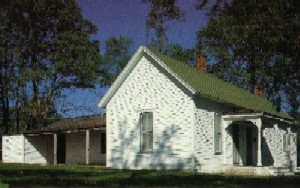
It should come as no surprise that the Jesse James Farm in Kearney, Missouri is said to be haunted. Given the violent temperament of some of its inhabitants, the untimely death of Jesse James, the violence that occurred on the property, and the tragic death of Jesse’s younger half-brother Archie.


Both Jesse and Frank James were raised in this house by their mother Zerelda, who was married to three different husbands and bore eight children. It was here that Jesse James was whipped as a teenager by Union militia who strung up his stepfather and burned nearby farms.


It was also here that Zerelda watched as her son Archie was murdered by Pinkerton detectives in an attack where she lost her right hand. After Jesse was killed, he was buried here, where she could protect the grave from trespassers or souvenir hunters. Later, his body was re-interred at the Mount Olivet Cemetery in Kearney.

The James Family Farm has said to have been haunted for more than a century. Evidently home to a number of lingering spirits, lights are said to move about both inside and outside of the property buildings. Others report hearing the sounds of pounding hooves, muffled shots and cries that are reminiscent of the area history, dating back to events of the Civil War.


Today, wide arrays of mysterious happenings occur in the house. Reports are frequent that lights are seen inside the building long after it has been locked up for the evening and movements are often seen which are never registered on a security monitoring system. Staff reports that feelings of a presence within the home are extremely intense. Others report that on foggy mornings, hushed voices and the sounds of restless horses can be heard from the nearby woods. However, when they follow up, there are no signs of a disturbance or tracks within the trees.


Virginia City, Nevada


Old Washoe Club

The Old Washoe Club is said to be the most haunted location in

Virginia City. A saloon occupies the lower level and has for many years. The second floor used to be The Millionaire's Club. The third floor was previously used as a brothel.


Ghosts known to haunt this location include a man dressed in black, a lady dressed in blue, and a small child. There is also the ghost known as Lena, who has been experienced all over the building. The Old Washoe Club has been featured on different TV shows including Ghosts Hunters.


Silver Queen Hotel & Casino

The story of the ghost at the Silver Queen Hotel & Casino is a sad one. A female spirit from the 1800's still lingers on there. The story goes that she was pregnant and waiting for her boyfriend to come back, but he never returned. She was so upset, that she committed suicide.


Virginia City Visitor's Center

The Virginia City Visitor's Center, located on C Street, across the street from the Ponderosa Saloon and Mine, was once a two story, dried goods stores. It is currently the home of the spirit of a little girl. The identity of the little girl is unknown.


The Chapin Boarding House

Originally built in 1862 by Samuel Chapin, the Chapin Boarding House was one of the finest boarding houses in all of Nevada. Today it sits vacant, for sale. People who enter the building complain of an uneasy feeling.


Gold Hill Hotel

Built in 1859, the Gold Hill Hotel is the oldest operating hotel and saloon in the state of Nevada. It is located just outside of Virginia City. Visitors arriving to Virginia City from either the Lake Tahoe or Reno areas pass by this small town en route to Virginia City. It is also a stop on the 35 minute train tour of the Virginia and Truckee Railroad tour.


At least two ghosts are said to reside here. First, there is William, a firefighter who died in the Yellow Jacket fire. Guests at the hotel have been known to smell his pipe tobacco. He particularly hangs out in room # 5 and has repeatedly awakened guests at 3:00 o'clock in the morning by shaking the bed.


There is also the ghost of Rosie. Rosie is believed to be a previous housekeeper who enjoys moving guests' keys around. A visitor can know when Rosie is present by the smell of old fashioned rose petals.


More Haunted Locations in Virginia City

There are many additional haunted locations in Virginia City such as The Red Dog Saloon, the Mackay Mansion, and Piper's Opera House. In fact, it seems like just about all of the old, historical buildings have a ghost or two, which is why Virginia City is considered the most haunted city in Nevada.


The Dunlop House, Virginia City, and employees stand in front of the building, approximately 1890 (pictured above)


Our family has been dedicated for 30 years in serving the
Western Horseman the safest most durable
Quality American made leather horse tack.......Buckaroo John Brand
Buckaroo Leather, The Brand to Demand
Visit Our Unique Store Today
Buckaroo Leather Shopping Site

Wednesday, August 4, 2010

Deadwoods' Famous Characters

Deadwood, South Dakota a mining town with a notorious history. Even more notorious were it's people. Seth Bullock, Al Swearengen, Sol Star, Wild Bill Hickok, Calamity Jane, Charlie Utter to name a few. Here is a brief history of Al Swearengen and Seth Bullock-

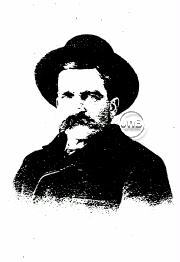
Seth Bullock
Seth Bullock was born at Sandwich, Ontario, Canada on July 24, 1847 and came to the United States about 1867-8, locating at Helena, Montana. According to various census records, his father George, a retired British Major living in Canada. His mother was Agnes Findley who was born in Scotland.

Seth had at least three sisters ( Agnes, Jessie and Alma) and a brother. Lieut. Frederick F. Kislingbury married Seth's sister Agnes in 1867. Kislingbury was an explorer who died with Greely's expeditition to the North Pole. Agnes died in 1878, and Frederick Kislingbury married her sister, Jessie.

In the 1870 U.S. Census the then 22-year-old Seth Bullock was living with a grocer and his family in Helena, Montana. Seth's occupation was listed as "auctioneer."

Seth was quickly chosen a member of the Montana legislature, after moving to that state. The Seventh & Eighth Sessions of the Montana legislature, held at the capital city of Virginia, from December 4, 1871 to May 8, 1873 under Benjamin F. Potts, governor, notes among the Members of the Council: "Seth Bullock - Lewis and Clark and Jefferson counties."

Seth Bullock married Martha [Marguerite] Eccles in 1874 in Salt Lake City. She was born about 1849 in Ohio, with her parents being both born in Pennsylvania. In 1876 Seth took his wife and children to Michigan, where they stayed while he traveled to Deadwood to set up a business.Seth and Martha Bullock had three children: Margaret ("Madge"), born about 1876 in Montana; Florence ("Floy"), b. October 3, 1878 in Tecumseh, Michigan; and Stanley, born October 1, 1880 in Lawrence Co., SD .

Seth was engaged in hardware and mining supplies business. After the gold discovery in the Black Hills, with his partner, Sol Star, he moved his stock to Deadwood, arriving there August 2, 1876. In 1880 Seth, his wife Martha, and two daughters, "Madge" and "Floy," were living in Deadwood, South Dakota. Seth was a hardware merchant at this time.

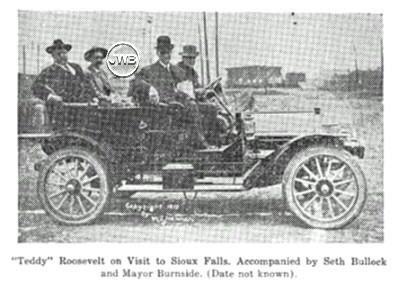
Seth Bullock was made sheriff of the provisional government in what is now known as South Dakota. He was also sheriff of Lawrence County after its organization and rendered effective service in clearing out the rough element. When Theodore Roosevelt was ranching in North Dakota [Theodore Roosevelt was a Deputy Sheriff from Medora, North Dakota around that time] they formed a close friendship, which lasted through life.

As President of the United States, Roosevelt appointed Bullock U.S. Marshall for South Dakota. Captain Bullock promoted and built the fine monument to Roosevelt that stands upon Mount Roosevelt, a few miles north of Deadwood.

In South Dakota there are two men who claimed the distinction of having introduced alfalfa into the state, namely Seth Bullock of the Black Hills region in the western part of the state and W.W. Bell of Valley Springs, in Minnehaha County. It is claimed that Bullock introduced it in 1881, while Mr. Bell claimed to have introduced it from Stockton, California in 1879.

In 1888, Seth Bullock of Lawrence Co. was a member of the Republic Central Committee in South Dakota.

Seth was a Spanish American War Veteran, who served starting about 1898. In 1920 his widow, Martha, applied for his pension. He was a captain in the 3rd Regiment of the U.S. Cavalry.

Seth Bullock died September 23, 1919, at his home in Deadwood, South Dakota after an illness of several weeks (of cancer) and is buried in Mount Moriah Cemetery in Lawrence County, South Dakota


Ellis Albert "Al" Swearengen

Born Oskaloosa, Iowa, July 8, 1845 – died Colorado, 1904) He was a pimp and early entertainment entrepreneur in Deadwood, South Dakota, running the Gem Theater, a notorious brothel, for 22 years, and combining a reputation for brutality with an uncanny instinct for forging political alliances.

Swearengen and his twin brother, Lemuel, were two of ten children of Daniel Swearengen and Keziah (often called Katie) Swearengen of Oskaloosa. Unlike so many of Deadwood's residents who left home at a young age to make their fortunes on the wild frontier, Swearengen remained at home well into his adult years, arriving in Deadwood in May, 1876 with his wife, Nettie Swearengen.

Nettie would later divorce him on the grounds of spousal abuse, and Swearengen would marry two more times, both marriages ending as the first.

Swearengen was one of the first Deadwood residents not to be a prospector or miner; he represented the beginning of a second wave of residents, attracted there by the promise of riches to be stripped not from the earth, but from the prospectors and miners.

(In the picture above Al Swearengen is the third from the right behind the bar)

He built a small saloon called the Cricket Saloon, which featured as entertainment in its close spaces local miners engaged in what were advertised as "prize fights", although no prizes were actually awarded. Within a year, Swearengen had accumulated enough money to build the much larger and more opulent Gem Variety Theater, which opened on April 7, 1877, featuring the now traditional "prize fights" in addition to stage shows, and, mainly, prostitution.

The Gem bought in an average of $5,000 a night, sometimes as much as $10,000 (between $140,000 and $280,000 inflation adjusted for 2009). When it burned down along with much of the town on September 26, 1879, Swearengen rebuilt it larger and more opulent than ever, to great public acclaim. Swearengen's talent for canny alliances and financial payoffs kept him insulated from the general drive to clean up the town, including the otherwise successful work of Seth Bullock, until the Gem burned down once again in 1899.

He remarried the same year to Odelia Turgeon. It appears that the Methodist church in Deadwood - which also took a moralist crusade to clean up the town - specifically targeted the Gem Theater. According to his recently rediscovered obituary, Albert Swearengen was found dead in the middle of a suburban Denver street on November 15, 1904. He apparently died of a massive head wound and was not hopping a freight train as is often reported.


Our family has been dedicated for 30 years in serving
the Western Horseman the safest most durable Quality
American made leather horse tack.......Buckaroo John Brand
Buckaroo Leather, The Brand to Demand
Visit Our Unique Store Today
Buckaroo Leather Shopping Site