Showing posts with label horses. Show all posts

Saturday, February 27, 2016

Mounted Shooting a Family Affair at Silver Dollar Ranch


 Lawson Family


If you go to Leann Berry Lawson’s Facebook page you may see quotes like:


 “This young lady just won a CMSA (Cowboy Mounted Shooting Association) Major! Ladies Level 2 Division Winner! Congratulations Rylee Lawson!! 
We are SO happy and proud of you!!!!!!


or

 “Smokin fast! Well... Not as fast as Dylan P Lawson !!!! He beat his dad! Dylan took first place in the limited division! He won $400.00 and a new Pistol!”


Leann is very proud of her children!  She should be!  It is exciting to see these two youths have such passion and drive!! Congrats to Leann and Kenny for fostering their passion!!!!


 Rylee, Dylan and Madi

Leann and her Husband Kenny Lawson of Silver Dollar Ranch are not just proud parents but they are skilled horse trainers and mounted shooting competitors. The Silver Dollar Ranch offers horse training, riding lessons and training horses for Cowboy Mounted Shooting. Kenny is a third-generation horse trainer. Kenny’s father, Rob Tanner, who was a World Champion and Hall of Fame trainer, was Kenny’s biggest influence. From a very young age, Kenny worked for his dad learning how to train one of the most complex breeds of horses, the American Saddle-bred. Kenny has the ability to educate horses without taking their curiosity from them.


 Kenny Lawson


All of Kenny’s training programs are based on a philosophy of mutual respect between horse and rider. He has solutions for horses with aggressive ground manners, to trailer loading issues or, for the competitor that would like to perform at the next level. Kenny also trains horses for many different disciplines. There are weekends where he, his family and clients will compete in Western Dressage on a Saturday and Mounted Shooting on a Sunday, all on the same horses. Kenny believes that a well-educated horse should be able to compete in many sports and activates. 


Leann Berry


Buckaroo Leather is proud to be apart of the Silver Dollar Ranch family! We our honored to have Kenny and the whole family not only endorse but use Buckaroo Leather's Saddle and Horse Tack. 

Visit the newly created Kenny and Leann Lawson category on the Buckaroo Leather website here.


Be sure to visit the Silver Dollar Ranch website and connect with them on Facebook. The Lawson family is also involved in the Valley Center Vaqueros. They are a family oriented equestrian club with activities for all ages. Visit the Vaquero facebook page here.


Our family has been dedicated for 30 years in serving the Western Horseman the safest most durable Quality American made leather horse tack....... Buckaroo John Brand Buckaroo Leather, The Brand to Demand Visit Our Unique Store Today Buckaroo Leather Shopping Site

Monday, February 1, 2016

Old West Cowboy Valentines Poem


Valentine's Day is just around the corner. Here is a traditional old west Cowboy poem for your sweetie! 
Remember Cowboys' needs were simple!!!!


A love Poem

My horse is brown,
my dog’s name is Blue.
I feel so lucky to
have someone like you.
Your hair is like cornsilk
blowing in the breeze.
It’s softer than Blue’s
without all the fleas.
Cut from good cloth
like my best longjohns,
You pluck chickens all day
and still sing sweet songs.
I think I’m in love,
and I’m tickled pink.
We go together like, a skunk goes with stink


Our family has been dedicated for 30 years in serving the 
Western Horseman the safest most durable 
Quality American made leather horse tack....... Buckaroo John Brand Buckaroo Leather, The Brand to Demand 
Visit Our Unique Store Today  

Wednesday, January 20, 2016

Mecate, Bosal, Hackamore Vaquero Tack


 Vaquero Horse Tack, Mecate, Bosal and Hackamore


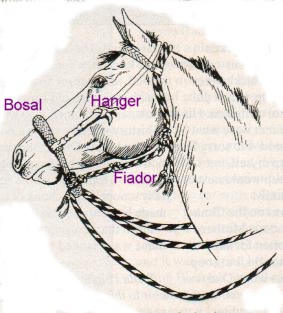
The Mecate is the rein portion of the horse tack, called the Hackamore. The Hackamore is a type of headgear for horse training. The unique part of the Hackamore is that it does not have a bit. It uses a braided noseband called a Bosal. The Bosal is a special type of noseband that works on pressure points on the horse's face, nose, and chin. The Mecate is a rope made from horse hair or soft feeling rope that serves as reins and lead rope.

The types of Hackamores include the Bosal and side pull. The Bosal Hackamore uses the Vaqueros tradition of the braided noseband and the Mecate rope.


 100% Alpaca Mecate
$100

The Mecate is tied to the Bosal in a specialized manner that adjusts the fit of the Bosal around the muzzle of the horse and creates both a looped rein and a long free end that can be used for a number of purposes.  

For the mounted rider, the free end is coiled and attached to the saddle or tucked under your belt. When the rider dismounts, the lead rein is not used to tie the horse to a solid object but used as a lead rope and a form of lunge line when needed.


 AAA Bosalitos Vaquero Style
 $249


The traditional Mecate used by the California Vaqueros was made from the long hair of a horse's tail and was hand braided. Modern Mecates are made with horse hair and synthetic rope with a horse hair tassel at one end and a leather popper at the other end.

A properly tied Mecate knot (please view the how to video here) allows wraps of rope to be added to the knot in front of the rein loop in order to tighten the Bosal noseband on a horse or the rope can be unwrapped to loosen the Bosal.


 Black Beauty Concha Hackamore
$259


 Cadillac Hackamore Set with Fiador and Mecate
$395


Our family has been dedicated for 30 years in serving the 
Western Horseman the safest most durable 
Quality American made leather horse tack....... Buckaroo John Brand Buckaroo Leather, The Brand to Demand 
Visit Our Unique Store Today  
Buckaroo Leather Shopping Site

Tuesday, January 12, 2016

Ed Bohlin Saddle Maker to Hollywood


 Eddie Bohlin


Eddie Bohlin ran away from home in Orebro, Sweden at age fifteen, hoping to find an apprenticeship as a silversmith. He was unable to find a position and instead worked his way to America on a four-masted schooner, arriving in New York in 1910. As he had been raised with horses, he headed for Montana, where he soon found his first job as a wrangler, rounding up more than nine hundred horses to be sold in Miles City, then the horse trading capital of the world.

For several years Bohlin worked as a cowboy on long cattle drives, both on horseback and as a hand on the freight trains that took cattle to the Chicago stockyards. Bohlin had an aptitude for art, this inspired him to attend the Art Institute in Minneapolis for four months. There he learned the basic concepts that later results in his artistic masterpieces.

Bohlin opened his first silver and saddle shop in Cody, Wyoming, just across the street from Buffalo Bill Cody's Irma Hotel. It was in this shop that he created his first fancy silver-mounted cowboy gear.

While in Billings, Montana, on a buying trip for his shop, an event occurred that changed his life. Billboards around town advertised a vaudeville performance with live horses on the stage, for which he purchased a ticket. Bohlin recognized one of the act's performers from one of his earlier cattle drives and was introduced by him to the show's manager. When Bohlin showed the manger some of his rope tricks that he had picked up along the way, he got hired. The vaudeville act, no matter how small-time, eventually gave Bohlin an unexpected break.

In Los Angeles, while performing at the new Pantages Theatre in 1922, Bohlin heard a loud voice call out from the audience, "Hey kid! What do you want for the coat?" The fellow had spotted Bohlin's coat of black, white and tan calfskin that he had made for himself. "Thirty-five dollars," Bohlin yelled back. When he returned the following night, the coat was gone from his dressing room and in its place was a thirty-five dollar check with Tom Mix's picture and name on it.


 Tom Mix


In those days the cowboy star Tom Mix (1880-1940) was one of Hollywood's most popular actors. Mix asked his friend and business associate, Pat Christman, to invite Bohlin to the studio and to bring some silver and leather goods with him. Tom Mix quickly purchased various items, including the silver decorated boots Bohlin was wearing at the time, for seventy-five dollars. Mix strongly encouraged him to stay on in Hollywood to produce silver and leather items for the studio market.

With this exciting encouragement, Bohlin immediately gave two weeks' notice to the vaudeville troupe's owner and started looking for a place to set up shop. He was fortunate enough to persuade the First Baptist Church in Hollywood to rent him part of their building on the corner of Cahuenga and Selma Avenues.


 Bohlin's personal show saddle (above) and bridle (below)
 both photos from Western Horseman Mag. May 1962


The rapid success of his business soon required him to move the shop to larger quarters. He occupied a series of addresses on Cahuenga and Selma Avenues, and hired many skilled leather workers and silversmiths to augment his own skills and vision.
 

Tom Mix, his first great customer and friend in Hollywood, was joined by many other film stars, who assured Bohlin of a built-in clientele. This connection with the studios quickly brought him the job of supplying the Egyptian-style chariot harnesses for Cecil B. DeMille's "The Ten Commandments," in 1923, and twenty Roman-style chariot harnesses for MGM's 1925 production of "Ben Hur." Another early studio job was supplying two hundred buckskin suits for Universal's 1923 movie "The Days of Daniel Boone." This order alone came to more than four thousand dollars, a huge sum in those days.


Bohlin's relationship with Tom Mix coincided with the beginning of the era of the super fancy movie cowboy, and his skills were matched by Hollywood's demands for spectacular goods in the Western style. In addition to the early custom work he made for Tom Mix, he produced a richly mounted custom saddle, bridle and breast collar for Buck Jones, and a pair of pistols inlaid with gold and silver for William S. Hart.


picture from Western Horseman Mag. May 1962
 

Soon, every successful Western star had to have Bohlin equipment for personal appearances, parades and the movies themselves. Bohlin's movie cowboy customers over the next thirty years would include Ray "Crash" Corrigan, Ken Maynard, Rex Bell, Will Rogers, Leo Carillo, Monte Montana, Monte Hale, Gene Autry, Charles Starrett, William Boyd (Hopalong Cassidy), Roy Rogers, Dale Evans, Clayton Moore (the Lone Ranger), and Ronald Reagan.

One of Bohlin's custom saddles was owned by two popular and durable Western actors. Ray "Crash" Corrigan (1902-1976) ordered a special saddle and tack from Bohlin in 1938 which he used in about forty movies. Corrigan appeared in dozens of Westerns and starred with John Wayne in twenty-four episodes of the 1930s serial "The Three Mesquiteers."


Although the fancy saddles Bohlin designed for cowboy stars provided him with great publicity, his stock designs sold to private horsemen were probably his greatest source of day-to-day income. The most luxurious of these made the movie saddles seem understated by comparison. One of the most spectacular of his stock saddles was the "Fiesta" model. In addition to its elaborately tooled leather, the saddle was heavily mounted with chased and engraved silver openwork plates and conchas, and further adorned with eighteen three-color gold steers' heads with ruby-colored gemstone eyes and other gold ornaments.

Understandably the "Fiesta" model was very expensive. Requiring more than six weeks of work, its list price in the 1941 catalog was $1,255. In 1941 the average cost of a new automobile was $925. (Bohlin's most expensive stock saddle in the 1941 catalog was the "P.K. Wrigley" model. With all of its matching tack, the saddle's list price was $5,750.)


picture from Western Horseman Mag. May 1962


Bohlin also designed and produced nearly ninety percent of the hundreds of silver-mounted parade saddles used in the Tournament of Roses Parade in Pasadena, California. In all, between 1923 and 1980, the Bohlin Shop designed, produced and sold more than twelve thousand saddles, most of which were extensively adorned with sterling silver ornamentation.

Unquestionably the most spectacular and unique example of his artistry was his very own parade saddle, lovingly fabricated with gold and silver over a fourteen-year span and finally completed in 1945. The seventy-pound saddle has gold and silver relief carvings that depict in minute detail scenes of western life and game animals of the Pacific Slope. When completed it was considered the most expensive parade saddle in the world with a value in excess of $125,000. Gene Autry later purchased it for an undisclosed sum. It is now in the collection of the Autry Museum of Western Heritage in Los Angeles.

After more than fifty years in the trade, the old master finally semi-retired in 1972. His longtime employee, Bud Phillips, ran the shop for him. Bohlin later suffered a stroke that left him paralyzed until his death on 28 May 1980.


Our family has been dedicated for 30 years in serving the 
Western Horseman the safest most durable 
Quality American made leather horse tack....... Buckaroo John Brand Buckaroo Leather, The Brand to Demand 
Visit Our Unique Store Today 
Buckaroo Leather Shopping Site

Monday, January 11, 2016

Rope Talk of the Old West Cowhands


Old West Cowhands "Rope Talk"


Here is a brief list of some general rope terms used by the Old West Cowhands:
 

Lariat is an Americanization of la reata, Spanish for the rope
 

Lasso is the lazo, meaning in Spanish a noose or snare.
 

Lazo reata is a Spanish term meaning snare rope.
 

Catch rope, throw rope, saddle rope, grass rope, twine, whale line, hard twist, lass rope, and rope are all used to designate a catch rope.
 

Reata is from the Spanish reata, meaning rope, but the American cowhands use it to designate a rawhide rope.
 

Reata men are hands who use a rawhide rope and they sometimes refer to this rope as a lass rope.
 

Roping terms used by the cowhand are, rope, meaning to throw a rope, roped, meaning to have caught something with the rope, roping the act of catching and looped meaning caught.


Our family has been dedicated for 30 years in serving the 
Western Horseman the safest most durable 
Quality American made leather horse tack....... Buckaroo John Brand Buckaroo Leather, The Brand to Demand 
Visit Our Unique Store Today  
Buckaroo Leather Shopping Site

The Reata Rope used by the Californio Vaqueros


The reata (or riata) was a long braided rawhide rope used by the early Mexican Vaqueros and was no doubt first introduced into Mexico by the Spanish conquerors.
 

Reata is from the Spanish word reatar, meaning to retie or a rope which ties one animal to another.
 

Though the word reata is often used to refer to any rope, the genuine Vaquero reata was and is a special item. It was usually 40 to 80 feet long and made from twisted strands of rawhide. The finest riatas used rawhide strands, cut by experts, from the primest part of several young heifer hides. The hides were well chosen and properly cured.

The Riatas are braided in 4, 6, or 8 strands. The 8 strand, if made by a top reatero, is a beautiful article and superb for light roping. For the average hard work on large stock, the 4 strand is the best. Diameters vary according to individual preference, but the 3/8 inch riata is the one most used.

A riata can be different stiffness's (called in roping circles: lays) depending on what type of rawhide is used. For instance, bull hide makes a very stiff rope for heel roping.


The Reateros (Spanish for "rope maker") were masters at the craft of braiding reatas and all other vaquero rawhide tools. Many of these tools were truly works of art. The braiding of the riatas was not only an art form but the braids had uniformity and even tension. This was to insure durable working tool for the Vaquero.
 

The riata was the most useful tool of the Californio Vaquero and he was highly proficient in handling it. The dexterity displayed by the Vaquero ropers impressed the early Americans cowhands and the riata was quickly adopted by them as were other items of equipment used by the vaquero. The riata can be thrown farther, with the use of less energy and retaining a more perfect loop, than any other type of rope on the market.

The Mexican way to treat a riata, to keep it supple, is to tie it between two trees. Then rub it first with lemon juice (cut a fresh lemon in two and rub the fruit along the length) and then rub it with beef fat (suet). This keeps the leather from drying out or becoming stiff. Using artificial products will make the reata too limber.


Our family has been dedicated for 30 years in serving the 
Western Horseman the safest most durable 
Quality American made leather horse tack....... Buckaroo John Brand Buckaroo Leather, The Brand to Demand 
Visit Our Unique Store Today  
Buckaroo Leather Shopping Site
Tuesday, January 5, 2016

Dog Collars to Match Your Horse Tack


Dog Collar and Leash Scalloped Set with Silver


Did you know that Buckaroo Leather can create a custom dog collar and leash too match your other 4 legged friend…your horse!!!!

Buckaroo Leather uses the same quality leather from Hermann Oak Leather that are tanned in the USA to create your dog collar and leash. 


Buckaroo Leather prides itself in making quality leather horse tack and dog collar/leashes right here in America!!


Western Dog Collar and Leash Set


Western Dog Collar and Leash Set


And as a side note a little interesting history on dog collars. In ancient Greece dog collars were used more to protect the dogs. Farm dogs wore spike studded collars and sheepdogs wore a leather collar studded with nails. These studs protected both dogs from being bitten in the neck by a wolf.


An interesting fact is that sheepdogs needed to be white, so they could be seen at night. While the farm dogs had to be black, so they could be concealed to surprise intruders.


In the Middle Ages, dogs were used as hunters and shepherds. Their dog collars used were made from simple leather for boar and hare hunting.

In Europe, during the Renaissance, owners used plain dog collars, but added rings for leashes and name tags.


Our family has been dedicated for 30 years in serving the 
Western Horseman the safest most durable 
Quality American made leather horse tack....... Buckaroo John Brand Buckaroo Leather, The Brand to Demand 
Visit Our Unique Store Today  
Buckaroo Leather Shopping Site

Monday, January 4, 2016

First American Cowgirl


 The First American Cowgirl....Lucille Mulhall


Equally skilled with rifle, lariat and horse, a teenager from Oklahoma named Lucille Mulhall became America’s first cowgirl. Will Rogers wrote that Lucille's achievement in competition with cowboys was the 'direct start of what has since come to be known as the Cowgirl'. He continued to write, “there was no such a word up to then as Cowgirl”. It was coined to describe her after she beat dozens of cowboys in a 1904 cattle-roping competition that set world records.

Lucille Mulhall was born on October 21, 1885, in St. Louis, Missouri to Colonel Zack and Agnes Mulhall. Native American tribes still roamed the open grassland of the Mulhall Ranch when Lucille was growing up. Wolves prowled the prairie, preying on the Mulhall livestock. Cowhands were a vital part of ranching; roping, branding, round-ups and shooting were practical skills instead of pastimes. The little blonde girl with blue-gray eyes was an eager student for the ranch hands and cowboys who lived in the bunkhouses of the Mulhall spread. Lucille, instead of learning piano or sewing like her sisters, learned to toss a lariat and tie a steer. Lucille learned her horsemanship and skills from the Cowboys who rode the cattle drives of the Old West.


Lucille Mulhall was a cowgirl long before she entertained crowds with feats of horsemanship on Governor, her trained horse. By the age of 7, she was riding around her father’s 80,000-acre ranch. Cowboys who rode the plains of the Indian Territories tutored her in the art of lassoing. Zack Mulhall claimed that when his daughter was 13, he told her she could keep as many of his steers as she could rope in one day. Lucille, he bragged, didn’t quit until she lassoed more than 300 cattle! "By the age of fourteen,” the New York Times reported, "She could break a bronco and shoot a coyote at 500 yards.” Teddy Roosevelt was among Lucille’s fans. While campaigning in Oklahoma as a vice presidential candidate in 1900, Roosevelt first saw the blonde teenager perform. It was the Fourth of July, and Lucille roped in front of a crowd of 25,000 people at a "Cowboy Tournament.” The Daily Oklahoman reported, "Roosevelt was most enchanted with the daring feats of Lucille Mulhall.” "She rode beautifully throughout the contest and lassoed the wildest steer in the field.”

Teddy Roosevelt was so dazzled by the 14-year-old’s skills that he invited the Mulhalls to join him and a select group of Rough Rider veterans at a private dinner. That night Lucille gave the hero of the charge up San Juan Hill the silk scarf she had worn during the Cowboy Tournament.


When Zack Mulhall reciprocated the dinner invitation by asking Roosevelt to stay at his ranch, Teddy readily accepted. After watching Lucille’s daredevil antics on the ranch, Roosevelt encouraged her father to get her more exposure. "Zack, before the girl dies or gets married or cuts up some other caper,” Roosevelt reportedly said, "you ought to put her on the stage and let the world see what she can do.” During that same visit, Roosevelt spent time in the saddle riding alongside Lucille. He saw a gray wolf at a distance, which whetted his appetite for the hunt. The wolf eluded Roosevelt that day, but it didn’t escape Lucille. After Roosevelt left, she hunted down the predator. By one account, she dispatched it with a shot from her Winchester, but in another version she lassoed the creature and clubbed it to death. The pelt was sent to Roosevelt, who displayed it in the White House after he and McKinley won the presidential election that fall. Roosevelt later gave Lucille a saddle and an 1873 Winchester .44-40 that had been presented to him.

Lucille Mulhall, was the first well known cowgirl. She competed with 'real' cowboys - the range hardened cowboys accustomed to riding for days in the saddle; the cowboys who spent many hours branding cattle. Her expert roping skills were a natural talent honed by the skills of another natural roper - Will Rogers. She not only was an expert at using the lariat but she had a natural gift of working with horses. She trained horses to respond to the roping of a steer as well as how to perform a number of what she called 'tricks.' Her trained horses she called 'high schooled horses' and one was particularly famous: "Governor." She claimed her horse, Governor, knew at least forty tricks. He could pull off a man's coat and put it on again, could walk upstairs and down again, a difficult feat. He could sit with his forelegs crossed, could lie down and do just about everything but talk.


In 1904 Lucille competed against the best cowhands from across the Southwest in a roping contest at Dennison, Texas. In this competition she won a belt buckle, declaring her to be the World's Champion Lady Roper. She won three solid gold medals in Texas for steer roping, a trophy for winning a Cutting Horse contest as well as many other medals, trophies and honors. At the turn of the twentieth century Lucille Mulhall was American's greatest cowgirl.

While still in her early teens, Lucille was the top cowboy performer in the West. Extremely feminine, soft-spoken, and well educated, she seemed a paradox, for she was so steel-muscled she could beat strong and talented men at their own games. She could have been a society belle, but she loved the rough, dangerous life of a cowboy. Had she been a man, she would have been content to work on a ranch, but as a woman she was a novelty and the only way she could make use of her singular talents was in show business. The term cowgirl was invented to describe her when she took the East by storm in her first appearance at Madison Square Garden (in 1905). "Against these bronzed and war-scarred veterans of the plains, a delicately featured blonde girl appeared,” a 1905 New York Times profile intoned. "Slight of figure, refined and neat in appearance, attired in a becoming riding habit for hard riding, wearing a picturesque Mexican sombrero and holding in one hand a lariat of the finest cowhide, Lucille Mulhall comes forward to show what an eighteen-year-old girl can do in roping steers.”


In 3 minutes and 36 seconds, she lassoed and tied three steers. "The veteran cowboys did their best to beat it,” the New York Times reported, "but their best was several seconds slower than the girl’s record-breaking time. The cowboys and plainsmen who were gathered in large numbers to witness the contest broke into tremendous applause when the championship gold medal was awarded to the slight, pale-faced girl, and from that day to this Miss Mulhall has been known far and wide throughout the West as the Queen of the Range.”

Lucille had set a new world record. She won a gold medal and a $10,000 prize. Just as she had dazzled Teddy Roosevelt, Lucille now entranced journalists. Newspapers showered her with titles like "Daring Beauty of the Plains” and "Deadshot Girl,” but the one that stuck was "Original Cowgirl.”

Lucille’s career took her to Europe, where she performed for heads of state and royalty. She officially retired in 1917 at age 32. Live Wild West performances were being eclipsed by the rise of Hollywood westerns. Ironically, many of the stars of silent movies, including "King of the Cowboys” Tom Mix, got their start in Zack Mulhall’s Congress of Rough Riders. But as late as the 1930s, Lucille still did exhibition riding on the Mulhall Ranch.


Throughout her life, Lucille remained captivated by show business and more loyal to her father than to any other man. Her two marriages ended in divorce, and she rarely saw her son, born in 1909, because she was always on tour. Though Lucille was a top draw at Wild West shows and had run her own company, "Lucille Mulhall's Round-up," many people considered her an ineffective wife and mother because she had never learned to do "woman's work."

Although Wild West shows became less popular and less financially viable starting in the mid 1910s, Lucille and her brother Charley continued to perform in them through the 1930s. Show attendance dwindled, as did the number of performers. Despite the lack of publicity being given to wild west shows in the shadow of the polio epidemic, the United States' entry into World War I, and then the Great Depression, Lucille seemed unable to pull herself away from the limelight. She made her last known public appearance in September of 1940.


Lucille went back to work at her families ranch, which was located fourteen miles north of Guthrie, Oklahoma, on highway 77. The Mulhall ranch at one time encompassed 80,000 acres of land, much of which was unclaimed land. In addition some land was leased. The original ranch began with 160 acres claimed at the 1889 Oklahoma Land Opening. The Mulhall family operated their show and cattle business from this ranch and had many visitors. Some of their famous visitors were President Theodore Roosevelt, Will Rogers, Tom Mix and even the outlaw Henry Starr. Geronimo also was an admirer of Lucille's talent and gave her a beaded vest and a decorated Indian bow.

Lucille Mulhall died less than a mile from the Mulhall Ranch in an automobile accident on December 21, 1940. She was only 55 years old. In December 1975, she was posthumously inducted into the National Rodeo Hall of Fame.


Our family has been dedicated for 30 years in serving the 
Western Horseman the safest most durable 
Quality American made leather horse tack....... Buckaroo John Brand Buckaroo Leather, The Brand to Demand 
Visit Our Unique Store Today
Buckaroo Leather Shopping Site

Friday, October 16, 2015

How to Video by Richard Winters and the Buckaroo Loping Hackamore


How To Video on the Buckaroo Leather Loping Hackamore 
by Richard Winters of Richard Winters Horsemanship


Thank you to Richard Winters for this great video!!! 
Richard Winters of  Richard Winters Horsemanship demonstrates  the Bitless Loping Hackamore from Buckaroo Leather.

Horseman and Clinician Richard Winters has been helping people through training, clinics, horse expos and horse training DVD’s and videos for over thirty years. Richard is a performance horse trainer with a natural horsemanship touch. From reined cow horses to jumping and dressage, Richard’s horsemanship is universal. 


This is our quality AMERICAN made western Hermann oak leather hackamore Loping soft nose bridle you hear about from the cutters, reiners, natural horsemanship trainers, all wanting some relief for their horses from the bit! We are honored that world known clinicians Richard Winters (www.wintersranch.com) and Mark Rashid (www.markrashid.com) uses this bridle on their own horses during clinics. This bridle is a must have for anyone wanting to use a bitless bridle for some bit relief. With many horse riders using this hackamore full time!
This is a round soft nose rope caveson hackamore designed to give relief from the bit and around your horse's nose and, because it is round, it works like a sidepull/hackamore combo. The rein and caveson are all one piece of marine yacht rope with a leather wrap under the chin binding it all together. It Does not slip or tighten under the chin!! 
You can also choose to add the Rawhide or soft chap leather to the nose for a firmer feel and control. The rein is a split rein 8' long with leather poppers.  or long LOOP one-piece rein.
The bridle features our working 5/8" harness leather double cheek adjustment headstall with a hand braided fiador (throat latch), which is adjustable to hold the hack in the proper position. Reins are 5/8"- 8' Nylon marine yacht rope with leather poppers.
- See more at: http://buckarooleather.com/shop/bosals,-hackamores-rawhide-gear/a-loping-soft-nose-hackamore-detail#sthash.Rv8fb91x.dpuf
This is our quality AMERICAN made western Hermann oak leather hackamore Loping soft nose bridle you hear about from the cutters, reiners, natural horsemanship trainers, all wanting some relief for their horses from the bit! We are honored that world known clinicians Richard Winters (www.wintersranch.com) and Mark Rashid (www.markrashid.com) uses this bridle on their own horses during clinics. This bridle is a must have for anyone wanting to use a bitless bridle for some bit relief. With many horse riders using this hackamore full time!

See more here and purchase


This is our quality AMERICAN made western Hermann oak leather hackamore Loping soft nose bridle you hear about from the cutters, reiners, natural horsemanship trainers, all wanting some relief for their horses from the bit! We are honored that world known clinicians Richard Winters (www.wintersranch.com) and Mark Rashid (www.markrashid.com) uses this bridle on their own horses during clinics. This bridle is a must have for anyone wanting to use a bitless bridle for some bit relief. With many horse riders using this hackamore full time!
This is a round soft nose rope caveson hackamore designed to give relief from the bit and around your horse's nose and, because it is round, it works like a sidepull/hackamore combo. The rein and caveson are all one piece of marine yacht rope with a leather wrap under the chin binding it all together. It Does not slip or tighten under the chin!! 
You can also choose to add the Rawhide or soft chap leather to the nose for a firmer feel and control. The rein is a split rein 8' long with leather poppers.  or long LOOP one-piece rein.
The bridle features our working 5/8" harness leather double cheek adjustment headstall with a hand braided fiador (throat latch), which is adjustable to hold the hack in the proper position. Reins are 5/8"- 8' Nylon marine yacht rope with leather poppers.
- See more at: http://buckarooleather.com/shop/bosals,-hackamores-rawhide-gear/a-loping-soft-nose-hackamore-detail#sthash.Rv8fb91x.dpu


Our family has been dedicated for 30 years in serving the 
Western Horseman the safest most durable 
Quality American made leather horse tack...Buckaroo John Brand Buckaroo Leather, The Brand to Demand 
Visit Our Unique Store Today 
Buckaroo Leather Shopping Site

Thursday, September 10, 2015

Equestrian Acts of the Old West Circus


Circuses were an important part of the old west culture in the 1800s.

Cowboys coming from the dusty cow trails, frontier men after a long work week and miners who were looking to forget there long hard day in the mine came to town looking for excitement and entertainment.

Circuses provided much needed entertainment for all. They had acts like wild animal menageries, clowns, acrobats, trapeze artists, tightrope walkers, brass bands, performing elephants and equestrians who could stand on horseback as they galloped around a center ring.


The circuses date back to Mexican times when shows based on European models came up from the South into California and the southwest around the middle of the 19th century. Circus troupes from the East began to reach settlements in the more accessible regions of Kansas and Nebraska. They traveled in horse drawn wagons over atrocious roads.

By 1880s when railroads had eased the difficulties of transportation, the circus came into its own as the greatest show in the West.

One of those shows was the John Rowe & Co. Pioneer Circus. Here is an excerpt from an article written about the show-


(From the book-“Men of the West-Life on the American Frontier” by Cathy Luchetti)

“ by far the most extensive and elegant organized equestriene establishment that ever appeared in CA…Traveling through the state at an expense of fifteen thousand dollars a month as an added incentive, the seats are carpeted, and attentive and gentlemanly ushers to wait on ladies and family."


The John Rowe & Co. Pioneer Circus was based in San Francisco, Ca and traveled extensively throughout California. As mentioned before, one of the circus acts was the equestrians who could do acrobatics on horseback.


Below is a glimpse into a typical equestrian performance at the Pioneer Circus.

The main acts of the Pioneer Circus were the equestrian events. At show time the audience was treated to all the spectacle and finery the troupe could provide. One of these spectacles was Miss Mary Ann Whittaker, the first female equestrian artist in America. She was ranked among the best in ballet and pantomime. She would ride out into the sawdust-covered ring standing on her milk white horse in pink tights and ruffles with stars and spangles. Then to the amazement of the crowd as she neared a ribbon held in her path 12 feet high by two colorful clowns, she would leap up off the horse and over the ribbon and then land gracefully onto the horses back all while it was speeding around the circus ring. The applause was thunderous and it continued through the evening. Other riders rode in pyramids on two horses with three riders stacked neatly on top of one another while still others did forward and backward flips through rings of fire.

For these amazing acts to work the horses and riders went through hours of rigorous training some of which is not what you would expect. While the horses went through their paces the grooms would carelessly kick cans about the ring, fire guns, and even tie five-gallon cans to the horse's tail! This was all done in training to teach the horse not to sway from its paces for anyone but its trainer. Timing was everything in the ring. An acrobatic rider doing a back somersault would not like it much if he came down from his leap only to find the horse spooked by a child with a firecracker and not be in his appointed spot.


The Circuses not only used their horses for entertainment, but for hauling all the equipment, animals, and performers in wagons. The travel was hard and taxing on all. Between the roads, or lack of, and the weather it made getting from one town to the next very eventful.

Usually the circus would only be able to cover two or three miles in an hour. Many of the stops were 10 to 15 miles apart and a rider would go ahead and mark the forks in the road with a rail so the caravan would go the right way.

Perhaps the worst occurrence would be after getting little or no sleep, fighting their way through a drenching rainstorm, pulling out and repairing wagons, and then hearing the word "lost." This of course meant retracing steps and going through all the problems again.

Rowe's Pioneer Circus played the mountain camps and towns until August when due to expenses they were forced to return to San Francisco. Before leaving they had played Yankee Jim, Iowa Hill, Illinois Town, Dutch Flats, Red Dog, Grass Valley, Rough and Ready, Nevada, Orleans Flat, Oroville, Horsetown, Marysville, Monk Hill, Railroad Flat, West Point, Chinese cap and Columbia.

I can just imagine the excitement of the circus coming to these prairie towns and watching the thrilling acts of the equestrian acrobatics.


Our family has been dedicated for 30 years in serving the Western Horseman the safest most durable Quality American made leather horse tack....... Buckaroo John Brand 
Buckaroo Leather, The Brand to Demand
Visit Our Unique Store Today Buckaroo Leather Shopping Site

Wednesday, August 5, 2015

Horses at Disneyland


 The Disneyland Monorail 1959


“If there’s anything to this reincarnation stuff, I’d like to come back to Disneyland as a horse someday!”…this is a quote from an officer from the Society for the Prevention of Cruelty to animals who had just finished an inspection at Disneyland. (taken from the Western Horseman magazine)


While cleaning out a closet, I came across some old Western Horseman magazines and one in particular caught my eye. It was the issue from September 1957. 


There was a fascinating article about the horses at Disneyland.

 I took a few photos of some of the pictures in the article and decided to write a quick blog about them. 

The stagecoach (pictured below) was one of many ways a visitor could ride around the Rainbow Desert in Frontier Land. 


They could also choose to ride a Conestoga Wagon or the pack mule train. (below)


In 1957 Disneyland maintained about 200 head of horses. The horses and the ponies were kept in individual toe stalls. The mules and burros had their own corrals and lots. The animals at Disneyland worked no more than 4 hours a day six days a week.

Disneyland also had a full time Farrier by the name of Charles Heumphreus on hand. To oversee the horse operations, Disney hired Mr and Mrs Owen Pope. They manufactured and repaired all the harnesses and horse tack for the horses. Owen was widely known for trailers he manufactured in Ft. Worth.

This is a great photo (below) of the horses all dressed up for the Easter Parade. Disneyland ordered 10 new Easter bonnets especially made for the horses at a total cost of $150.


Here is a close up of the Disneyland Horse and the decorative bridle. This picture is from 1959.


Our family has been dedicated for 30 years in serving the Western Horseman the safest most durable Quality American made leather horse tack....... Buckaroo John Brand Buckaroo Leather, The Brand to Demand Visit Our Unique Store Today Buckaroo Leather Shopping Site

Tuesday, July 28, 2015

New Light Weight Saddle at Buckaroo Leather


This Saddle has a new option of the Slick Fork Wade Style 
(like the above photo) 
or the All Around Style (like the photos below)


Are you looking for a light weight quality ranch saddle that will not break your wallet???

Buckaroo Leather has found a gem of a light weight saddle. It is a Diamond M Wade Saddle, designed by McCall saddles for Diamond M. This saddle is not only light weight, less than 24lbs, but durable and tough. It is comfortable for both horse and rider and it is easy to saddle.

This saddle feels like a feather compared to other Wades!

This ranch saddle uses a new Kevlar Tree. This innovative tree is made from foam and E-Glass creating a light weight and Extremely strong Tree! What is Kevlar? Kevlar fibers are 43 percent lighter than typical fiberglass, 10-times stronger than aluminum, and literally five-times stronger than steel.


All the trees have a ground seat built into the tree making the seats consistent and comfortable!

These saddles are assembled in China but the quality and lightness of this saddle are great for the horseman or women who want an affordable Wade Saddle. Skilled American craftsman helped them all through the production of these saddles.


The cost of this saddle is $1075.

Available in 14, 15 and 16" seats.

Gullet: Quarter Horse 6 1/2" wide x 7 1/2" high
-Cheyenne 2" Cantle: 4" high x 13" wide
-Wade Lite Style Horn: 3" x 3"

The Tree has a 100% lifetime warranty


These saddles are available for immediate delivery and are in Placerville Ca. just give John a call at 530-545-013 
or see more information here.....


Our family has been dedicated for 30 years in serving the 
Western Horseman the safest most durable 
Quality American made leather horse tack....... Buckaroo John Brand Buckaroo Leather, The Brand to Demand 
Visit Our Unique Store Today  
Buckaroo Leather Shopping Site