Showing posts with label christmas in the old west. Show all posts

Tuesday, December 21, 2010

An 1800s Christmas in the Old West


In the Old West in the 1800s the pioneers and cowboys on the prairie celebrated Christmas in much the same ways we do today. There was Santa Claus, presents, holiday decorations and of course the Christmas feast.

The difference was seen in the humbleness of the gifts and holiday decorations. Life in the Old West on the prairie was hard and unpredictable. There were often terrible blizzards and cold December winds. The Pioneers would not forget the spirit of Christmas though.


The women would begin baking for the holiday feast weeks in advanced. There would be plum pudding, preserved fruits and vegetables, fresh game (if available), and maybe if their year was good, a fresh ham.


The holiday decorations were homemade from whatever natural materials were available, like pine-cones, evergreen, nuts and berries. A Christmas tree was decorated with homemade decorations as well. Homemade figures and dolls made from straw or yarn were used. Yarn, ribbon, berries, popcorn strings, paper stings, and cookie dough ornaments, such as gingerbread men were also used.


The gifts were also handmade. Corn husk dolls, sachets, carved wooden toys, pillows, and embroidered items were all made with love by the family members.


Another glimpse at Christmas in the Old West on the Prairie-

Below is a few excerpts from the book "Christmas in the Old West A Historical Scrapbook", by Sam Travers.


In the West, probably one of the first Christmas celebrations was held by Lewis and Clark’s Corps of Discovery in the winter of 1805. The expedition had reached the Oregon Coast and was
waiting for the warmer spring weather in a small fort they had built. The men celebrated the holiday by firing their rifles and singing. Later, Lewis and Clark gave presents to their men out of the few supplies they had left, handkerchiefs and tobacco. Christmas on the frontier was
sometimes just like any other day. Miles from any big city, fur trappers living in the West were more concerned about surviving the brutal weather than having a party. David Thompson, an explorer and fur trapper wrote in the early 1800’s “Christmas and News Years day came and passed. We could not honor them, the occupations of every day demanded our attentions; and time passed on, employed in hunting for a livelihood.” Most of the mountain men were alone and the holiday was not remarkable in any way, but sometimes the lonely men got together and tried to have some celebration to keep their spirits up. In 1833, one man wrote in his journal at a Hudson’s Bay Company trading post. “This being Christmas day I gave the men a liberal regale of eatables and drinkables, to make up in some measure for the bad living they have had all year here, and they enjoyed the feast as might be expected men would do who lived solely on soup since they came here. Weather still very cold.”


The tradition of Santa Claus was popular among children on the frontier as well and a journal called “St. Nicholas” was available for children out West. This journal was published from around the early 1800’s to the 1940’s. It was designed for children in isolated areas and included 500 pages of stories, poetry, contests, games, and crafts. It was particularly helpful in keeping children entertained during the long winter months on the frontier.


The clever way in which the pioneer families brought holiday celebrations to the West is a sign of their wanting to make a home, no matter where they found that home to be. Making the most of a tough situation, pioneer Catherine Haun wrote in 1849, “Although very tired of tent life many of us spent Thanksgiving and Christmas in our canvas houses. I do not remember ever having had happier holiday times. For Christmas we had grizzly bear steak for which we paid
$2.50, one cabbage for $1.00 and oh horrors, some more dried apples! And for a Christmas present the Sacramento River rose very high and flooded the whole town!”


Merry Christmas from Buckaroo Leather and all the
Best in the New Year!!!!!!


Our family has been dedicated for 30 years in serving the
Western Horseman the safest most durable
Quality American made leather horse tack.......Buckaroo John Brand
Buckaroo Leather, The Brand to Demand
Visit Our Unique Store Today
Buckaroo Leather Shopping Site

Wednesday, December 1, 2010

The Cowboy Christmas Ball-An Old West Tradition


The Cowboys’ Christmas Ball Poem
By Larry Chittenden

“Way out in Western Texas,
where the Clear Fork's water flows,
Where the cattle are "a-browsin',"
an' the Spanish ponies grow; Where the Northers "come a-whistlin',"
from beyond the Neutral strip;
And the prairie dogs are sneezin',
as if they had "The Grip";
Where the coyotes come a-howlin'
round the ranches after dark.
And the mockingbirds are singin'
to the lovely medder lark" ;
Where the 'possum and the badger,
and the rattlesnake abound,
And the monstrous stars are winkin'
o'er a wilderness profound;
Where the lonesone, tawny prairies
melt into airy streams,
While the Double Mountains slumber,
in heavenly kinds of dreams;
Where the antelope is grazin'
and lonely plovers call-
It was there that I attended
"The Cowboys' Christmas Ball."

The town was Anson City,
old Jones' county seat,
Where they raise Polled Angus cattle,
and waving whiskered wheat;
Where the air is soft and "bammy",
an' dry an' full of health,
And the prairies is explodin'
with agricultural wealth;
Where they print the Texas Western,
that Hec Mc Cann supplies,
With news and yarns and stories,
uv most amazin' size;
Where Frank Smith "pulls the badger",
on knowin' tenderfeet,
And Democracy's triumphant,
and mighty hard to beat;
Where lives that good old hunter,
John Milsap from Lamar,
Who "used to be the Sheriff,
back East in Paris, Suh."
'Twas there, I say, at Anson,
with the lively "Wider Wall,"
That I went to that reception,
"The Cowboys' Christmas Ball."

To Read the rest of this Poem click Here


History of the Cowboy Christmas Ball

William Lawrence "Larry" Chittenden,(pictured above 1st pic) an American journalist from "Back East" attended the first "Cowboys' Christmas Ball" in Anson in 1885. Chittenden was in town visiting his uncle who owned one of the largest ranches in Texas. Chittenden’s original intent was to write about the burgeoning ranching industry in that part of Texas.

Back in 1885, there wasn't much in Anson but a few dirt roads, some cowhands and the Star Hotel, which was a fine hotel for its day. But Star Hotel operator M. G. Rhodes had big ideas, and one of them was to host a Grand Ball at his hotel for entertainment for the cowhands of the area. He picked the weekend just before Christmas and began to spread the word among the cowhands about the Ball at his hotel. M.G. Rhodes also imposed a bit of decorum. Rhodes made the men check their hats, spurs and guns at the door to prevent any fistfights from starting.

Chittenden attended the dance and became enthralled with the scene he saw; cowboys and their ladies danced the square, the schottische, the heel-and-toe polka, the waltz, and the Virginia reel.

He was so amused, he wrote the humorous poem, "The Cowboys' Christmas Ball", which was published in the Anson Texas Western newspaper on June 19,1890. The poem was published after the Star Hotel had been destroyed by fire earlier in the year.

Later, in 1893 the poem appeared in the first volume of Larry Chittenden's "Ranch Verses" a collection of his poems. This is one of the first books printed in the genre of Cowboy Poetry in the 1880s. The poem became one of the most popular humorous poems in the 19th Century- and has become a classic of Cowboy Poetry in the 20th and 21st Century.

Dances were held at Christmas in Anson at irregular intervals with little regard for the poem for several decades following its publication. In 1934 the event was revived under the title Cowboys' Christmas Ball by Leonora Barrett, Anson teacher and folklorist. This first reenactment was held in the high school gymnasium and continued on an annual basis thereafter. The Anson dancers attempted to retain the old dance customs, steps, and songs. The men bowed and the women curtsied. The music was slow enough to allow the dances to be done in an unhurried manner and with much grace.

In 1940 The Pioneer Hall, in Anson, was built solely for the Ball. The Ball has been held there ever since.


Still a Tradition Today

Today in Anson Texas a local organization, The Texas Cowboys' Christmas Ball Association keeps the poem and the old west tradition alive. The annual re-enactment of this 1885 Ball is open to the public and held the Thursday, Friday, and Saturday nights before December 25th.


The Hall has simple traditional decorations of quilts and beribboned cedar boughs. There is a mandatory dress code for both men and women. The women need to be wearing a skirt on the dance floor, just like in the old west, so most guests dress in 19th-century attire. Matching outfits are mandatory for association members; the men wear black vests and cowboy duds, and the women wear white Victorian blouses and voluminous burgundy taffeta skirts over hoop petticoats.


In 2010 the Christmas Ball and its venue Pioneer Hall were designated as a historical event and site by the Texas Historical Commission and honored with a Texas Historical Marker.

To be apart of this Traditional Cowboy Christmas Ball and old west history please visit The Texas Cowboys' Christmas Ball Association website.


Our family has been dedicated for 30 years in serving the
Western Horseman the safest most durable
Quality American made leather horse tack.......Buckaroo John Brand
Buckaroo Leather, The Brand to Demand
Visit Our Unique Store Today
Buckaroo Leather Shopping Site

Monday, March 8, 2010

Patent Medicine & Traveling Medicine Shows of the Old West

Diphtheria instantly relieved and permanently cured by using “Kurakoff, Nature’s Life Preserver.”


If you were a cowboy living in the 1800’s on the frontier in the west, you may have seen a sign with a statement like the one above.

Traveling Medicine men selling all sorts of dollar-a bottle tonics and restoratives for any matter of mental or physical ills were part of the normal scenery in an old west town.


These tonics and patent medicines were popular in the western country for many reasons,

  • Just as in society today, the cowboys and frontier men wanted a cheap, quick, painless way to reach good health.
  • Gullibility, ignorance and pure boredom were also factors.
  • The most important reason was just the fact that there was a scarcity of qualified doctors. In their absence, “granny” remedies and magic cure-all's were substituted.
  • To make matters worse, many of the elixirs were concocted by greed-inspired men who could boast a medical degree, and some of the poorly trained physicians in country practice actually prescribed the pills and potions of the traveling medicine men.

The main reason for the tonics demand was the alcohol content.

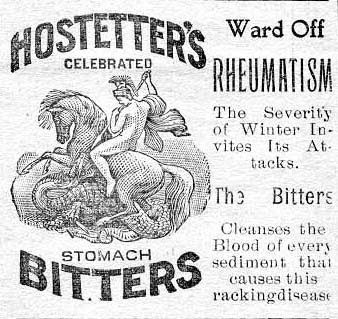
Some of the more popular tonics like Hostetter’s Celebrated Stomach Bitters had an alcohol content of 44.3% by volume. Others, like Parkers Tonic had 41.6% and Peruna had 28%.


Along with the Traveling Medicine men and their tonics, were their entertaining medicine shows. The pioneers and cowboys living in the scattered towns were very much deprived of entertainment. The shows were a natural draw. The shows typically opened with banjo or piano music, then proceeded with variety acts, minstrel skits, and sing-alongs, followed by the medicine man’s sales pitch. This cycle continued until the crowd thinned out; promising more entertainment after the sales period kept audience members in their seats. Other popular medicine show attractions included sword swallowers, fire eaters, tumblers, fortunetellers, flea circuses, magicians, strongmen, and buxom female singers.


The pioneers, mesmerized by the entertainment, forked over their hard-earned dollars for every kind of tonic, salve, or solution. And it was not just the cowboys or miners who paid for the tonics. People of all ages and walks of life, including women, and children used the patent medicines.

Which in turn, outraged the legitimate doctors. Doctors already had the daunting task of over coming the terrain and sheer distances between towns and well as the absence of public health precautions resulting in constant epidemics. Now they had to contend with the cheap easier fix for health ailments.

When the doctors were ultimately called, it was often to late for the doctor to help. The doctors were blamed for deaths that were directly or indirectly related to the Traveling Medicine men tonics.

The Traveling Medicine Men paved the way for all manner of “quackery”. The variety was limited only by the imagination of the inventors and the gullibility of the suffering. From doctors gadgets to clinics and health institutes that promised quick cures for almost everything.

In Oklahoma and Kansas before the turn of the century two fast-talking con men swindled hundreds of unsuspecting citizens (mostly women) with an imaginative patent medicine scheme. One of the “doctors” would appear in a town and spend a week or so visiting all the chronic cases, hypochondriacs and any other potential pushover’s he could find. He was glib and sympathetic, and as he chatted with them he wrote down all their symptoms, how long they had been suffering and, of course, his analysis of their ability to pay. People were pleased because he listened, and he didn’t try to force his medicines on them. Then, with his research completed, he’d leave town.


Not long after wards, his henchman would appear, and this second “doctor” would set up an office and advertise extensively in the community newspaper. Soon the same complainers came to see them. A nurse, (also part of the team) would get the patient’s name, and the “doctor” would proceed to look up the individual’s history secured the week before by his cohort.

When the victim was ushered in, the smooth talking quack would rattle off the patient’s symptoms in a wise, professional manner. The dupe, of course, would be amazed at the “doctor’s” brilliance, and when a guaranteed cure was offered-payable in advanced, of course- the response was immediate. By the time the phony physician had gone through this entire list, he would have a bundle of money, all for a few bottles of cheap tonic, which he gave to each caller as the first step in his treatment. And that would also be the last, too, because the “doctor” would suddenly disappear-off to the next frontier town where his partner had prepared a new clientele.

(The above story is from the book, “Doctors of the Old West” by Robert F. Karolevitz)


Look for future stories of the Traveling Medicine Men and life living in the old west.


Our family has been dedicated for 30 years in serving
the Western Horseman the safest most durable Quality
American made leather horse tack.......

Buckaroo John Brand

Buckaroo Leather, The Brand to Demand
Visit Our Unique Store Today
Buckaroo Leather Shopping Site

Friday, December 18, 2009

Christmas in the Old West on the Prairie in the 1800s

In the Old West in the 1800s the pioneers and cowboys on the prairie celebrated Christmas in much the same ways we do today. There was Santa Claus, presents, holiday decorations and of course the Christmas feast.

The difference was seen in the humbleness of the gifts and holiday decorations. Life in the Old West on the prairie was hard and unpredictable. There were often terrible blizzards and cold December winds. The Pioneers would not forget the spirit of Christmas though.

The women would begin baking for the holiday feast weeks in advanced. There would be plum pudding, preserved fruits and vegetables, fresh game (if available), and maybe if their year was good, a fresh ham.

The holiday decorations were homemade from whatever natural materials were available, like pine-cones, evergreen, nuts and berries. A Christmas tree was decorated with homemade decorations as well. Homemade figures and dolls made from straw or yarn were used. Yarn, ribbon, berries, popcorn strings, paper stings, and cookie dough ornaments, such as gingerbread men were also used.

The gifts were also handmade. Corn husk dolls, sachets, carved wooden toys, pillows, and embroidered items were all made with love by the family members.

Another glimpse at Christmas in the Old West on the Prairie-

Below is an excerpt from the book "Christmas in the Old West A Historical Scrapbook", by Sam Travers.


In the West, probably one of the first Christmas celebrations was held by Lewis and Clark’s Corps of Discovery in the winter of 1805. The expedition had reached the Oregon Coast and was waiting for the warmer spring weather in a small fort they had built. The men celebrated the holiday by firing their rifles and singing. Later, Lewis and Clark gave presents to their men out of the few supplies they had left, handkerchiefs and tobacco. Christmas on the frontier was
sometimes just like any other day. Miles from any big city, fur trappers living in the West were more concerned about surviving the brutal weather than having a party. David Thompson, an explorer and fur trapper wrote in the early 1800’s “Christmas and News Years day came and passed. We could not honor them, the occupations of every day demanded our attentions; and time passed on, employed in hunting for a livelihood.” Most of the mountain men were alone and the holiday was not remarkable in any way, but sometimes the lonely men got together and tried to have some celebration to keep their spirits up. In 1833, one man wrote in his journal at a
Hudson’s Bay Company trading post. “This being Christmas day I gave the men a liberal regale of eatables and drinkables, to make up in some measure for the bad living they have had all year here, and they enjoyed the feast as might be expected men would do who lived solely on soup since they came here. Weather still very cold.”

The tradition of Santa Claus was popular among children on the frontier as well and a journal called “St. Nicholas” was available for children out West. This journal was published from around the early 1800’s to the 1940’s. It was designed for children in isolated areas and included 500 pages of stories, poetry, contests, games, and crafts. It was particularly helpful in keeping children entertained during the long winter months on the frontier.

The clever way in which the pioneer families brought holiday celebrations to the West is a sign of their wanting to make a home, no matter where they found that home to be. Making the most of a tough situation, pioneer Catherine Haun wrote in 1849, “Although very tired of tent life many of us spent Thanksgiving and Christmas in our canvas houses. I do not remember ever having had happier holiday times. For Christmas we had grizzly bear steak for which we paid
$2.50, one cabbage for $1.00 and oh horrors, some more dried apples! And for a Christmas present the Sacramento River rose very high and flooded the whole town!”


Our family has been dedicated for 30 years in serving
the Western Horseman the safest most durable Quality
American made leather horse tack.......

Buckaroo John Brand

Buckaroo Leather, The Brand to Demand
Visit Our Unique Store Today
Buckaroo Leather Shopping Site