Showing posts with label tonics. Show all posts

Thursday, June 4, 2015

Old West Natural Remedies.....Lydia Pinkham Story


Today, many people look for natural or home remedies for their aliments. Natural herbs, spices, “mothers”recipe for curing the cold, can all be found on the internet.

In the Old West Traveling Medicine Wagons came to the towns to sell you that miracle tonic that would cure whatever ailed you. The biggest producer of patent medicine was Lydia E Pinkham. Her success was not only the product, which like all the patent medicines contained a high alcohol content, but her unique marketing strategy.
 

Her strategy was to simply give the women of the 1800's a voice. Women' s medical conditions and problems were not discussed in the 1800's. Lydia Pinkham encouraged women to talk about their conditions and gain knowledge on how to treat them.


Her Story….

Lydia Estes Pinkham (February 9, 1819 – May 17, 1883) was an iconic concocter and shrewd marketer of a commercially successful herbal-alcoholic "women's tonic" meant to relieve menstrual and menopausal pains.
 

Lydia Pinkham was born in the manufacturing city of Lynn, Massachusetts, the tenth of the twelve children of William and Rebecca Estes. William Estes was originally a shoemaker, but by the time Lydia was born in 1819 he had become wealthy through dealing in real estate and had risen to the status of "gentleman farmer" Lydia was educated at Lynn Academy and worked as a schoolteacher before her marriage in September 1843.


Isaac Pinkham was a 29 year old shoe manufacturer when he married Lydia in 1843, he would try various business without much success. Lydia gave birth to her first child Charles Hacker Pinkham in 1844, lost her second child to gastroenteritis, and gave birth to her second surviving child Daniel Rogers Pinkham in 1848. A third son, William Pinkham, was born in 1852 and a daughter Aroline Chase Pinkham in 1857. (All the Pinkham children would eventually be involved in the Pinkham medicine business.)

Like many women of her time Lydia Pinkham brewed home remedies, which she continually collected. Her remedy for "female complaints" became very popular among her neighbors to whom she gave it away. One story is that her husband was given the recipe as part payment for a debt, whatever truth may be in this the ingredients of her remedy were generally consistent with the herbal knowledge available to her through such sources as John King's American Dispensary, which she is known to have owned and used. In Lydia Pinkham's time and place the reputation of the medical profession was low. Medical fees were too expensive for most Americans to afford except in emergencies, in which case the remedies were more likely to kill than cure.

Isaac Pinkham was financially ruined in the Panic of 1873, he narrowly escaped arrest for debt and his health was permanently broken by the associated stress. The fortunes of the Pinkham family had long been patchy but they now entered on hard times. Lydia sometimes accepted payment for her popular remedy for female complaints. It is reputed to have been her son Daniel who came up with the idea, in 1875 of making a family business of the remedy. Lydia initially made the remedy on her stove before its success enabled production to be transferred to a factory, she answered letters from customers and probably wrote most of the advertising copy. 


Mass marketed from 1876 on, Lydia E. Pinkham's Vegetable Compound became one of the best known patent medicines of the 19th century. Descendants of this product are still available today. Lydia's skill was in marketing her product directly to women and her company continued her shrewd marketing tactics after her death. Her own face was on the label and her company was particularly keen on the use of testimonials from grateful women.

Advertising copy urged women to write to Mrs. Pinkham. They did, and they received answers. They continued to write and receive answers for decades after Lydia Pinkham's death. These staff-written answers combined forthright talk about women's medical issues, advice, and, of course, recommendations for her product. In 1905 the Ladies' Home Journal published a photograph of Lydia Pinkham's tombstone and exposed the ruse. The Pinkham Company insisted that it had never meant to imply that the letters were being answered by Lydia Pinkham, but by her daughter-in-law, Jennie Pinkham.

Although Pinkham's motives were partly self-serving, many modern-day feminists admire her for distributing information on menstruation and the "facts of life" and consider her to be a crusader for women's health issues in a day when women were poorly served by the medical establishment.

(biography from Wikipedia)


You can still purchase Lydia Pinkham Vegetable Compound today. The ingredients have been updated to meet FDA standards, but the claims of relief are the same.


The original formula for Lydia Pinkham's Vegetable Compound was:

Unicorn root (Aletris farinosa L.) 8 oz.
Life root (Senecio aureus L.) 6 oz.
Black cohosh (Cimicifuga racemosa (L.) Nutt.) 6 oz.
Pleurisy root (Asclepias tuberosa L.) 6 oz.
Fenugreek seed (Trigonella foenum-graecum L.) 12 oz.


The Modern formula-straight from the bottle:

Supplement Facts
Serving Size: 1 Tablespoon
Amount Per 1 Tablespoonful %Daily Value
Vitamin C 20 mg 33%
Vitamin E 5 mg 16.5%%
Proprietary Blend 3 g
Jamaica Dogwood (bark)
Motherwart (leaf)
Dandelion (root)
Pleurisy (root)
Glycyrrhiza (licorice root)
Black Cohosh (root)
Gentian (root)

Ingredients: water, fructose, ascorbic acid, dogwood bark, motherwart leaf, flavor, dandelion root, alcohol 10%, pleurisy root, licorice root, salicylic acid, edetic acid, sodium benzoate, black cohosh root, dl-alpha tocopheryl acetate, BHA, butylparaben, gentian root.
 

Directions: Shake before using. Take 1 tablespoon 3 times a day with meals. For best results, take regularly throughout the month. If preferred, mix with fruit juice.

If you are pregnant or nursing a baby, seek the advice of a health professional before using this product.


Our family has been dedicated for 30 years in serving the 
Western Horseman the safest most durable 
Quality American made leather horse tack....... Buckaroo John Brand Buckaroo Leather, The Brand to Demand 
Visit Our Unique Store Today 
Buckaroo Leather Shopping Site


Wednesday, March 17, 2010

Patent Medicine Trail Blazer, Lydia E. Pinkham


Last week I wrote of the traveling medicine shows and the phenomenon of patent medicine. I wanted to share this biography of one of the biggest producers of patent medicine, Lydia E Pinkham. Her success was not only the product, which like all the patent medicines contained a high alcohol content, but her unique marketing strategy.

Her strategy was to simply give the women of the 1800's a voice. Women' s medical conditions and problems were not discussed in the 1800's. Lydia Pinkham encouraged women to talk about their conditions and gain knowledge on how to treat them.

Lydia E Pinkhams story is a fine example of the strength and resolve of the women in the 1800's.

(biography from Wikipedia)

Lydia Estes Pinkham (February 9, 1819 – May 17, 1883) was an iconic concocter and shrewd marketer of a commercially successful herbal-alcoholic "women's tonic" meant to relieve menstrual and menopausal pains.

Lydia Pinkham was born in the manufacturing city of Lynn, Massachusetts, the tenth of the twelve children of William and Rebecca Estes. William Estes was originally a shoemaker, but by the time Lydia was born in 1819 he had become wealthy through dealing in real estate and had risen to the status of "gentleman farmer" Lydia was educated at Lynn Academy and worked as a schoolteacher before her marriage in September 1843.

Isaac Pinkham was a 29-year-old shoe manufacturer when he married Lydia in 1843, he would try various business without much success. Lydia gave birth to her first child Charles Hacker Pinkham in 1844, lost her second child to gastroenteritis, and gave birth to her second surviving child Daniel Rogers Pinkham in 1848. A third son, William Pinkham, was born in 1852 and a daughter Aroline Chase Pinkham in 1857. (All the Pinkham children would eventually be involved in the Pinkham medicine business.)

Like many women of her time Lydia Pinkham brewed home remedies, which she continually collected. Her remedy for "female complaints" became very popular among her neighbors to whom she gave it away. One story is that her husband was given the recipe as part payment for a debt, whatever truth may be in this the ingredients of her remedy were generally consistent with the herbal knowledge available to her through such sources as John King's American Dispensary, which she is known to have owned and used. In Lydia Pinkham's time and place the reputation of the medical profession was low. Medical fees were too expensive for most Americans to afford except in emergencies, in which case the remedies were more likely to kill than cure. For example a common "medicine" was calomel, in fact not a medicine but a deadly mercurial toxin, and this fact was even at the time sufficiently well known among the skeptical to be the subject of a popular comic song. In these circumstances there is no mystery why many preferred to trust unlicensed "root and herb" practitioners, and to trust women prepared to share their domestic remedies such as Lydia Pinkham.


Isaac Pinkham was financially ruined in the Panic of 1873, he narrowly escaped arrest for debt and his health was permanently broken by the associated stress. The fortunes of the Pinkham family had long been patchy but they now entered on hard times. Lydia sometimes accepted payment for her popular remedy for female complaints. It is reputed to have been her son Daniel who came up with the idea, in 1875 of making a family business of the remedy. Lydia initially made the remedy on her stove before its success enabled production to be transferred to a factory, she answered letters from customers and probably wrote most of the advertising copy. Mass marketed from 1876 on, Lydia E. Pinkham's Vegetable Compound became one of the best known patent medicines of the 19th century. Descendants of this product are still available today. Lydia's skill was in marketing her product directly to women and her company continued her shrewd marketing tactics after her death. Her own face was on the label and her company was particularly keen on the use of testimonials from grateful women.


Advertising copy urged women to write to Mrs. Pinkham. They did, and they received answers. They continued to write and receive answers for decades after Lydia Pinkham's death. These staff-written answers combined forthright talk about women's medical issues, advice, and, of course, recommendations for her product. In 1905 the Ladies' Home Journal published a photograph of Lydia Pinkham's tombstone and exposed the ruse. The Pinkham Company insisted that it had never meant to imply that the letters were being answered by Lydia Pinkham, but by her daughter-in-law, Jennie Pinkham.

Although Pinkham's motives were partly self-serving, many modern-day feminists admire her for distributing information on menstruation and the "facts of life" and consider her to be a crusader for women's health issues in a day when women were poorly served by the medical establishment.


In 1922, Lydia's daughter Aroline Chase Pinkham Gove founded the Lydia E. Pinkham Memorial Clinic in Salem, Massachusetts. The clinic, still in operation as of 2004[update], provides health services to young mothers and their children. It is designated Site 9 of the Salem Women's Heritage Trail.


You can still purchase Lydia Pinkham Vegetable Compound today. The ingredients have been updated to meet FDA standards, but the claims of relief are the same.


The original formula for Lydia Pinkham's Vegetable Compound was:

* Unicorn root (Aletris farinosa L.) 8 oz.
* Life root (Senecio aureus L.) 6 oz.
* Black cohosh (Cimicifuga racemosa (L.) Nutt.) 6 oz.
* Pleurisy root (Asclepias tuberosa L.) 6 oz.
* Fenugreek seed (Trigonella foenum-graecum L.) 12 oz.


Modern formula-straight from the bottle

Supplement Facts
Serving Size: 1 Tablespoon
Amount Per 1 Tablespoonful %Daily Value
Vitamin C
20 mg 33%
Vitamin E
5 mg 16.5%%
Proprietary Blend
3 g
Jamaica Dogwood (bark)

Motherwart (leaf)

Dandelion (root)

Pleurisy (root)

Glycyrrhiza (licorice root)

Black Cohosh (root)

Gentian (root)

†Daily value not established.
Ingredients: water, fructose, ascorbic acid, dogwood bark, motherwart leaf, flavor, dandelion root, alcohol 10%, pleurisy root, licorice root, salicylic acid, edetic acid, sodium benzoate, black cohosh root, dl-alpha tocopheryl acetate, BHA, butylparaben, gentian root.

Directions: Shake before using. Take 1 tablespoon 3 times a day with meals. For best results, take regularly throughout the month. If preferred, mix with fruit juice.

If you are pregnant or nursing a baby, seek the advice of a health professional before using this product.

*This statement has not been evaluated by the Food and Drug Administration. This product is not intended to diagnose, treat, cure or prevent any disease.


Our family has been dedicated for 30 years in serving
the Western Horseman the safest most durable Quality
American made leather horse tack.......

Buckaroo John Brand

Buckaroo Leather, The Brand to Demand
Visit Our Unique Store Today
Buckaroo Leather Shopping Site

Monday, March 8, 2010

Patent Medicine & Traveling Medicine Shows of the Old West

Diphtheria instantly relieved and permanently cured by using “Kurakoff, Nature’s Life Preserver.”


If you were a cowboy living in the 1800’s on the frontier in the west, you may have seen a sign with a statement like the one above.

Traveling Medicine men selling all sorts of dollar-a bottle tonics and restoratives for any matter of mental or physical ills were part of the normal scenery in an old west town.


These tonics and patent medicines were popular in the western country for many reasons,

  • Just as in society today, the cowboys and frontier men wanted a cheap, quick, painless way to reach good health.
  • Gullibility, ignorance and pure boredom were also factors.
  • The most important reason was just the fact that there was a scarcity of qualified doctors. In their absence, “granny” remedies and magic cure-all's were substituted.
  • To make matters worse, many of the elixirs were concocted by greed-inspired men who could boast a medical degree, and some of the poorly trained physicians in country practice actually prescribed the pills and potions of the traveling medicine men.

The main reason for the tonics demand was the alcohol content.

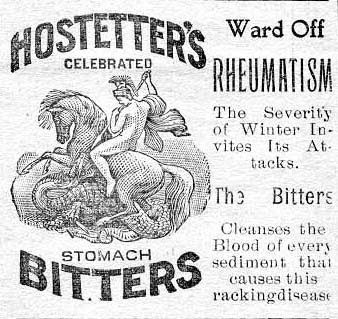
Some of the more popular tonics like Hostetter’s Celebrated Stomach Bitters had an alcohol content of 44.3% by volume. Others, like Parkers Tonic had 41.6% and Peruna had 28%.


Along with the Traveling Medicine men and their tonics, were their entertaining medicine shows. The pioneers and cowboys living in the scattered towns were very much deprived of entertainment. The shows were a natural draw. The shows typically opened with banjo or piano music, then proceeded with variety acts, minstrel skits, and sing-alongs, followed by the medicine man’s sales pitch. This cycle continued until the crowd thinned out; promising more entertainment after the sales period kept audience members in their seats. Other popular medicine show attractions included sword swallowers, fire eaters, tumblers, fortunetellers, flea circuses, magicians, strongmen, and buxom female singers.


The pioneers, mesmerized by the entertainment, forked over their hard-earned dollars for every kind of tonic, salve, or solution. And it was not just the cowboys or miners who paid for the tonics. People of all ages and walks of life, including women, and children used the patent medicines.

Which in turn, outraged the legitimate doctors. Doctors already had the daunting task of over coming the terrain and sheer distances between towns and well as the absence of public health precautions resulting in constant epidemics. Now they had to contend with the cheap easier fix for health ailments.

When the doctors were ultimately called, it was often to late for the doctor to help. The doctors were blamed for deaths that were directly or indirectly related to the Traveling Medicine men tonics.

The Traveling Medicine Men paved the way for all manner of “quackery”. The variety was limited only by the imagination of the inventors and the gullibility of the suffering. From doctors gadgets to clinics and health institutes that promised quick cures for almost everything.

In Oklahoma and Kansas before the turn of the century two fast-talking con men swindled hundreds of unsuspecting citizens (mostly women) with an imaginative patent medicine scheme. One of the “doctors” would appear in a town and spend a week or so visiting all the chronic cases, hypochondriacs and any other potential pushover’s he could find. He was glib and sympathetic, and as he chatted with them he wrote down all their symptoms, how long they had been suffering and, of course, his analysis of their ability to pay. People were pleased because he listened, and he didn’t try to force his medicines on them. Then, with his research completed, he’d leave town.


Not long after wards, his henchman would appear, and this second “doctor” would set up an office and advertise extensively in the community newspaper. Soon the same complainers came to see them. A nurse, (also part of the team) would get the patient’s name, and the “doctor” would proceed to look up the individual’s history secured the week before by his cohort.

When the victim was ushered in, the smooth talking quack would rattle off the patient’s symptoms in a wise, professional manner. The dupe, of course, would be amazed at the “doctor’s” brilliance, and when a guaranteed cure was offered-payable in advanced, of course- the response was immediate. By the time the phony physician had gone through this entire list, he would have a bundle of money, all for a few bottles of cheap tonic, which he gave to each caller as the first step in his treatment. And that would also be the last, too, because the “doctor” would suddenly disappear-off to the next frontier town where his partner had prepared a new clientele.

(The above story is from the book, “Doctors of the Old West” by Robert F. Karolevitz)


Look for future stories of the Traveling Medicine Men and life living in the old west.


Our family has been dedicated for 30 years in serving
the Western Horseman the safest most durable Quality
American made leather horse tack.......

Buckaroo John Brand

Buckaroo Leather, The Brand to Demand
Visit Our Unique Store Today
Buckaroo Leather Shopping Site