Showing posts with label life in 1800's. Show all posts

Thursday, April 19, 2012

Pioneer Women of the 1800's...Strong, Courageous, smart.

Women on the frontier in the 1800's were not the beautiful dainty wallflowers like their counter parts in Europe. The frontier women had to be strong, resourceful, hard working, and a great horseman.

Women in the 1800’s took part in all facets of Frontier Life. The hardship of frontier life required that all members of the family take part to make ends meet. So, 1800 women mounted their horses to hunt with their husbands and also camp out for days. Some women even became cattle-women. One such cattle-women was Elizabeth E. Johnson.

*Elizabeth E. Johnson was born in Missouri in 1843. She moved to Hays County, Texas soon after her father had established the Johnson Institute there in 1852. Lizzie began teaching at the school when she was sixteen. Later she left to teach in schools at Manor, Lockhart, and Austin. Quietly she saved her money and added to her income by writing stories for Frank Leslie’s Magazine. As she accumulated money, she invested it. At one point she purchased $2,500 worth of stock in the Evans, Snider, Bewell Cattle Co. of Chicago. She earned 100 percent dividends for three years straight and then sold her stock for $20,000. On June 1, 1871, she invested the money in cattle and registered her own brand (CY) in the Travis County brand book along with her mark.

Lizzie Johnson’s wealth continued to grow. So did her responsibilities. In the summer of 1879, at the age of thirty-six, she married Hezkiah G Williams, a preacher and widower with several children. She continued to teach school in Austin, write magazine articles, and invest in cattle. She maintained control over her wealth, having had her husband sign a paper agreeing that all of her property remained hers. On his own, Hezkiah entered the cattle business in 1881, but he was a poor businessman who also liked to drink, and Lizzie had to keep pulling him out of financial trouble. At least twice Lizzie and Hezkiah traveled up the Chisholm Trail to Kansas. They rode behind the herd in a buggy drawn by a team of horses. This was about 1879, and Lizzie was the first woman to drive her own herd up the trail. For several years she and her husband, after coming up the trail, spent the fall and winter months in St. Louis, where Lizzie made extra money by keeping books for other cattlemen. When she died in 1924, at the age of 81 (her husband had died on 1914), Lizzie Johnson’s estate totaled more than $200,000, including large holdings in Austin real estate.


(*An excerpt from Emily Jones Shelton, “Lizzie E Johnson: A Cattle Queen of Texas” Southwestern Historical Quarterly, Vol L (1947)
pp 349-366)

The old west is filled with stories like this of men and women and their adventures on the trail. They worked hard for a living and expec
ted their horse tack to work just as hard and to last.

The styles of the old time horse tack are not only appealing to the “old time cowboy” but like the horse tack of the 1800, the durability and quality is essential to the cowboy and the horse.

Breast Collar Old Martingale style "Choker"

Hand crafted from the finest Hermann Oak Rough Out Oiled Golden Bridle Leather with chap lining. This Old Martingale style shaped breast collar (some in the sage call it a "CHOKER") features an over the shoulder fit for a better pulling position. Also featured is the adjustable neck strap and billet.


Cowboy Style Headstall/ReinSet

This old time Traditional Buckaroo Cowboy Style Leather Headstall Set with Shaped Cheeks and Flair Brow is hand crafted from premium heavy weight Harness Hermann Oak Leather.


Our family has been dedicated for 30 years in serving the
Western Horseman the safest most durable
Quality American made leather horse tack.......Buckaroo John Brand
Buckaroo Leather, The Brand to Demand
Visit Our Unique Store Today
Buckaroo Leather Shopping Site

Monday, March 8, 2010

Patent Medicine & Traveling Medicine Shows of the Old West

Diphtheria instantly relieved and permanently cured by using “Kurakoff, Nature’s Life Preserver.”


If you were a cowboy living in the 1800’s on the frontier in the west, you may have seen a sign with a statement like the one above.

Traveling Medicine men selling all sorts of dollar-a bottle tonics and restoratives for any matter of mental or physical ills were part of the normal scenery in an old west town.


These tonics and patent medicines were popular in the western country for many reasons,

  • Just as in society today, the cowboys and frontier men wanted a cheap, quick, painless way to reach good health.
  • Gullibility, ignorance and pure boredom were also factors.
  • The most important reason was just the fact that there was a scarcity of qualified doctors. In their absence, “granny” remedies and magic cure-all's were substituted.
  • To make matters worse, many of the elixirs were concocted by greed-inspired men who could boast a medical degree, and some of the poorly trained physicians in country practice actually prescribed the pills and potions of the traveling medicine men.

The main reason for the tonics demand was the alcohol content.

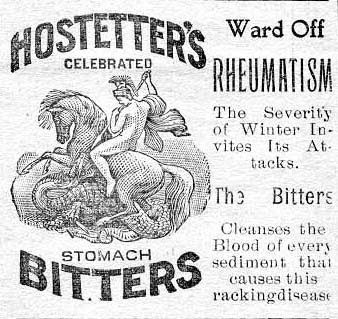
Some of the more popular tonics like Hostetter’s Celebrated Stomach Bitters had an alcohol content of 44.3% by volume. Others, like Parkers Tonic had 41.6% and Peruna had 28%.


Along with the Traveling Medicine men and their tonics, were their entertaining medicine shows. The pioneers and cowboys living in the scattered towns were very much deprived of entertainment. The shows were a natural draw. The shows typically opened with banjo or piano music, then proceeded with variety acts, minstrel skits, and sing-alongs, followed by the medicine man’s sales pitch. This cycle continued until the crowd thinned out; promising more entertainment after the sales period kept audience members in their seats. Other popular medicine show attractions included sword swallowers, fire eaters, tumblers, fortunetellers, flea circuses, magicians, strongmen, and buxom female singers.


The pioneers, mesmerized by the entertainment, forked over their hard-earned dollars for every kind of tonic, salve, or solution. And it was not just the cowboys or miners who paid for the tonics. People of all ages and walks of life, including women, and children used the patent medicines.

Which in turn, outraged the legitimate doctors. Doctors already had the daunting task of over coming the terrain and sheer distances between towns and well as the absence of public health precautions resulting in constant epidemics. Now they had to contend with the cheap easier fix for health ailments.

When the doctors were ultimately called, it was often to late for the doctor to help. The doctors were blamed for deaths that were directly or indirectly related to the Traveling Medicine men tonics.

The Traveling Medicine Men paved the way for all manner of “quackery”. The variety was limited only by the imagination of the inventors and the gullibility of the suffering. From doctors gadgets to clinics and health institutes that promised quick cures for almost everything.

In Oklahoma and Kansas before the turn of the century two fast-talking con men swindled hundreds of unsuspecting citizens (mostly women) with an imaginative patent medicine scheme. One of the “doctors” would appear in a town and spend a week or so visiting all the chronic cases, hypochondriacs and any other potential pushover’s he could find. He was glib and sympathetic, and as he chatted with them he wrote down all their symptoms, how long they had been suffering and, of course, his analysis of their ability to pay. People were pleased because he listened, and he didn’t try to force his medicines on them. Then, with his research completed, he’d leave town.


Not long after wards, his henchman would appear, and this second “doctor” would set up an office and advertise extensively in the community newspaper. Soon the same complainers came to see them. A nurse, (also part of the team) would get the patient’s name, and the “doctor” would proceed to look up the individual’s history secured the week before by his cohort.

When the victim was ushered in, the smooth talking quack would rattle off the patient’s symptoms in a wise, professional manner. The dupe, of course, would be amazed at the “doctor’s” brilliance, and when a guaranteed cure was offered-payable in advanced, of course- the response was immediate. By the time the phony physician had gone through this entire list, he would have a bundle of money, all for a few bottles of cheap tonic, which he gave to each caller as the first step in his treatment. And that would also be the last, too, because the “doctor” would suddenly disappear-off to the next frontier town where his partner had prepared a new clientele.

(The above story is from the book, “Doctors of the Old West” by Robert F. Karolevitz)


Look for future stories of the Traveling Medicine Men and life living in the old west.


Our family has been dedicated for 30 years in serving
the Western Horseman the safest most durable Quality
American made leather horse tack.......

Buckaroo John Brand

Buckaroo Leather, The Brand to Demand
Visit Our Unique Store Today
Buckaroo Leather Shopping Site