Showing posts with label mining towns. Show all posts

Tuesday, May 6, 2014

Pearl Hart.....The Last of the Lady Road Agents


Pearl Hart


The Last of the Lady Road Agents


On May 30, 1899 two people stepped out onto the road with guns drawn, and commanded the driver of the stage to “Halt!”. Thus began the life of “The Last of the Lady Road Agents” .

Pearl Hart wearing a rough miner’s shirt, blue overalls, and boots obviously too large for her robbed the stage coach. Her accomplice was tall, muscular and sported a fancy mustache his name was Joe Boot. A posse found them soon after the stage robbery. Boot went quietly, but Pearl put up a fight and the Arizona Star reported “ She is a wild-cat of a woman and had she not been relieved of her gun a bloody foray might have resulted”.


Pearl Hart was born in 1872 in Ontario, Canada. Her early years are some what of a mystery. She did enter a boarding school for young ladies when she was 16 and met a man named Hart. After a year of dating they eloped. 

Hart was a man of many trades, gambler, bartender, and a full time drinker. While married, Pearl would return a number of times to her mother’s but Hart would romance Pearl with new promises to bring her back.


In 1893 they went to Chicago to find a permanent job at the World Columbian Exposition. Hart was confident he could get a good job as a bartender. He ended up though as a barker in a shabby side show. Pearl, however, discovered the glamour of the West in the form of the tall, muscular cowboys who were part of the entertainment. It wasn't long before one of the cowhands convinced Pearl to accompany him to Colorado. He paid her way but soon left her there to fend for herself.

Pearl's “love” of cowboys ended and she began cooking in the mining camps of the west. Pearl for the first time began to save money and she especially liked the attention she received from the male population. One day in Phoenix, Arizona, she ran into Hart, who was still her husband. Hart saw that she was doing well for herself and once again romanced himself back into her life with the same old promises.


For a time life was good and Hart held a steady job and Pearl had two children. Hart began drinking again and Pearl decided she was through with her husband so she sent her children to her mother’s in Ohio and returned to the mining camps. She drifted from place to place and began drinking herself. In 1889 at an Arizona mining camp Pearl met and became friends with Joe Boot.
 

The idea for the robbery came from a letter Pearl received. The letter said that her mother was very ill and that she needed money for medical expenses. So, Pearl and Boot devised a plan to rob the stage coach. Pearl’s first encounter with law became her last and she will forever be know as the “Last of the Lady Road Agents.”


Our family has been dedicated for 30 years in serving the 
Western Horseman the safest most durable Quality American made leather horse tack....... Buckaroo John Brand 
Buckaroo Leather, The Brand to Demand 
Visit Our Unique Store Today Buckaroo Leather Shopping Site

Thursday, July 14, 2011

Jo Monaghan -The Ballad of Little Joe


Josephine (Jo) Monaghan
"The Ballad of Little Joe"


In 1904, the Boise City Capital News reported the death of Jo Monaghan, "a well-known character" who had worked, ranched and ridden roundups in Idaho for more than thirty years.

Deemed like able, if a little odd, by his neighbors, Jo had never given anyone reason to suspect that he was actually a woman. He had even enjoyed such exclusively male privileges as voting and serving on juries.

Jo Monaghan arrived in Owyhee County, Ruby City, Idaho in 1867. This city was Idaho's latest center for the gold rush fever. Jo was only 5ft tall in his cowboy boots. He was slight and and had a high pitched voice. His nick name became "Little Joe".


Jo Monaghan lived in Ruby City, in a little shack for 10 years. He tried his skill at mining
(but was unsuccessful) and sheep herding. He also raised chickens and hogs, and made money by keeping a cow and selling the milk to the miners.

He took a job as a sheepherder
and spent 3 years, alone with just his horse and dog watching over the sheep. Jo fended off wolves through the long snowy winters.

Jo also worked on cattle drives or wrangling and shearing sheep for local ranchers. He never bathed or bunked with the other cow hands and laid his bedroll outside. He also had no interest in bars and dance halls.
Little Joe had only one close friend, an older mine superintendent. He entrusted him with all his hard earned money for safe keeping. The superintendent disappeared one day with all of Joe's savings, 2 decades worth. Joe and his neighbors formed a posse and chased after the thief, but never found him or the money.

Little Joe was a natural on horseback He took to breaking wild horses for a living-he became known throughout the Owyhee's as a superior horseman.

In early 1880's little Joe moved to Rockville, along the Idaho and Oregon border, and started a homestead. 21 citizens lived in Rockville-Joe loved the little city. He was well liked by all there and before long he had a dozen head of his own cattle and horses.

Joe continued to take jobs on other ranches. Through these ranchers- it was suggested that Little Joe try out for a Wild West Show. The other ranchers arranged a meeting between Little Joe and Andrew Whaylen. Andrew Whaylen was a former member of Buffalo Bill's Wild West Show who was starting his own show.

Whaylen's Wild West Show hired Little Joe and featured him as "Cowboy Joe" and offered $25 to any man who could bring in a bronc that Joe could not ride. Little Joe was able to ride any bucking horse with ease and even horses that had thrown all the other local riders.
Whaylen saw an article for Vitagraph Film Co. They touted themselves as the next big thing-"moving pictures". Whaylen wrote to the film co. and suggested they film his Wild West Show.

Albert Smith of Vitagraph eagerly accepted-it would be the first Western movie to be filmed west of the Mississippi. The shows star performance was Cowboy Joe Monaghan. He was filmed on a bucking bronc.


After the Wild West show closed for the season, Joe returned home to his ranch. In 1903 Joe was driving his cattle to pasture near the Boise river, when he took ill. He was taken to the Malloy Ranch for care. He died there on January 1904.


During the burial preparations, Joe's long held secret was revealed. Joe was actually a woman. There was further evidence found in Joe's home. The neighbors were going through Joe's things and found letters written by Joe's sister.


The letters told about a debutante from Buffalo New York, Josephine Monaghan, who had a child out of wedlock. She was disowned by her wealthy family. Her son's name was Laddie. She was a desperate mother trying to make a living by working as a waitress at a restaurant in New York City. Laddie was born in 1866 and her and the child were abandoned by the father. At one point Joe was forced to put, Laddie in an asylum. All this became to much for Josephine (Joe) and she left her child with her sister.

Laddie eventually graduated from Columbia Law School and entered the New York State Bar Association.

Josephine (Jo) Monaghan's amazing story was made into a movie called "The Ballad of Little Joe".


Information for this story came from the books-
"Cowgirls" by candace savage
"More Than Petticoats:Remarkable Idaho Women" by Lynn E Bragg


Our family has been dedicated for 30 years in serving the
Western Horseman the safest most durable
Quality American made leather horse tack.......Buckaroo John Brand
Buckaroo Leather, The Brand to Demand
Visit Our Unique Store Today
Buckaroo Leather Shopping Site

Wednesday, August 4, 2010

Deadwoods' Famous Characters

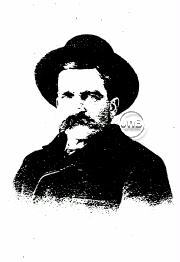
Deadwood, South Dakota a mining town with a notorious history. Even more notorious were it's people. Seth Bullock, Al Swearengen, Sol Star, Wild Bill Hickok, Calamity Jane, Charlie Utter to name a few. Here is a brief history of Al Swearengen and Seth Bullock-

Seth Bullock
Seth Bullock was born at Sandwich, Ontario, Canada on July 24, 1847 and came to the United States about 1867-8, locating at Helena, Montana. According to various census records, his father George, a retired British Major living in Canada. His mother was Agnes Findley who was born in Scotland.

Seth had at least three sisters ( Agnes, Jessie and Alma) and a brother. Lieut. Frederick F. Kislingbury married Seth's sister Agnes in 1867. Kislingbury was an explorer who died with Greely's expeditition to the North Pole. Agnes died in 1878, and Frederick Kislingbury married her sister, Jessie.

In the 1870 U.S. Census the then 22-year-old Seth Bullock was living with a grocer and his family in Helena, Montana. Seth's occupation was listed as "auctioneer."

Seth was quickly chosen a member of the Montana legislature, after moving to that state. The Seventh & Eighth Sessions of the Montana legislature, held at the capital city of Virginia, from December 4, 1871 to May 8, 1873 under Benjamin F. Potts, governor, notes among the Members of the Council: "Seth Bullock - Lewis and Clark and Jefferson counties."

Seth Bullock married Martha [Marguerite] Eccles in 1874 in Salt Lake City. She was born about 1849 in Ohio, with her parents being both born in Pennsylvania. In 1876 Seth took his wife and children to Michigan, where they stayed while he traveled to Deadwood to set up a business.Seth and Martha Bullock had three children: Margaret ("Madge"), born about 1876 in Montana; Florence ("Floy"), b. October 3, 1878 in Tecumseh, Michigan; and Stanley, born October 1, 1880 in Lawrence Co., SD .

Seth was engaged in hardware and mining supplies business. After the gold discovery in the Black Hills, with his partner, Sol Star, he moved his stock to Deadwood, arriving there August 2, 1876. In 1880 Seth, his wife Martha, and two daughters, "Madge" and "Floy," were living in Deadwood, South Dakota. Seth was a hardware merchant at this time.

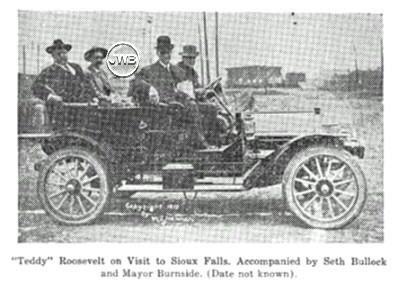
Seth Bullock was made sheriff of the provisional government in what is now known as South Dakota. He was also sheriff of Lawrence County after its organization and rendered effective service in clearing out the rough element. When Theodore Roosevelt was ranching in North Dakota [Theodore Roosevelt was a Deputy Sheriff from Medora, North Dakota around that time] they formed a close friendship, which lasted through life.

As President of the United States, Roosevelt appointed Bullock U.S. Marshall for South Dakota. Captain Bullock promoted and built the fine monument to Roosevelt that stands upon Mount Roosevelt, a few miles north of Deadwood.

In South Dakota there are two men who claimed the distinction of having introduced alfalfa into the state, namely Seth Bullock of the Black Hills region in the western part of the state and W.W. Bell of Valley Springs, in Minnehaha County. It is claimed that Bullock introduced it in 1881, while Mr. Bell claimed to have introduced it from Stockton, California in 1879.

In 1888, Seth Bullock of Lawrence Co. was a member of the Republic Central Committee in South Dakota.

Seth was a Spanish American War Veteran, who served starting about 1898. In 1920 his widow, Martha, applied for his pension. He was a captain in the 3rd Regiment of the U.S. Cavalry.

Seth Bullock died September 23, 1919, at his home in Deadwood, South Dakota after an illness of several weeks (of cancer) and is buried in Mount Moriah Cemetery in Lawrence County, South Dakota


Ellis Albert "Al" Swearengen

Born Oskaloosa, Iowa, July 8, 1845 – died Colorado, 1904) He was a pimp and early entertainment entrepreneur in Deadwood, South Dakota, running the Gem Theater, a notorious brothel, for 22 years, and combining a reputation for brutality with an uncanny instinct for forging political alliances.

Swearengen and his twin brother, Lemuel, were two of ten children of Daniel Swearengen and Keziah (often called Katie) Swearengen of Oskaloosa. Unlike so many of Deadwood's residents who left home at a young age to make their fortunes on the wild frontier, Swearengen remained at home well into his adult years, arriving in Deadwood in May, 1876 with his wife, Nettie Swearengen.

Nettie would later divorce him on the grounds of spousal abuse, and Swearengen would marry two more times, both marriages ending as the first.

Swearengen was one of the first Deadwood residents not to be a prospector or miner; he represented the beginning of a second wave of residents, attracted there by the promise of riches to be stripped not from the earth, but from the prospectors and miners.

(In the picture above Al Swearengen is the third from the right behind the bar)

He built a small saloon called the Cricket Saloon, which featured as entertainment in its close spaces local miners engaged in what were advertised as "prize fights", although no prizes were actually awarded. Within a year, Swearengen had accumulated enough money to build the much larger and more opulent Gem Variety Theater, which opened on April 7, 1877, featuring the now traditional "prize fights" in addition to stage shows, and, mainly, prostitution.

The Gem bought in an average of $5,000 a night, sometimes as much as $10,000 (between $140,000 and $280,000 inflation adjusted for 2009). When it burned down along with much of the town on September 26, 1879, Swearengen rebuilt it larger and more opulent than ever, to great public acclaim. Swearengen's talent for canny alliances and financial payoffs kept him insulated from the general drive to clean up the town, including the otherwise successful work of Seth Bullock, until the Gem burned down once again in 1899.

He remarried the same year to Odelia Turgeon. It appears that the Methodist church in Deadwood - which also took a moralist crusade to clean up the town - specifically targeted the Gem Theater. According to his recently rediscovered obituary, Albert Swearengen was found dead in the middle of a suburban Denver street on November 15, 1904. He apparently died of a massive head wound and was not hopping a freight train as is often reported.


Our family has been dedicated for 30 years in serving
the Western Horseman the safest most durable Quality
American made leather horse tack.......Buckaroo John Brand
Buckaroo Leather, The Brand to Demand
Visit Our Unique Store Today
Buckaroo Leather Shopping Site