Showing posts with label rawhide bosal. Show all posts

Wednesday, January 20, 2016

Mecate, Bosal, Hackamore Vaquero Tack


 Vaquero Horse Tack, Mecate, Bosal and Hackamore
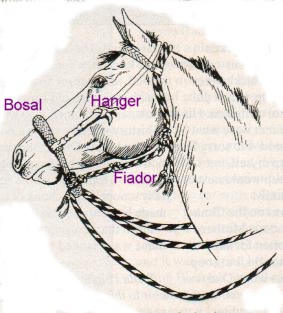


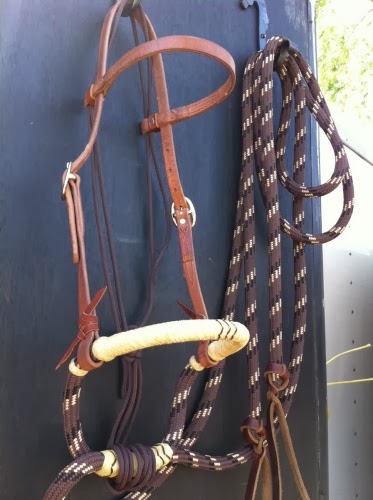
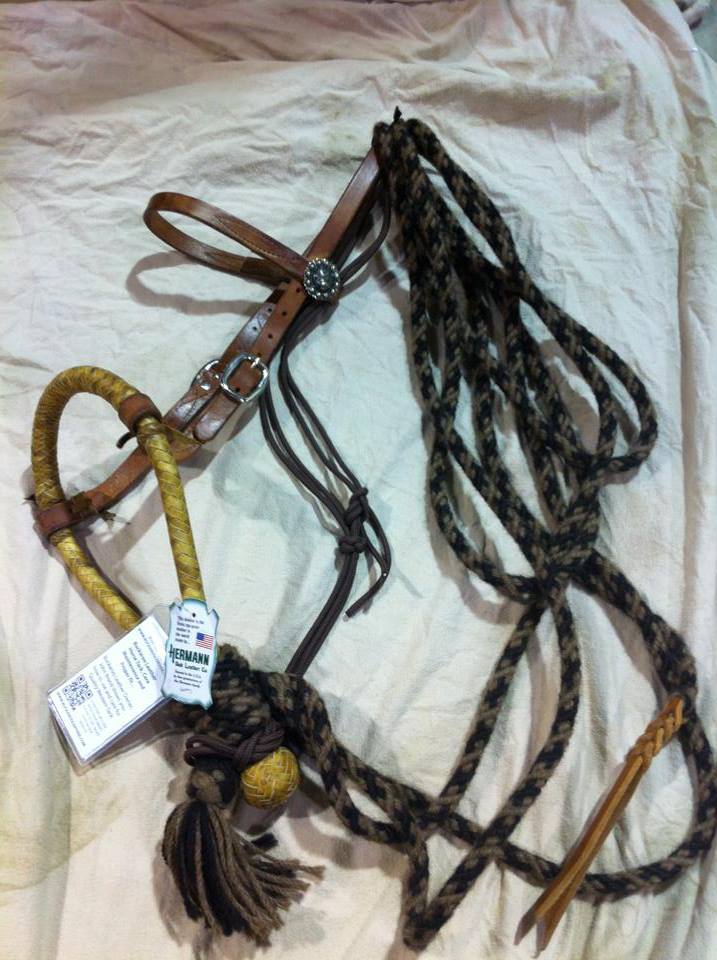
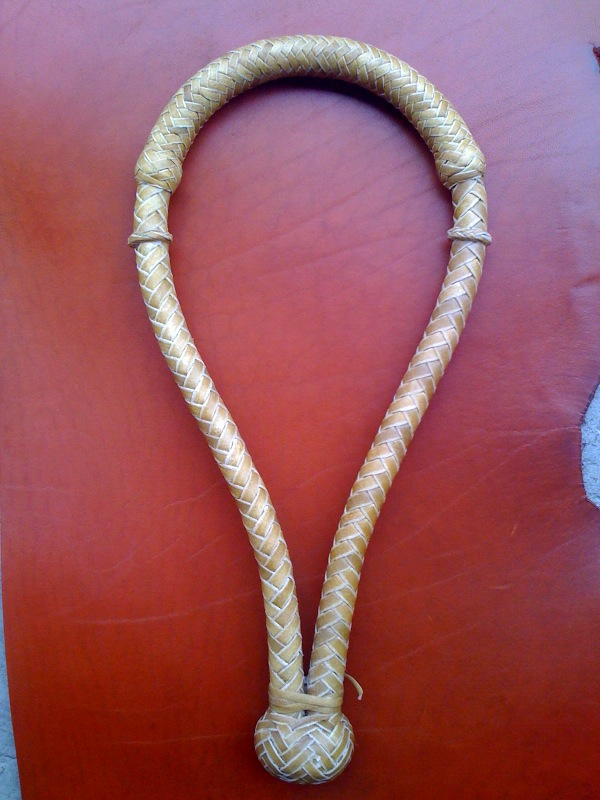
The Mecate is the rein portion of the horse tack, called the Hackamore. The Hackamore is a type of headgear for horse training. The unique part of the Hackamore is that it does not have a bit. It uses a braided noseband called a Bosal. The Bosal is a special type of noseband that works on pressure points on the horse's face, nose, and chin. The Mecate is a rope made from horse hair or soft feeling rope that serves as reins and lead rope.

The types of Hackamores include the Bosal and side pull. The Bosal Hackamore uses the Vaqueros tradition of the braided noseband and the Mecate rope.


 100% Alpaca Mecate
$100

The Mecate is tied to the Bosal in a specialized manner that adjusts the fit of the Bosal around the muzzle of the horse and creates both a looped rein and a long free end that can be used for a number of purposes.  

For the mounted rider, the free end is coiled and attached to the saddle or tucked under your belt. When the rider dismounts, the lead rein is not used to tie the horse to a solid object but used as a lead rope and a form of lunge line when needed.


 AAA Bosalitos Vaquero Style
 $249


The traditional Mecate used by the California Vaqueros was made from the long hair of a horse's tail and was hand braided. Modern Mecates are made with horse hair and synthetic rope with a horse hair tassel at one end and a leather popper at the other end.

A properly tied Mecate knot (please view the how to video here) allows wraps of rope to be added to the knot in front of the rein loop in order to tighten the Bosal noseband on a horse or the rope can be unwrapped to loosen the Bosal.


 Black Beauty Concha Hackamore
$259


 Cadillac Hackamore Set with Fiador and Mecate
$395


Our family has been dedicated for 30 years in serving the 
Western Horseman the safest most durable 
Quality American made leather horse tack....... Buckaroo John Brand Buckaroo Leather, The Brand to Demand 
Visit Our Unique Store Today  
Buckaroo Leather Shopping Site

Tuesday, March 3, 2015

Californio Vaquero Hackamore Very Poplular Today


The “old west” style of Hackamores are very popular today!!

The traditional Hackamore used by the Californio Vaquero long ago had a beautiful braided rawhide Bosal and adorned with rawhide buttons. The Mecate rein was made from the long hair of the horse’s tail and was hand braided.....truly a work of art.


The influence of the Vaquero style is seen in our Hackamores today. They have a traditional braided rawhide Bosal and the Mecate reins are made with mane horse hair or mohair and are beautifully hand braided.

Today’s Hackamores not only have the Vaquero style, they have their timeless quality. The Vaquero used the braided rawhide Bosal and horse hair Mecate reins because the durability and quality was long lasting. The horse hair is strong but lightweight, better for training and working the horse then and now.

It is exciting to see the influence of the Californio Vaquero still around today.


Complete Hackamore Set includes an all natural color beautifully   hand braided 12 plait 5/8" Vaquero style, All rawhide core (no cable core) natural rawhide bosal, natural with beautiful black accents

Price $259


These are Braided in the old Vaquero tradition with a forelock tie, 
some of the finest braiding we have ever seen.

Price $249


Beautiful Quality hand braided feel and communication. These mecates are the best we have found braided in the old California Vaquero Style.

Price $119


Our family has been dedicated for 30 years in serving the 
Western Horseman the safest most durable 
Quality American made leather horse tack....... Buckaroo John Brand Buckaroo Leather, The Brand to Demand 
Visit Our Unique Store Today 
Buckaroo Leather Shopping Site

Thursday, April 24, 2014

The Anatomy of the Bosal by Pasini Equine


Hackamore principles and the hackamore itself can be applied to any horse and any discipline. Garrick Pasini of Pasini Equine believes and uses these principles with all his new colts and in his Hackamore Horsemanship clinics. Garrick has a true respect for the hackamore. If you want a horse with a soft mouth, that responds to light cues, Garrick recommends that you try the Hackamore. 


The hackamore consists of the fiador, hanger and bosal. (watch the Buckaroo Leather how to video on the hackamore...click here) 


Garrick recently dissected a part of the hackamore, a starter 5/8th bosal....See below... 

(the information and pictures below are from Garrick's facebook page)   

This started bosal that Garrick built was 11 inches long with a 8 in. nose button. Notice the grime on the inside of the nose button showing contact on the horses nose, very important.


As he un-braids the nose button you can see different colors of muzzle hair embedded in the braid. (pictured below) The rawhide used for the cheek piece is still in great condition, which is very important for communication.


With all buttons completely removed we are left with nothing but the round or body. You can see the reata core in the first picture. (below) I will now add nerve buttons to the nose button in the second picture.


With the nose button prepped its time to braid the button.


If you are interested in learning more about Garrick Pasini and his hackamore clinics be sure to visit his website and facebook page to stay connected. 

 Garrick's next clinic


Our family has been dedicated for 30 years in serving the 
Western Horseman the safest most durable 
Quality American made leather horse tack....... Buckaroo John Brand Buckaroo Leather, The Brand to Demand 
Visit Our Unique Store Today  
Buckaroo Leather Shopping Site

Tuesday, November 19, 2013

The History of the Hackamore and Mecate


 Vaquero's

The Hackamore was used by the Vaquero's in the beginning for horse training. The Vaquero's quickly learned that this piece of horse tack was a must for every day riding too. Today the hackamore is wildly popular among the Natural Horseman and women and horse riders still true to the Vaquero ways.

The unique part of the Hackamore is that it does not have a bit. It uses a braided noseband called a Bosal. The Bosal is a special type of noseband that works on pressure points on the horse's face, nose, and chin. 


                      Cadillac Hackamore set with Fiador and Mecate


The mecate is the rein portion of the Hackamore.The Mecate is a rope made from horse hair or soft feeling rope. The mecate can act as a lead rope too.

The traditional Mecate used by the California Vaqueros was made from the long hair of a horse's tail and was hand braided. Modern Mecates are made with horse hair and synthetic rope with a horse hair tassel at one end and a leather popper at the other end.


The history of the Hackamore and Mecate goes all the way back to 4,000 BC. The first Hackamore was probably a piece of rope placed around the nose or head of a horse not long after domestication. These early devices for controlling horses may have been adapted from equipment used to control Camels. Over time, this means of controlling a horse became more sophisticated.

The Persians in 500 bc were one of the first to use a thick plaited noseband to help the horse look and move in the same direction. This was called a Hakma. On this Hakma was a third rein added at the nose, which allowed the rider to achieve more power from the horse. Later this third rein moved from the top of the noseband to under the chin, where it is still part of the modern Bosal style Hackamore with Mecate reins.


The Hackamore used in the United States came from the Spanish Vaqueros in California. From this, the American Cowboy adopted two different uses, the "Buckaroo" tradition closely resembling that of the original Vaqueros and the "Texas" tradition which blended some Spanish techniques with methods from the eastern states.


Bosal Hackamore Style

These types of Hackamores include the Bosal and side pull. The Bosal Hackamore uses the Vaqueros tradition of the braided noseband and the Mecate rope.

The Mecate is tied to the Bosal in a specialized manner that adjusts the fit of the Bosal around the muzzle of the horse and creates both a looped rein and a long free end that can be used for a number of purposes.

For the mounted rider, the free end is coiled and attached to the saddle or tucked under your belt. When the rider dismounts, the lead rein is not used to tie the horse to a solid object but used as a lead rope and a form of lunge line when needed.


A properly tied Mecate knot allows wraps of rope to be added to the knot in front of the rein loop in order to tighten the Bosal noseband on a horse or the rope can be unwrapped to loosen the Bosal.

This Vaquero style of Hackamore is used in Western Riding and is an indispensable part of the Vaquero way of making a California reined horse. It is also used with horses that have dental issues, where a bit would be painful. Some riders also like to use this style of Hackamore in the winter instead of a frozen metal bit.


Sidepull Headstall / Hackamore

The side pull Hackamore or headstall is a modern design inspired by the Bosal style. This style has a heavy noseband with side rings that attach the reins on either side of the head. This allows very direct pressure to be applied from side to side.


                             Loping Sidepull Hackamore


The noseband is made of leather, rawhide, or rope with a leather or synthetic strap under the jaw. It is held on by a leather or synthetic headstall.

Visit the Buckaroo Leather Website for our full collection of Hackamores......


Our family has been dedicated for 30 years in serving the 
Western Horseman the safest most durable 
Quality American made leather horse tack....... Buckaroo John Brand Buckaroo Leather, The Brand to Demand 
Visit Our Unique Store Today
Buckaroo Leather Shopping Site

Monday, July 8, 2013

How to tie a Mecate on your Hackamore Rawhide Bosal


How to tie a cotton mecate on your rawhide bosal hackamore.


Watch this video and learn how to tie a mecate on your rawhide bosal just like the Vaqueros (cowboys) of the old west. This particular "rig" was the favorite of the Californio Vaqueros when starting young horses for head set and control, before they were moved in to the bridle.

In this video you can watch Buckaroo John from Buckaroo Leather Products walk you thru how to tie the mecate to suit your needs and size.

Buckaroo John starts with a basic rawhide bosal and the cowboy harness leather hanger headstall. This headstall does not have hardware, just a basic wrap around tie in a cowboy knot for adjustment.

Buckaroo John is using a 23' cotton mecate to tie around the bosal. You can use a cotton, nylon, horsehair, alpaca and yacht rope mecate. The most common type of mecate used by the natural horseman is the cotton/nylon mecate. The Traditional style of mecate is the horsehair, it was used by the Vaqueros of the old west.


Begin by:

Taking the tassel end of the mecate through the "v" part of the bosal, making sure it is facing away from your hanger headstall.

Wrap your mecate around the "v" portion of  the bosal 3 times

Push the mecate down sung

Reach from underneath and pull down the mecate to form your reins in the length you need.

Push down the mecate inside the "v" portion of your bosal.

Pull the popper end of the mecate and continue wrapping the mecate around 2 times above your reins.

You can adjust the number of wraps to accommodate the size of the opening in the bosal. The less wraps you have the larger the bosal opening to accommodate a larger nose.

The more wraps of the mecate on the bosal the smaller the bosal opening to accommodate a smaller nose.

Take the popper end and put it back down in between your last 2 wraps. If you have done it correctly the popper will come across your reins.

The popper end is used as a light lead when you are off your horse. Or you can be like the Vaqueros of old and use the popper in the western style by tucking the popper in your belt while riding.


Our family has been dedicated for 30 years in serving the 
Western Horseman the safest most durable Quality 
American made leather horse tack.......Buckaroo John Brand
Buckaroo Leather, The Brand to Demand
Visit Our Unique Store Today
Buckaroo Leather Shopping Site
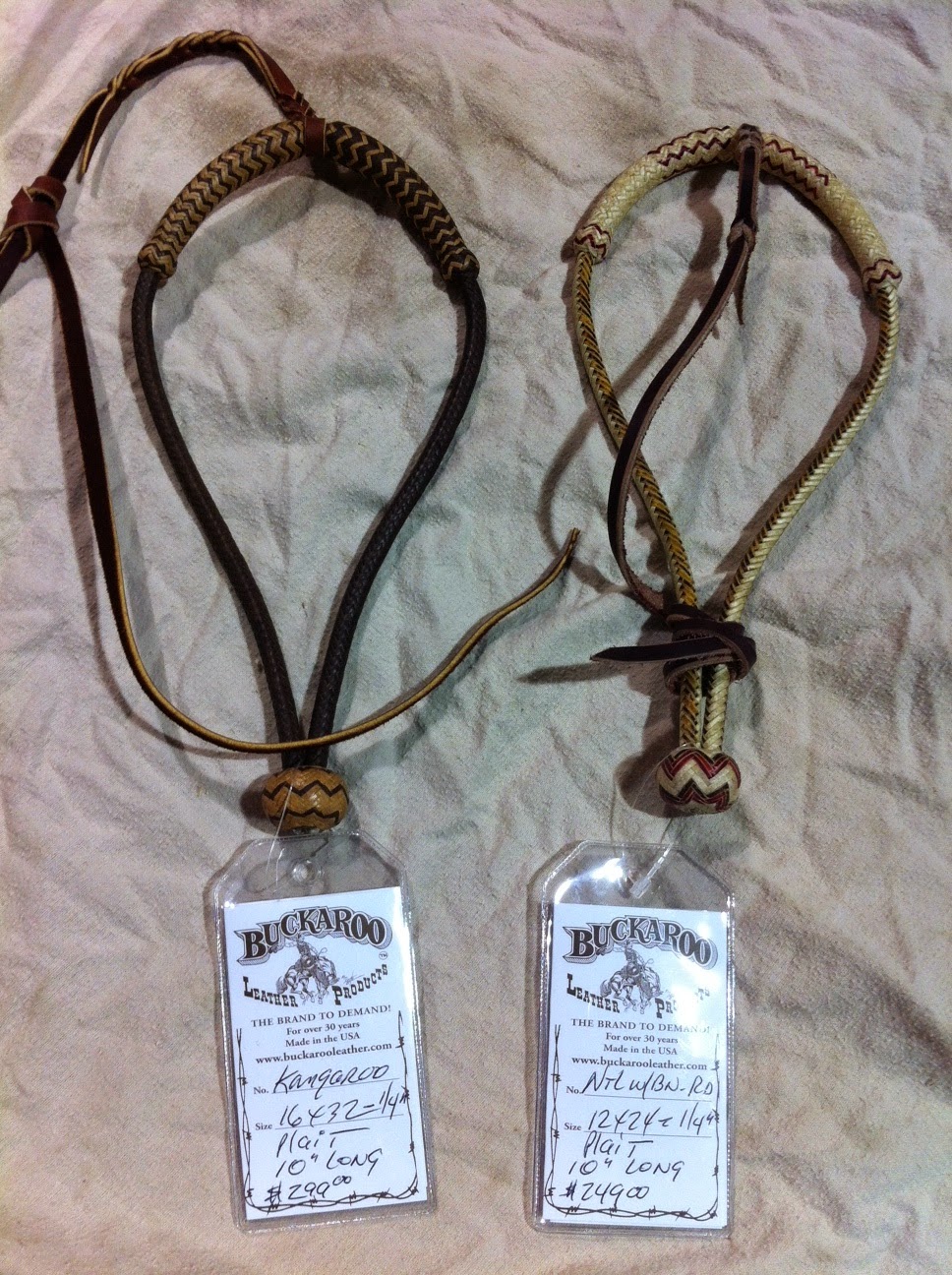
Thursday, September 1, 2011

Californio Vaquero Horse Training in the Old West


Californio Vaquero Horse Training in the Old West
The Californio Vaquero's prided themselves on their horsemanship and horse tack. They took great care too hand braid their horse hair mecates and romel reins. The Vaquero hand braiding techniques are still used today.
The rawhide bosals, riatas and quirts, headstalls, hackamores, are all part of the Vaquero "tool box" to train their horses.

The Vaqueros trained their horses for 7-10 years, starting at 4 years old, to react with very little pressure from the rider. At the end of training, the horse and rider would be one.

The 3 stages of the Vaquero horse training....

The 1st stage - starts with a hackamore bitless braided rawhide headstall to teach the horse to yield to pressure. The reins were long hand braided horse hair mecates.

The 2nd stage - called "Two Rein". The Vaquero would use a thinner simpler version of the hackamore nose piece, the bosal. This bosal was lighter for this part of the stage. The mecate bridle had a spade bit and a braided rawhide romel rein. During this stage of the training the Vaquero would hold both sets of reins and the horse would be controlled with mostly the bosal and light on the bit. Then the Vaquero would transition to only using the bit and would then get rid of the bosal all together.

The 3rd stage- is called the "Straight upon the Bridle". The Vaquero handles the horse with just the spade bit. The Bit is connected with romel reins. The bosal and mecate are used under the bridle to lead the horse.

This extensive training enabled the Vaquero to control the horse with little pressure. The Vaquero's horse was a skilled cattle horse and would be tested....

The Vaquero use to test their horses skills by tying a thread
to the links section of the chain part of the romel reins. The Vaquero would then bring the horse to a stop with a "light" pull of the reins. If the thread broke- the Vaquero needed to pull to hard.


Another way to show off their skills.....trying to rope Grizzlies!!!

Can you imagine the horsemanship skills and the communication of the horse and rider to stop and move in an instant to rope a Grizzly!!!!!

Our family has been dedicated for 30 years in serving the
Western Horseman the safest most durable
Quality American made leather horse tack.......Buckaroo John Brand
Buckaroo Leather, The Brand to Demand
Visit Our Unique Store Today

Buckaroo Leather Shopping Site

Thursday, October 28, 2010

How to Tie a Mecate Rein


John Brand of Buckaroo leather shows you how to tie a Soft Cotton Mecate Rein to a quality Rawhide Bosal

Our family has been dedicated for 30 years in serving the
Western Horseman the safest most durable
Quality American made leather horse tack.......Buckaroo John Brand
Buckaroo Leather, The Brand to Demand
Visit Our Unique Store Today
Buckaroo Leather Shopping Site

Thursday, September 24, 2009

Rawhide Horse Tack


Rawhide, a Brief History

Rawhide is the hide of an animal that has been kept it is natural state and not treated. Leather is the hide of an animal that been altered by a special "pickling" process called "tanning." After the tanning process is completed the hide is termed "tanned." The look and feel of leather is different than the look and feel of rawhide, and its strength and utility properties are different than those of rawhide.

Most rawhide originated from the skin of buffalo, deer, elk or cattle. It is prepared by removing all fur, meat and fat. The hide is then usually stretched over a frame before being dried. The resulting material is hard and translucent. It can be shaped by rewetting and forming before being allowed to thoroughly re-dry. It can be rendered more pliable by bending repeatedly in multiple directions. This happened by rubbing it over a post and even sometimes using a traditional method of chewing. It may also be oiled or greased for a degree of waterproofing.

Rawhide was one of the most useful products of the pioneer cattleman. From it he made ropes, hobbles, clotheslines, bedsprings, seats for chairs, overcoats, trousers, and shirts. It patched saddles and shoes, strips of it bound loose wagon tires or lashed together pieces of broken wagon tongue, as well as substituting for nails and many other things. Indians made drum heads, and shield covers. It was so tough it became known as Mexican iron. The Vaqueros used this "Mexican Iron" for their horse tack because of its durability.

The Vaqueros used many types of fancy braided rawhide horse equipment during their daily activities. It was common to see vaqueros using braided rawhide headstalls, bridle reins with , Romals, riatas, hobbles, Quirts, hackamores and bosals, and other types of horse gear. The vaquero took special pride in having good quality braided rawhide equipment and a well-trained horse.


Buckaroo Leather carries the traditional Vaquero Rawhide Romals,


Rawhide Romal Rein (pictured right)

These are the finest 12 plait Braiding we have found! Hand Braided in the Old Traditional California Style Buttons. Each Natural Rawhide strand is beveled on both sides for a smooth, comfortable feel on the reins and romal. The popper is hand basket stamped and braided. The rein portion is the traditional full 52" long.


Rawhide Romel Rein w/rein chains  (pictured right)


These are the finest 12 plait Braiding we have found! Hand Braided in the Old Traditional California Style Buttons. Each Natural Rawhide strand is beveled on both sides for a smooth, comfortable feel on the reins and romal. The popper is hand basket stamped and braided. The rein portion is 42" long with rein chain making them the traditional 52" long. The Traditional rein chains are so slobber and water will not ruin the bit ends.


Our family has been dedicated for 30 years in serving
the Western Horseman the safest most durable Quality
American made leather horse tack.......

Buckaroo John Brand

Buckaroo Leather, The Brand to Demand
Visit Our Unique Store Today
Buckaroo Leather Shopping Site

Monday, September 14, 2009

Rawhide Romels & Quirts


Vaquero Tradition- The Romal


In the Vaquero tradition, a quirt with a long handle, known as a romal, was attached to the end of a closed set of reins.In Spanish the word is spelled "ramal" .

In Spanish, "El ramal" means literally a branch road, a division, or a ramification. Thus attached as it is by the loop to the bridle reins, the romal becomes but a ramification of the rein, a handy addition that may be used as a quirt and dropped from the hand without fear of its getting lost.

The Romal was not to be used to strike a horse, but rather was a tool used to assist in moving cattle.

A romal is usually made of leather or rawhide, is about four to five feet long, flexible and somewhat heavy, to prevent excess swinging and to aid control.
The Romal is historically associated with the Californios and the vaquero tradition of western riding. The romal was primarily used as a noisemaker to slap or goad cattle. (The handle made it too slow and of the wrong length for use on the horse.)

This combination of romal and closed reins, today referred to as romal reins, or romal-style reins, is seen primarily in the horse shows for certain horse breeds that are shown in the "Californio style" of western riding, or in other western events in the United States.


The 1st Picture above is the Rawhide Romal Rein RW327 from Buckaroo Leather. This Romal has the finest 12 plait Braiding! It is hand Braided in the Old Traditional California Style Buttons. Each Natural Rawhide strand is beveled on both sides for a smooth, comfortable feel on the reins and romal. The popper is hand basket stamped and braided. The rein portion is the traditional full 52" long.


The Quirt
The word Quirt is derived from the Spanish cuarta de cordon, meaning whip of cord.

The Quirt is a cowboy's woven leather forked type of stock whip. The Quirt usually has two falls at the end that are made of leather, buffalo, or cow hide. The core of the quirt is usually a leather bag filled with lead shot, the main part including the handle is often made from braided rawhide, leather or kangaroo hide and is usually somewhat stiff but flexible.

The Quirt was another tool of the old time cowboy. It was introduced to the cowboys by the Vaqueros. The quirt, due to its slow action, was not a useful riding aid for horses. Rather, it is an effective tool to slap or goad cattle from horseback.

The old style horse quirt is still carried by some Western horsemen, and can be seen in the early Western cowboy films.

Our family has been dedicated for 30 years in serving
the Western Horseman the safest most durable Quality
American made leather horse tack.......

Buckaroo John Brand

Buckaroo Leather, The Brand to Demand
Visit Our Unique Store Today
Buckaroo Leather Shopping Site

Wednesday, July 22, 2009

Git-Down-Rope- the Rage of the Sage


In keeping with the traditional Vaquero style- the Get-Down-Rope is becoming popular with both the casual riders, following the vaquero style, and the old west working cowboy.


The traditional cowboys used the “git” down rope to keep there horse standing still while they “git” down to shut the gate, pick up something or have some “doughgods” ( old west cowboy word for biscuits) by the campfire.


Today the, get-down-rope is used in the same way, especially in training young horses to stand still.


The Git-Down-Rope is used along with your Bosal and hackamore set up. The Bosal is favored by Western Horsemen, especially those following the Traditional Vaquero Style.


The Git-Down-Rope is used in place of a halter and is easy to use.


Watch the step by step video to learn the proper way to attach the old west “git” down rope and the proper comfortable fit for the horse.


18' long with leather popper. 1/4" Nylon Marine yacht braid with Beautiful Natural Rawhide Button with Hair Tassel. Or 1/2" Cotton with natural rawhide button and cotton tassel (small picture). To be used in place of a halter and lead rope with a pencil bosal and hanger under a bridle for leading. When you “get down” off your horse you have a lead


Git Down Rope and 3/8" Pencil Bosal w/ 1/2" harness leather Hanger headstall (complete set as pictured)- Get Down Rope is 18' long with leather popper. 1/4" Nylon Marine yacht braid with Beautiful Natural Rawhide Button with Hair Tassel. Or 1/2" Cotton with natural rawhide button and cotton tassel. To be used in place of a halter and lead rope with a pencil bosal and hanger under a bridle for leading. When you “git down” off your horse you have a lead. Pencil Bosal is 3/8" and 14 Plait Beautiful all natural rawhide braid with a rawhide core.


Our family has been dedicated for 30 years in serving
the Western Horseman the safest most durable Quality
American made leather horse tack.......

Buckaroo John Brand

Buckaroo Leather, The Brand to Demand
Visit Our Unique Store Today
Buckaroo Leather Shopping Site